Friday, 21 January 2022

Check out my latest: NEVER SEEN AGAIN


I’m really made up today to be able to share this with you all. It’s the finished jacket art for my next novel, NEVER SEEN AGAIN, which will be published by Orion on March 17 this year.

Obviously, this new title will be the main subject of my conversation today, but in keeping with the spirit of what I hope you’ll find a very dark thriller, I’ll also be reviewing ANTWERP, a macabre but very cool murder mystery from the pen of Nicholas Royle.

If you’re only here for the Nick Royle review, that’s absolutely fine, as always. You’ll find it, as usual, in the Thrillers, Chillers section at the lower end of today’s post.


First though, why don’t we talk a little bit about …


Before I say any more, here’s the official back-cover blurb, which I hope you’ll find interesting.

Jodie Martindale and her boyfriend were kidnapped six years ago. Her boyfriend was found dead the next week. Jodie was never seen again.

Journalist David Kelman, once a hotshot but now washed up, illegally comes into possession of Jodie’s brother's old phone. And on that phone is an unheard voicemail from two weeks ago. The voice is unmistakeably that of Jodie Martindale.

The message begins an obsession for Kelman - which takes him down a rabbit hole of lies, to a dark and deadly truth....

NEVER SEEN AGAIN is a my brand new stand-alone crime novel, though the eagle-eyed among you may notice one or two characters and institutions from earlier novels (all my thrillers take place in the same universe). Like my last novel, ONE EYE OPEN, it’s set on the Essex/Suffolk borderland, a district where stretches of beautiful countryside intersperse with towns that are not exactly blots on the landscape, but in social terms are a bit of a mess (a sort of microcosm of England itself, you might say).

Here, we follow the fortunes, or misfortunes, of one David Kelman, a former crime reporter for the Essex Examiner, a daily newspaper read county-wide, where, many years ago, after breaking a sensational story about local police corruption, he was instrumental in setting up Crime Beat, an office of investigative journalism, the operatives of which prided themselves on getting deep into the guts of the Essex criminal fraternity, a group that included every kind of malefactor, from gangsters to ex abusers to serial killers.

For a brief time, Crime Beat was the bane of the Essex underworld. And then, from out of the blue, a budding young business tycoon and wealthy heiress, Jodie Martindale, was kidnapped along with her boyfriend. A few days later, the boyfriend was found on a refuse site, hands zip-tied at his back, a bullet in his skull. However, of Jodie there was still no trace.

Energised by the horror of the crime, David Kelman and his associates got on the case, David, as always, attempting to circumnavigate the police enquiry, and on this occasion making a horrific mistake, which had devastating consequences.

When we join the action, six years have passed, Jodie Martindale hasn’t been heard of since and the Essex Examiner is defunct. David Kelman is still an investigative reporter, but now chasing dirty stories – which celeb is secretly sleeping with who, etc – for the gutter press. Former colleagues revile him, the cops mistrust him, and after falling out with him as a direct result of all this, his wife, Karen, left and took his kids with her (though David doesn’t consider himself much of a role model anyway), so now he lives alone, short on cash and minus respect.

And then, one day, while sniffing around the edges of another family tragedy, he finds himself in illegal possession of a battered and barely functioning mobile phone. More important than this is the unanswered voice-message it contains. It was placed there by none other than Jodie Martindale, begging for someone to come and save her … and it was sent only two weeks ago!

Out of nowhere, David Kelman, the once-ace investigator, has a chance to redeem himself. But he knows that simply reporting this precious find won’t be good enough. If he wants to restore his reputation, and maybe do something good for a change, he has to find Jodie herself.

But it isn’t going to be easy. Because David Kelman is now on his own, with no back-up, no resources, and next to no money, and whoever the people are who’ve got her, they are stone cold killers …

Here, for your delectation, are a couple of choice excerpts:

It might be summer, but the pitch darkness was dank and chill. A stench of urine engulfed him; his feet kicked bottles and loose planks. He clicked his phone-light on, but the subterranean gloom only retreated a short distance. Every two yards, he paused to listen, but it was deathly quiet. When he came to a T-junction, the passage on the left ran about ten yards to the foot of a flight of concrete steps with a hint of daylight shimmering down. He ascended warily, reaching a switchback landing, where a single burned spoon lay in one of the corners.
     ‘Great place to spend your final days, Freddie.’
     On the next floor, there were windows, but again they’d been covered by steel hoardings, which allowed in minimal daylight. From here, passageways led off in two different directions. The one in front led to more stairs, but the one on the left travelled a significant distance, passing various battered-open doorways. David waited again, listening.
     He hadn’t planned what he was going to do once he got in here. Probably go from one flat to the next, looking for clues. Most likely, they’d show signs that vagrants had been living in them. Even here, on the landing of the first floor, there were tell-tale signs: crack phials, the occasional used syringe, but if there was anywhere where it was obvious the police had been, that would be the starting point.
     After that, though, it was anyone’s guess what he might glean from this.
     He went along the main corridor, steel-clad windows on his left, broken doorways on his right. There was nothing telling behind any of the latter. Fire-damaged walls, piles of masonry where ceilings had collapsed. His eyes were now attuning, however, and he came to an abrupt standstill when he saw what he thought was a figure waiting at the far end. He advanced again. Slower than before. The figure didn’t move, but the closer David drew, the more distinct it became.
     Whoever it was, they were wearing black. But had they also painted their face white? …


*

HMP Brancaster, or Gull Rock, had terrifying renown. Britain had no death penalty, but most of the inmates there had no hope of release. Not only were they all lifers, in many cases they’d had tariffs imposed, minimum sentences to be served: thirty years, forty years, even fifty, while in several notorious cases no parole date would ever be granted at all. Horror stories had thus spread far and wide about a regime of ultimate punishment, the damned souls trapped there suffering as they did in no other prison in the UK …
     A sharp electronic buzz broke Norm from his reverie. He peered up the towering slab of rivetted steel that was HM Brancaster’s inner gate.
     He huddled deeper into his anorak, not that it was offering great protection against the swirling gusts of rain, and glanced irritably at the heavy cloud cover as another zigzag of lightning split it end-to-end. To think that all the way north from Colchester he’d seen nothing but blue skies and summer sun. How quickly, as he’d neared his destination, all that had changed.
     With a hefty clunk, a single-door section of the gate swung inward.
     Norm stepped through into semi-darkness. Bare brick walls stood to either side; damp paving stones lay under his feet. He pulled back his hood and unzipped his anorak as two unsmiling officers emerged from a side office, checked him over with a portable metal detector and then subjected him to a vigorous body search. He’d already been advised not to bother bringing a notebook or pen, as both would be taken off him. Instead, he’d equipped himself with his Dictaphone, which, despite having told the authorities about it beforehand, the officers regarded with grave suspicion before handing it back without comment.
     One of them withdrew into his office, while the other indicated that Norm should accompany him. They left the gatehouse, passing along a covered corridor, on top of which the rain thundered. Through its high letterbox windows, he saw the glare of moving spotlights.
     ‘This the way prisoners are brought in?’ Norm asked.
     The officer, a tall, angular, lugubrious sort, seemed surprised to have been addressed.
     ‘They come in round the back, by secure transport,’ he said. ‘They only see this side of the prison if they’re being released. And that almost never happens.’
     ‘So, all this stark functionalism …’ Norm tried to sound as if he was being light-hearted. ‘That’s purely for the visitors?’
     ‘Visitors?’ The officer cracked a smile.


THRILLERS, CHILLERS, SHOCKERS AND KILLERS …

An ongoing series of reviews of dark fiction (crime, thriller, horror and sci-fi) – both old and new – that I have recently read and enjoyed. I’ll endeavour to keep the SPOILERS to a minimum; there will certainly be no given-away denouements or exposed twists-in-the-tail, but by the definition of the word ‘review’, I’m going to be talking about these books in more than just thumbnail detail, extolling the aspects that I particularly enjoyed (I’ll outline the plot first, and follow it with my opinions) … so I guess if you’d rather not know anything at all about these pieces of work in advance of reading them yourself, then these particular posts will not be your thing.


ANTWERP 
by Nicholas Royle (2004)

Outline
Johnny Vos is an arthouse moviemaker from the US with a deep fascination for the works of Belgian expressionist painter, the late Paul Delvaux. Perhaps inevitably, he isn’t the sort who attracts big funding for his projects, but this doesn’t stop him travelling to Antwerp, where he intends to make a documentary that will be the last word on a mysterious artist whose specialism was the creation of urban dreamscapes populated by naked, somnambulant women.

Vos, who is the kind of filmmaker that we suspect makes plans as he goes along, intends to reconstruct some of these surreal tableaux on celluloid, but in order to find sufficient women who are prepared to pose naked in public, hires prostitutes and exotic dancers from the city’s red light areas. We’re in liberated Belgium, of course, so this doesn’t cause too much of a stir … until two of the women are brutally murdered in apparent ritualistic circumstances, their ravaged corpses left in situ with video tapes of films made by cult Belgian director Harry Kümel (who, like Delvaux, is actually a real person).

Enter Frank Warner, a British film writer who has appeared in other Nick Royle works. Warner arrives in Antwerp with his personable girlfriend, Siân, looking for an opportunity to interview Vos, but finds a country still overshadowed by the crimes of another real-life personality, maniac Marc Dutroux, and reeling from the revelation that a new serial killer is on the prowl. The police are actively on the case in the guise of Detectives Bertin and Dockx but seem less than capable, which implies that Belgian officialdom has not learned a great deal since the Dutroux scandal of the 1980s and 1990s.

Though we readers meet the killer relatively early in the book, we don’t learn his identity but join him as he roams the city’s districts of post-industrial dereliction, particularly around the port area, dementedly planning further atrocities while reminiscing on a childhood from Hell.

While all this is going on, the author dangles several potential suspects in our path.

Vos himself is an obvious one, especially as he makes himself scarce after the police instruct him to stay put, while Harry Kümel, who would have been about 64 when this book was written and still very active, also makes a couple of guest appearances – not exactly as a potential murderer, though his movies are clearly held in some kind of reverence by the miscreant, so he’s a person of interest. Much more suspicious is the amoral diamond merchant and pornographer, Wim De Blieck, whose so-called ‘Last House on the Left’, a backstreet webcam house, has provided several of the sex workers cast by Vos, not to mention the odious Jan Spitzner, a former freakshow exhibit himself, now turned provider of ugly oddities through his own gruesome website, and someone who seems to be particularly besotted with certain of the ‘Last House’ housemates.

Initially, of course, our central protagonist, Frank Warner, is mainly interested in the works of Johnny Vos, though he is intrigued by the seeming connection between the murders and the two filmmakers. However, it takes a turn for the much more personal when Siân, who never really wanted to join Warner on this trip because she regards Vos as a chauvinistic conman, suddenly goes missing.

Warner is left bereft in the foreign city (‘foreign’ in so many ways, he now learns), hampered by unknowable bureaucracy, while the woman he loves – he didn’t realise how much until now! – has quite possibly been abducted by a relentless and deranged killer …

Review
Nicholas Royle first came to my attention back in the early 1990s as the author of countless readable but challenging short stories. Readable because they were so smoothly and beautifully written. Challenging because they were of a strongly surrealist bent, and while they were nominally horror stories, tended to go much, much deeper than that. His tales were also richly textured in terms of time, place and atmosphere, for all of which reasons I’m completely unsurprised that the first novel of Royle’s that I’ve ever read, Antwerp, is so engrossing.

To start with, the novel is well named, because Antwerp itself is a character in this narrative, if not the character. While the majority of the ensemble cast pursue each other at breakneck pace through the intricacies of the murder-mystery plot, the overarching presence, even though not every part of the story is set there, is the totemic titular city, which Royle doesn’t just describe in methodical, street-by-street detail, giving us far more than even the average tour-guide would, he also assesses in terms of its history, its culture, its many social and political upheavals, ultimately viewing it as a microcosm of Belgium overall, a small but compact country, which through the eyes and mouths of the book’s characters, most of whom are native (even Vos is of Belgian descent!) seems to be confused not just about its past, but about its present, and which is divided in terms of language and politics, and constantly seeking to establish a recognisable identity.

These are the author’s views, of course, or at least are the impression he was given after what must have been numerous exhaustive trips to Antwerp, because he writes about it as effortlessly, affectionately and familiarly as the rest of us might write about our home towns.

The Paul Delvaux factor is another indication of Royle’s interest in Belgian culture, the avant-garde painter well-regarded in his homeland. But the pursuit of the elusive Delvaux spirit, by the author and several of the protagonists in Antwerp, also underlines another of the author’s fascinations: the Euro art scene, not least European cinema, which, in an eerie fusion with the erotic horror-fantasies of Delvaux, plays a prominent role throughout this haunting tale.

However, Royle doesn’t immerse us in these interests of his just for the sake of it.

Voyeurism is a key theme throughout, particularly the voyeurism of women by men. And not just in the Delvaux paintings, but in Frank Warner’s endless trampings around the red light quarters of Antwerp (and other towns), wherein sad, scantily-dressed prostitutes tap on the windows to attract his attention, in the existence of the Last House on the Left, whereby men all over the world can watch selected women go about daily routines, which includes undressing and going to the lavatory, and even in the revered films of Harry Kümel, such as 1971’s Daughters of Darkness, a decadent vampire thriller about the modern day depredations of lesbian blood-drinker, Elizabeth Bathory, and Malpertuis, in which a mad genius manipulates his nubile victims through a vast and torturous maze.

Rather nicely, though, and perhaps a tad mischievously, Royle throws us an alternative viewpoint in the persona of Siân, who is unimpressed by all this intellectualisation of what she considers to be nothing more than sordid mysoginy, and doesn’t hesitate to say it.

But Antwerp is not just about its subtext. It is also a serial murder story, and though few of us, even in fiction, are unlikely ever to encounter a killer who wraps his victims in video tape or buries them in rubble with the cassettes of art-horror classics, there is a distinct air of the grimly real about it all. The bleak corners of Antwerp, the derelict shipyards, the burned-out factories, the empty, labyrinthine shells of buildings where business and commerce once thrived (dead zone, Doel, for example, is marvellously realised as one of the last places on Earth!) are ghoulishly reminiscent, to my mind at least, of Northern England during the scourge of the Yorkshire Ripper, and make the perfect hunting ground and deposition site for an urban predator of the 21st century, particularly when his chosen prey, though they might briefly stimulate the male gaze, will never be anything more to most men than a disposable pleasure.

(To Royle’s immense credit, by the way, he ascribes names and faces to many of these poor victims, describing to a degree their torturous everyday experiences so that we at least feel something as life leads them to the lion’s den. In my view, too many serial killer stories lack any kind of compassion for the victims).

Yes, there’s a dark, stark and very scary aura around the murder case itself, the blundering local police juxtaposed with a phantom figure, who is never seen and only heard from whenever his victims are found. The desperation Frank feels as he searches for Siân is painful to experience. The hopelessness of his cause as he scours the wearisome cityscape, mostly just following his nose as a journalist, feels utterly dispiriting.

On top of all this, of course, and without going into too much detail for fear of providing spoilers, Royle shows his horror-writing chops by spicing the whole thing with several taut, nerve-wracking sequences, again relying heavily and successfully on strange and terrible derelict structures, creating an atmosphere of jeopardy and despair.

All round, Antwerp is an excellent and enthralling thriller, quite arty in some of its ambitions, but only in the best kind of way, and though never terrifying, exacting in terms of the stress its complex and chilling storyline puts you through. Strongly recommended for all those with an interest in the darker side of fiction (and the arts).

And now, as usual, on the off-chance that Antwerp gets a sniff of a film or TV deal, I’m going to be ill-advised enough to try and get my casting suggestions in first. Only a bit of fun, of course. Who would listen to me anyway?

Frank – Timothy Innes
Siân – Millie Brady
Johnny Vos – Matthew Lillard
Jan Spitzner – Carel Stuycken
Harry Kümel – Jeroen Krabbé
Wim De Bliek – Walter Baele

Wednesday, 22 December 2021

Part Three of the festive chiller: STUFFING


With only a couple of days to go, it's time for me to wish all my regulars on here, and even those just making a flying visit, a very Merry Christmas and a Happy New Year.

I hope you’re all getting in the mood by now. If you’re not, maybe this will help? It’s the third and final installment of my festive chiller, STUFFING. 

Before you commence reading, just a quick reminder - this is PART THREE. If you want to start at the beginning, aka PART ONE, and you haven’t done that already, just scroll down to the previous two posts, You’ll find PART ONE on December 8, and PART TWO on December 16.

In addition to that, and because we’re on the subject of short scary stories today, I’ll also be posting a detailed review of last year’s amazing horror anthology, AFTER SUNDOWN, as edited by the indefatigable Mark Morris (I know, I know ... the bloke is everywhere at present). As always, you’ll find that review towards the bottom end of today’s post in the Thrillers, Chillers section.

But that’s for later. Before then, let’s get going with ...


STUFFING
3

Max inserted an ear-bud and played back what he’d recorded. “What are you talking about?”
     “You can’t seriously be buying all this?” Kerry said.
     “Are you kidding? This is fantastic.”
     “Fantastic?”
     “If nothing else, it’ll be a weird and wonderful podcast.”
     “But he talks about that damn bear as if it was some kind of rival.”
     Max shrugged. “In some ways it was, wasn’t it? As Cleghorn’s act waned, the bear grew popular. Think about the era. The Muppets were on telly, Basil Brush, Rod Hull and Emu. But the stand-up guys who’d started on the club circuit were fading …”
     “He talks about it as if it was real. As if it was deliberately trying to undermine him.”
     “Obviously that’s the way it seems to him.”
     “That’s the way it would seem to someone who isn’t right in the head. How long are we staying and listening to this? The last train’s eight-thirty … we can’t afford to miss it.”
     Max sighed. “What time is it now?”
     She glanced at her watch. “Nearly six-thirty.”
     “We’re okay yet. It’s what, eight or nine miles to the station. That’s a fifteen-minute taxi ride. We’ve got bags of time.”
     Cleghorn re-entered the room, carrying a flattish cardboard parcel. Again, Kerry felt surprise. The guy was so far off the grid down here, it was difficult to imagine he could be the recipient of Amazon deliveries and such. He dropped the parcel onto the telephone table, scooped up his glass and headed back to the drinks cabinet.
     “Where were we?” he said, slurring a little. “Oh yeah, the catch. That wretched bear.” He poured himself another generous measure. “Well, they weren’t getting me with that caper, I can tell you. I’d see to the bastard personally.” He plonked himself down. “There was only room for one clown on this stage, and it certainly wasn’t going to be him.”
     Kerry decided that if Max didn’t soon realise they’d got everything useful they could out of this man, she’d announce it publicly. As Max consulted his notes, she stood up, crossed the room and glanced around the curtain – and was stunned to see a winter wonderland.
     Those first few flakes she’d spotted earlier had only been the prelude to a snowfall so heavy that despite the relatively short time since, the front garden was already inches deep. Not only that, snow was still falling, fast and thick, and whipping on a sharp wind. So intense was it that she could barely see the main gates at the end of the drive.
     “Max!” She pushed the curtain open. “We need to call a taxi immediately.”
     Max got to his feet, equally surprised by the outdoor scene, and not a little disappointed.
     Kerry nodded at Cleghorn, who seemed oblivious to the problem. “I’m sure you’ve got enough material now, aren’t you, Max?”
     “Well, I …”
     “Mr Cleghorn? Max and I need to leave before we get snowed in. Thank you for your hospitality. But I’m wondering, may we use your landline?”
     Cleghorn gave an indifferent shrug.
     She walked to the telephone table. “I don’t suppose you know any taxi firm numbers?”
     Again, a shrug. He swilled more booze. Irritated, Kerry dug through a pile of dog-eared paperwork stacked next to the phone, and with fortuitous speed, found a small card.
     She placed the call, glancing at Max, who was standing around looking frustrated. He seemed to be about to raise an objection, when the call was suddenly answered.
     “Eastside Cars,” came a woman’s voice.
     “Can we have a taxi as soon as possible please?” Kerry replied. “We’re going to the railway station.”
     “Where are you, my love?”
     For half a second, Kerry couldn’t remember the address. She grabbed up the cardboard package and turned it over, only to find that it was blank. On both sides.
     She tossed the package onto the sofa, and asked Max. Sulkily, he told her.
     “15, Hockton Mill Lane,” she said.
     “Oh, I’m sorry, love.” The tone had immediately changed. “I can’t send a car down there. Not in this weather.”
     “Are … are you serious?” Kerry stuttered.
     “I’ve never been more serious.”
     “But we can’t be marooned here. It’s Christmas Eve. We have to get home.”
     “I’m sorry, love. I’m not sending cars down that road in this weather. Last time we did that, we had two of them stuck there all night.”
     As if for emphasis, the line went dead.
     Kerry relayed the info to Max, who absorbed it without comment as he buttoned his overcoat. Behind him, meanwhile, Cleghorn seemed nonplussed as he turned the unaddressed package over in his hands. Presumably he hadn’t looked at it properly when picking it up from his doormat.
     “Mr Cleghorn,” Kerry said. “Are there any other taxi companies in town?”
     He gave her a troubled frown. “What’s that?” Before she could answer, he swung to Max. “You didn’t manage to open the shed?”
     “Erm, we … well …” Max looked fazed, “we loosened the wire.”
     Cleghorn’s expression changed: from sudden anxiety to outright fear. He ripped at the package, which came apart with remarkable ease, as if the cardboard was old and rotten.
     “Max!” Kerry said, worried. “What’re we going to do?”
     There was a low but voluble curse. They glanced round and saw Cleghorn backing away from his sofa, staring at the item he’d dumped there, though to their eyes it was no more than a heap of colourful material.
     “Chriiist!” the ex-comedian finally choked. “Good Christ almighty!
     With more energy than either of them had imagined possible, he spun and lurched out of the room. A few seconds later, they heard swift impacts on the staircase.
     “What was that about?” Kerry said. “He disapproves of Christmas presents too?”
     “Maybe he disapproves of guests suddenly walking out mid-conversation.”
     “Max!” She stared at him askance. “Look what’s happening outside!”
     “I see that. But I was making headway. And now suddenly we’re going?” More out of frustration than actual interest, he grabbed up the pile of material Cleghorn had been repulsed by. “I hadn’t even got to the nitty-gritty!”
     “You mean why he stopped being famous?” she said. “For God’s sake, how about he developed a fixation that a puppet was plotting against him? That isn’t revelation enough …?”
     “Jesus!” Max interrupted, having opened the material out.
     It was an archetypical Christmas jumper; you could tell that from the thick woollen knit, from the parallel rows of Christmas trees, skiers and reindeer heads. It was also filthy: impacted with dirt, stinking of mold. But the most noticeable thing was its size. Whichever man wore this, he’d need to be truly massive.
     “This came through the letterbox?” Max asked.
     “I suppose,” Kerry replied. “It’s unaddressed, so I imagine it was delivered by hand.”
     He visibly paled.
     “Why?”
     With a thunder of footfalls again belying his age, Bernie Cleghorn descended the staircase and came back into the lounge. He’d donned a heavy mac and a scarf.
     He regarded them stonily. “You were unable to summon a taxi, I gather?”
     Dumbly, Max nodded.
     “In which case, I’ll be glad to drive you.”
     Kerry frowned. “Haven’t you been drinking?”
     Cleghorn gave her a pitying look. “My dear, do you really think any police will be looking to pull motorists over on a night like this?”
     “Well, yes. It’s Christmas Eve.”
     A tremendous bang, a real impact this time, not some hollow thud, sounded from the rear of the house. Cleghorn jerked, but pointedly didn’t look round.
     “I imagine blizzard conditions like these will make it difficult for them to judge who’s been drinking and who is simply struggling in the snow,” he said. “The thing is … I’ve decided to make a festive visit to my sister in Coventry.” He indicated a suitcase out in the passage; from the rags and tags of clothes protruding, it had been hastily packed. “Of course, if you’d rather walk …?”
     “No, no, it’s fine,” Max said, with a sudden, distinct feeling that leaving wasn’t such a bad idea.
     “Good.” Cleghorn went out again, heading into the depths of the house. “Just wait by the car …”
     “Max!” Kerry protested. “The guy’s half-cut.”
     “Like he says, we can always walk.”
     He headed out into the corridor, and she had no option but to follow. At the front door, they drew the bolts back, turned the key, and stepped into a tumult of wind and flakes. Huddled and shivering, they crunched along the front of the building. On rounding the corner to the car port, the whole rear end of the vehicle had already been plastered white.
     “So, the octogenarian driver’s drunk,” Kerry said. “The car’s a wreck and the conditions are horrific. What could go wrong?”
     “Like I say …” Max replied. “Podcast of all time.”
     She turned to him. “Why did that jumper upset you? One minute earlier, you were ready to take your chances with this storm. Now you can’t wait to go.”
     He shook his head, unsure how to phrase it. “It … well, it’s got to be a joke.”
     From the front of the house, the main door banged closed, and a key rattled as it turned. Cleghorn, wearing a flat cap and muffler on top of everything else, stumbled towards them, humping his case.
     “Whoa!” Max shouted.
     “Kerry spun back. “What?”
     He stared past the Humber at the sheet of polythene, which again was flapping and rippling. “Thought … from the corner of my eye, I thought …” He told himself that he’d been mistaken. Or tried to. “Nah, it’s … silly.”
     “Max, what?”
     “Someone on the other side of that sheet. Just a silhouette, but …”
     Cleghorn arrived alongside them, his face pinched and eyes watering. “If you could move that mess off the car, I’ll get it started.” And he sidled around to the vehicle’s driver’s door, unlocked it and folded his lanky body in behind the wheel.
     Max stared at the polythene again, trying hard to think his way through the bizarre events of the last ten minutes. Kerry meanwhile was scraping handfuls of snow off the car’s rear window. When she called to him, he hurried to assist, grabbing boxes, rags and other garbage, and flinging them aside. Neither had really expected the ancient car to start, but they hadn’t realised their host had even been trying when he suddenly stuck his head out again.
     “You! What’s-your-name!”
     Max looked up. “Sorry, me?”
     “Yes, you. Look under the bonnet, will you?”
     “But I don’t know anything about …” The driver’s door clunked closed. “This is ridiculous,” Max grumbled as he slid sideways towards the front. “Maybe we should try walking. If we can get some distance up that valley road, the taxi might meet us half way. What do you think?”
     Kerry didn’t respond, just hugged herself. She was increasingly troubled that time was getting on. It had to be approaching seven now, easily.
     “Bloody hell,” Max groaned. “This isn’t good.”
     “What?”
     “The bonnet’s already open.” He lifted it and, with the aid of his phone light, peered in – at a mishmash of shattered pipes and cylinders. “Shit.” Another kind of chill ran down his back. He straightened up stiffly. “Mr Cleghorn! You need to see this!”
     “What is it?” Kerry asked.
     Max shook his head. “This can’t be real …”
     Cleghorn opened his door again. “What the devil’s the matter now?”
     “I think you’ve been sabotaged.”
     Hurriedly, Cleghorn climbed out and joined Max by the open bonnet. His face registered total dismay. At which point, movement caught Kerry’s eye.
     Behind the hanging polythene.
     In fact, directly behind Max.
     Though it wasn’t so much a shape as something shapeless. A huge, hulking something.
     She screamed and pointed. Cleghorn saw it too. He froze, eyes goggling. Max spun, but already the shape had withdrawn from view. He turned back. “This damage has been done deliberately, Mr Cleghorn. Whoever it was, they broke the bonnet open to get at it ...”
     But the ex-comedian wasn’t looking either at him or the ruined engine. Gaze still locked on the polythene, he was shaking violently.
     “Enough … enough of this!” he stammered. “This ends.” He dug a gloved hand into the pocket of his mac, and pulled out what they both thought was a dummy revolver, some prop from one of his shows. But then he snapped open its cylinder, and they saw that its chambers were loaded with ammunition. He clicked it closed again. “It ends now!
     He turned on them so fiercely that Max backed away along the car.
     “They told me you can’t offset your fate.” Cleghorn’s voice was a snarl, his eyes teary and livid, though he barely seemed to see them. “That you can’t change your destiny once it’s fixed. But you can. I showed them you can. They thought they’d been clever, imposing that thing on me. Only slowly did I realise that was the catch, but once I did, I took the damn thing down … what if I burned my own career in the process? I’m still here, aren’t I? At eighty! And I’ve got miles and miles left yet!”
     Abruptly, he seemed to remember that he had company.
     He frowned. “You two … I’m sorry you’ve been caught in this. I don’t know what the rules are regarding interlopers, but I fancy they’re not good. So you should go.”
     “Mr Cleghorn,” Kerry said, “if there’s someone here who shouldn’t be. Some old enemy, or …”
     “Go! … While you can.”
     And with gun levelled, he fought his way through the hanging sheet.
     “My God …” Kerry shook her head. “Oh my God!”
     Max blundered out onto the drive. “We need to exit stage left … right now.”
     “But there’s clearly someone here who means Cleghorn harm. Someone he may have annoyed on the past …”
     “Kerry, we need to go.” He lurched across the drive.
     She hurried after him, grabbing his arm. “And go where?”
     “Like I say, up the road.”
     “Shouldn’t we call the police?”
     “How? The front door’s locked and I’m not sure I want to go around the back, are you?”
     “Max, I know he’s an old sod … but do we really want to leave him?”
     “Christ’s sake, Kerry, he’s got a gun. He’s better protected than we are.”
     “And what if he does something terrible with that gun?”
     “All the better we’re not here.”
     “Max!
     But they were now blundering up the garden, the deluge of flakes swirling, the wind factor adding a sword’s edge, a combination that almost overwhelmed their senses. Then, from somewhere behind came a muffled but sharp detonation. They stopped and turned. The house was already concealed from view; not just by the snow, but by darkness, for there were no exterior lights.
     “Was that a gunshot?” Kerry said.
     “I don’t know,” Max replied. “Could’ve been something blowing about in the wind.”
     Another noise followed. Again dulled by the blizzard, it nevertheless was hollow and metallic, the sound a car’s bodywork might make if something struck it.
     “Okay, that’s it!” Max took Kerry’s elbow, steering her forward.
     Still half-blinded, they went by pure instinct, tripping and tottering, only for the tall gate to loom up in front of them like a phantom. Max tried to pull it open, but yanked his hand back, yowling. Kerry activated her own phone light.
     Their eyes almost popped.
     The gate had not just been closed, but was fastened in place by long strands of barbed wire woven through its bars and around the gateposts. Without doubt, it was the same wire they’d seen wrapped around the shed, though such was the gnawing cold that the import of this took an age to sink in. When it did, Kerry and Mac twirled round together.
     They saw only gusting, depthless flakes. But both were instinctively certain that someone was approaching. Or in Max’s mind, something.
     He pushed Kerry towards the side of the garden.
     “What are we doing?” she whimpered.
     “There was a break in the perimeter … I saw it when we entered.” In seconds they’d come to a tall boundary wall clustered with ivy, though both brick and leaf were already pasted with snow. “Somewhere round here …”
     Kerry glanced over her shoulder again. “Max, for God’s sake, find it!”
     “Here!” he shouted.
     And indeed, there was a crevice in the wall, as if a huge wedge of aged brickwork had fallen out. They clambered through into flat woodland. The tree trunks were sparsely spread, but there were thickets of undergrowth too, all shrouded in white. No discernible path led through, but they battled forward anyway, lashed by frozen vegetation. Kerry glanced back continually; the break in the wall fell steadily behind until that too was invisible.
     “Max, where are we going?”
     “We must be following the valley road,” he replied. “The river ran parallel to it, and that’s somewhere on our right. As long as we stay between the two, we’re going the right way.”
     From somewhere to their rear came a loud fibrous crackle, as if a sapling had been uprooted or a hefty branch torn down. Kerry threw another backward glance, and some ten yards to their rear, saw twigs threshing violently.
     “Max!” she half-screamed.
     He grabbed her hand and lugged her on. Even in their panic, they realised they should try to veer leftward at some point, to connect with the road again. But the further they progressed, the more steeply the ground to their left rose upward. That had been the way of it, of course. All the way along Hockton Mill Lane, they’d descended ever deeper into this valley.
     With a splintering crack, another bough behind was demolished.
     Closer this time. Much closer.
     They were both out of condition, but fear can drive the human body like a motor, and they crashed on and on, breath billowing. When open ground at last appeared in front, they hadn’t the time to feel relieved, but scrambled on across it for what seemed like an age, until with chests aching and lungs wheezing, they decelerated through utter exhaustion and risked a further glance behind. Nothing obvious was in pursuit.
     Too fatigued to talk, they pressed on, though there was no going left now for the ground on that side had ascended to cliff-like proportions. There had to be a stair of some sort, they reasoned: a path with switchbacks maybe, old stone steps, an access road connecting to one of the derelict factories they’d seen. But they spotted nothing like that, and when they came to the first of those factories, it was no more than a shell, upright sections of jagged, rotted brickwork, heavily shelved along their tops with snow. The corrugated metal fence encircling it had collapsed, allowing them access. But they halted before going in, again scanning the woodland behind.     
     Still nothing visible followed. Equally reassuring, the storm was finally weakening, the wind abating, fewer and fewer flakes descending.
     They proceeded amid the gutted relics of buildings, the black holes of broken doors and windows gaping on all sides. As the clouds overhead cleared, the lying snow reflected spectral blue moonlight. Kerry glanced over her shoulder again. “What happened back there?”
     “Dunno.” Max’s teeth juddered together as the sweat-damp in his clothes turned frigid. “All we need to think about now is getting somewhere warm.”
     “Look!” She pointed between two roofless outbuildings, where a snow-covered track led away at an angle but clearly crossed over the river. “That bridge must lead somewhere.”
     They lumbered forward, initial brief concerns that the bridge might be unsafe diminishing as they crossed. On the other side, an access road, presumably once having serviced the factory, appeared to ascend out of the valley. They followed it eagerly.
     For about two-hundred yards.
     At which point it was blocked off by a tall, steel fence.
     They stood in disbelief, the body-heat steaming off them.
     Max fidgeted with his phone, desperately trying to obtain a signal. While he did that, Kerry peeped along a path beaten through the snow-clad hawthorns on their right. It was certainly well-trodden and, from what she could see, mostly level. She called Max and they ventured along it. It was firm enough underfoot despite the carpet of white. The main problem was that it headed back the way they had come. When Kerry raised a concern about this, Max replied that at least they were on the other side of the river.
     However, the further they followed the new route, the less comfortable they felt. Overhead, the valley side steepened until it became obvious the path was not going to suddenly divert uphill. Instead, it rolled on and on in the same direction, and all the while the excruciating cold reduced their feet to leaden weights, their hands to bloodless lumps.
     “This is a nightmare,” Kerry moaned, unable to fathom how they’d finished up in such a predicament.
     “Wait, look!” Max shouted.
     Not far ahead, down and to the right, they saw Christmas lights.
     “Surely that’s where we came from?” she said.
     “There were no decorations at Cleghorn’s house, remember?”
     That was true, she realised.
     Max started forward, hauling her with him. “There must be another house on this side of the river. With luck, they’ll have a phone. Maybe even a car they can give us a ride in. We might make that last train yet.”
     His enthusiasm infected her and they dashed forward together.
     When the path commenced its descent, it was shallow, so there was no danger of slipping. They ran faster, eager to get back to some kind of sanity. Back on river-level, the route changed direction, cutting hard to the right, scything through snow-deep undergrowth. Any unease Kerry felt was allayed by knowledge that the river still lay in front of them, but then their feet started drumming on snow-covered boards, and they realised they were crossing back over via a footbridge. On the far bank, the path ended at a broken-down gateway.
     Beyond this stood a mass of rhododendron bushes, and on the other side of those, the familiar outline of a garden shed. When they sidled around to the front of it, its door hung from a splintered jamb. Wearily, they turned. The house beyond the weeds was unquestionably Cleghorn’s, though now it glimmered with festive lights, bulbs in every window. A further source of light was its open back door.
     “I really don’t want to go in there,” Max mumbled.
     “I know,” Kerry said, “but we’re literally refrigerating out here.”
     “He doesn’t do Christmas anymore. He told us that. Something’s still wrong.”
     She pondered bleakly. “Suppose we sneak in, grab the phone, call 999? I don’t see we’ve any choice. We’d never make it back to that ruined factory, let alone the main road.”
     She wasn’t exaggerating, and Max knew it. Their extremities felt frost-bitten.
     Stealthily as possible, they proceeded, sliding sideways through the brittle structures of the weeds. At the back door, they waited again and listened. For maybe a whole minute, but the silence in the house was sepulchral. They glanced at each other, nodded, and went in. As with the shed, they immediately noticed that the back door, which, thanks to Kerry, had been held only by a single bolt at the top, had also succumbed to brute force.
     More distracting than this, though, was the state of the kitchen, because a set of old, dingy fairy lights had been draped haphazardly around it. Over its cabinets, across its worktops. It was the same further in: in the warren of dim-lit passages, more strands of coloured bulbs, most thick with dust, hung from the odd nail or were slung across the tops of doors.
     Creeped out beyond belief, they halted at each junction to listen. Still there was no sign that anyone else was present.
     When they reached the part-open door to the lounge, they listened again. Very intently.
     As before, nothing.
     Holding his breath, Max pushed the door.
     Beyond it, the spacious room stood motionless, the rancid Christmas jumper lying where Max had dropped it, the shaggy brown beanbag sitting next to the couch. The obvious main difference was that this room too had now been decked for the season. There were lights along the mantelpiece and over the tops of the curtains, while tinsel glittered from the bookcase. There was even a Christmas tree in the far corner, a scattering of white beads around the base of it to create the illusion of indoor snow. The tree itself was a scruffy, garish thing, reddish in colour, but overly decked with tinsel and crêpe, festooned with baubles, streamers and additional loops of twinkling lights.
     They barely looked at it. On seeing the room was unoccupied, Max made straight for the telephone, Kerry standing guard by the door.
     “Damn it!” he hissed. “The bloody line’s dead.”
     “For God’s sake, it was working earlier!”
     “I know, but there’s been a blizzard since then, hasn’t there!”
     He slammed the receiver on the cradle three times, but it remained lifeless.
     Hastily, he groped along the cable to see if it had come loose from the wall.
     With nothing stirring in the corridor, Kerry crossed the room to the window with the open curtain. The lights in the building painted lurid patterns on the snow outside, but nothing else moved.
     “Max, I think there’s no one …” Any additional words ended in a stupefied croak.
     But it was only after Max discovered the end of the telephone cable, which had not been detached from the wall, but appeared to have been chewed clean through, that he straightened up, ice-cold again, and then saw his other half rigid as a plank, one mittened fist jammed into her mouth as she stared from close range at the Christmas tree.
     Which on more prolonged inspection wasn’t a Christmas tree at all.
     Near the top of it, through gaps in the festive wrappings, the tortured remnants of a human face were visible. The head had angled backward at a ninety degree angle, the mouth gaping around an upwardly protruding pole, which was either an old clothes prop, or maybe just a broken broom handle, though either way the limp form of a man had been impaled on it lengthways and then hefted upright.
     Max and Kerry stood stiff. Aghast. Frozen to the core.
     Unable to look any longer, Kerry averted her gaze to the floor and the scattering of fake snow. The white beads. Which, even through her swirl of horrified thoughts, were clearly not actually intended to be fake snow, but were more likely the innards of some item of furniture, the outer skin of which, all brown and furry, now lay torn in ribbons just to her left. Even then, she was too sickened with horror to make sense of this, or to notice as the great shaggy shape of the beanbag, so ingrained with dirt after all these years that it had now transformed from polar-white to deepest coffee-brown, uncurled itself and rose inexorably to its full seven feet of height.
     They sensed it rather than saw it, and despite that it was almost too late.
     Shrieking, they managed to dash past it, reaching the lounge doorway. Only to find that the door had been backheeled closed, and that two colourful costumes hung there: the slinky uniform of a saucy French maid, and the jester-like garb of the Lord of Misrule.
     The brief halt this brought them too was all the delay the vast shape behind them needed, as it came on apace, its eyes flipping from brightest blue to searing red.

***

What a finale for our podcast Christmas special … to actually have been made part of the show. We’ve even got costumed up. I mean, you’ve got to get into the spirit of the thing, haven’t you?
     He did. He’s recreated every part of it.
     Even when he came to take Kerry for their routine. Violet-eyed or not, he brought his burlap sack.
     Course, I don’t know what time he’ll be coming to take me. I don’t even know what time it is now, because all I can see through this grimy window with the barbed wire stretched across it is darkness and falling snow. But I assume that Christmas Day is almost over. In which case, I’m not sure where I’ll fit in. Boxing Day? New Year’s Day? Most likely it’ll be Twelfth Night, the last night of the twelve days of Christmas. I’m the Lord of Misrule after all, always the last man standing. By the way, calling me ‘Lord’ is a misnomer. Look how I’m dressed. The Lord of Misrule is actually a clown. The lowest in the pecking order. Especially now. As Bernie used to say, there’s only one clown on this stage … and it isn’t me.
     “But what’s this nonsense?”, I hear you cry. “What are you jabbering about? Clearly, Kerry was right. Cleghorn was a nasty piece of work, a crackpot. He’d been antagonising people for years. Someone had simply come for payback, plucking at the heartstrings of his past to drive him even crazier than he already was.”
     I thought that too, which is why, as I tried to flee that lounge, I saw the old fool’s revolver on the armrest of the sofa. That’s why I grabbed it and cocked it, and punched all five remaining rounds through the centre of that great shaggy barrel chest.
     But there’s the rub, you see. Because even I hadn’t bargained for what came out of it.
     Can you guess?
     Of course you can.
     Stuffing.


****

So there we go. Hope you enjoyed STUFFING. If you did, you might be interested that, to date, I've published two collections of festive-themed horror stories in paperback, Audible and on Kindle. They are: IN A DEEP, DARK DECEMBER and THE CHRISTMAS YOU DESERVE. It’s probably also worth mentioning that my Victorian-era Christmas ghost story / romance, SPARROWHAWK, was shortlisted for the British Fantasy Award in the capacity of Best Novella in 2010.

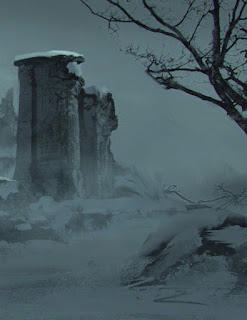
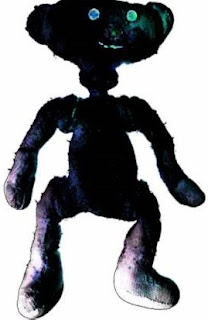
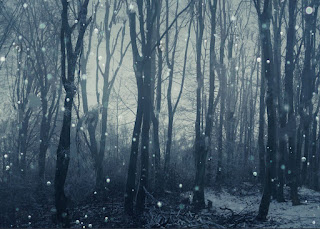
(The image of the stone ruins in the snow-bound forest is a fragment of the masterly painting, Snowy Ruins, by Markus Luotero. Meanwhile, whoever owns the bear image, or any of the images used on here, feel free to give me a shout, and I will happily give you a credit). 


THRILLERS, CHILLERS, SHOCKERS AND KILLERS …

An ongoing series of reviews of dark fiction (crime, thriller, horror and sci-fi) – both old and new – that I have recently read and enjoyed. I’ll endeavour to keep the SPOILERS to a minimum; there will certainly be no given-away denouements or exposed twists-in-the-tail, but by the definition of the word ‘review’, I’m going to be talking about these books in more than just thumbnail detail, extolling the aspects that I particularly enjoyed … so I guess if you’d rather not know anything at all about these pieces of work in advance of reading them yourself, then these particular posts will not be your thing.


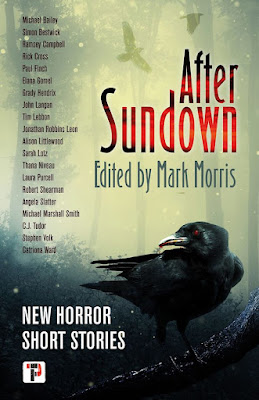
AFTER SUNDOWN 
edited by Mark Morris (2020)

For quite a while now, British horror writer, editor and all-round expert, Mark Morris, has been looking for a new base from which to launch an all-new horror anthology series. Something unthemed but clearly inspired by the great anthology series of the past, the Pans and Fontanas, though perhaps with more modern sensibilities and a wider-ranging remit when it comes to the subgenres of horror. There have been a couple of false starts on the way, but now at last, the great man seems to have found a publishing house who are doing this worthy ambition proud.

Flame Tree Press are an imprint of London and New York-based indie publishers, Flame Tree Publishing, and though relatively new (they’ve only been trading since 2018), have already got on board the horror anthology express with Morris, to publish this first in what it is hoped will become an ongoing series of terror-filled collections of short stories.

First of all, rather than simply hit you with a succession of brief short story outlines, I’ll let the publishers give you their own official blurb:

This new anthology celebrates the horror genre with twenty original stories from some of the top names in the field. Chosen by esteemed horror editor Mark Morris, sixteen of the tales were commissioned and four were selected from hundreds of stories sent during an open submission window. Varying in theme and subject matter, you’ll find everything from dark mysticism to killer plants, with some terrifying revenants along the way. There are even some stories so strange that they defy categorisation.

The most obvious thing to say about After Sundown is that it contains a wealth of talent from the world of dark fiction, boasting a most impressive line-up of contributors, a host of big names sitting alongside a smaller group who perhaps are lesser known, though all provide tiptop spooky material.

First off, and this is something I was delighted to see, After Sundown offers us a huge bunch of what I consider to be traditional, near-Gothic horror stories, tales that wouldn’t be out of place in an anthology from the golden age of eerie fiction, though again I reiterate that they are also very modern in tone.

Laura Purcell’s Creeping Ivy, for example, concerns a gold-digging young husband in Victorian England, who marries a wealthy widow, only to learn that she cares more about her plants than him. Likewise, Angela Slatter’s Same Time Next Year follows a forlorn female phantom, who, every year on the same night, relives the events of her own murder.

In We All Come Home by Simon Bestwick, a depressed man returns to the drear stretch of woodland where his friends disappeared when they were young, desperate to find out what happened to them. He was there, but has blotted it all from his memory, and yet he can’t help thinking that it had something to do with their all going underground.

Equally alarming but equally ‘golden age’ in tone is Bokeh by Thana Niveau, in which a single mother is concerned that her daughter, who has struggled to cope since her father ran away, has made friends with a bunch of invisible beings in her back garden whom she is convinced are fairies.

Mark Morris also opts to throw us a few tales that we might also think of as traditional in that they are grim parables of vengeance from beyond, though perhaps in these cases with a harder, darker edge than is usual; in that regard, they wouldn’t be out of place in Tales from the Crypt or one of the old Amicus portmanteaux.

A good example is That’s the Spirit from the ever reliable Sarah Lotz. In this excellent tale, a charlatan medium struggles to convince his sick and ageing partner that he doesn’t have an actual gift, but then, one day, what may be a genuine message comes through to him. Similar paths are taken by Grady Hendrix’s Murder Board and Elana Gomel’s Mine Seven, though these are particularly strong contributions to the book in my view, so more detail about those two later.

Of course, scaring folks is one laudable aim of a book like this, but no modern horror anthology would be complete without it straying a little bit into the realms of the strange and weird as well.

Completely fulfilling that requirement here, but nevertheless disturbingly eerie, we have The Importance of Oral Hygiene from one of the genre’s true masters of unclassifiable darkness, Robert Shearman. In this astonishingly discomforting tale, a respectable Victorian lady embarks on an affair with her attractive but decidedly strange dentist, while at the same time wondering what became of his wife.

Even stranger is Catriona Ward’s A Hotel in Germany, which sees a spoiled and pretentious movie star and her PA pitch up in a hotel in Germany, where the staff are driven slowly mad by a series of absurd and sinister demands.

Swanskin, by Alison Littlewood, also falls into this category, though it overlaps into dark fantasy as well. It follows the fortunes of a young fisherman who lives in a remote community where the women can shapeshift into swans, though their menfolk feel challenged by this and are determined to take action.

Perhaps the strangest story in the entire book is The Naughty Step by Stephen Volk despite its deceptively prosaic urban setting, but it’s also one of the best, so more about this one later too.

One thing I found particularly interesting about After Sundown was the way so many of the stories have been consciously written on a small canvas. This is very much in keeping with the horror story custom – they are so often very personal experiences for their protagonists. But a couple of the stories in After Sundown take the ‘personal’ to a whole new level, giving us introspective tales set in the insular, everyday world of modern suburbanites, which only appears to be mundane.

Two particular masters of the modern horror story, Tim Lebbon and Ramsey Campbell, excel in this department.

The former contributes Research, in which a thriller writer is lured to a basement by the insane couple next door, who trap him there, eager to see what happens when he can’t release his inner darkness onto the written page. The latter gives us Wherever You Look, a tremendous piece which introduces us to another writer, though this one is haunted by a mysterious and menacing being, who initially appears to him in one of his own books.

In The Mirror House, meanwhile, by Jonathan Robbins Leon, we meet Stephanie, who is married to a the bombastic Edgar and though she finds him tolerable, feels that the relationship is ending, until she locates a hidden door, which leads to a drab mirror-image version of their own home.

Perhaps the most curiously personal of all the stories in After Sundown, one which clearly relates to heartfelt experience, comes from old-stager Michael Marshall Smith, who hits us with It Doesn’t Feel Right, in which a self-employed everyman has endless trouble getting his difficult five-year-old ready for school, though even when he notices that other kids in the neighbourhood are misbehaving in similar ways and worse, it still doesn’t occur to him that these might be down to more than mere temperament.

At the opposite end of the scale, a more explosive form of horror fiction can be found in forecasts of the apocalypse. Truly, no anthology of fantastic fiction in the 21st century can be considered complete without at least one mission to the End of the World.

There are several in After Sundown, though all differ from each other widely, each one inventive and disturbing. CJ Tudor leads the way with Butterfly Island, in which, with Earth on the cusp of Armageddon through germ warfare, a bunch of survivors head to an Australian offshore wildlife sanctuary, though there are dangers there too, not least a flock of man-eating butterflies.

A very different tone is struck by Michael Bailey’s Gave, wherein an unspecified pandemic is rapidly depopulating the planet, and one particular citizen, an ageing man who never fathered any children, becomes so obsessed with trying to protect his fellow men that he donates gallons of his own blood. But how much can he afford to give, and will there be anyone left to receive it?

More epic in concept yet is Rick Cross’s Last Rites for the Fourth World, which sees tired firemen fighting colossal forest fires in California and kids witnessing bizarre things while surfing off Hawaii, the world slowly ending through a series of catastrophic anti-miracles.

I haven’t mentioned every story in this book. That’s deliberate; there has to be something here for the reader to discover for his or herself. But hopefully I’ve illustrated just how astonishingly diverse the subject-matter is in this latest high quality horror antho from Mark Morris, which I can’t give a big enough recommendation to. Let’s just hope that its uptake among fans of the genre will be such that his new publishers will have no hesitation in commissioning more from him (as a quick addendum, Beyond the Veil, vol 2 in the series, is on the bookshelves at the time of this writing, which I will be reviewing on here as soon as I get hold of it). Here’s hoping for yearly volumes ad infinitum.

And now …

AFTER SUNDOWN – the movie.

Okay, no film maker has optioned this book yet (as far as I’m aware), and I honestly don’t know how likely it is, but as this part of the review is always the fun part, here are my thoughts just in case someone with cash decides that it simply has to be on the big screen.

Note: these four stories are NOT the ones I necessarily consider to be the best in the book, but these are the four I perceive as most filmic and most right for adaptation in a compendium horror. 
Of course, no such horror film can happen without a central thread, and this is where you guys, the audience, come in. Just accept that unusual circumstances have arisen that require us viewers to be told four spooky stories. 

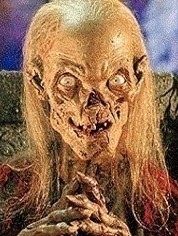
It could be that the Crypt-keeper of Tales from the Crypt fame delivers them to us, along with a glut of the usual quips and appalling puns, or maybe, if you feel this one merits a less irreverent atmosphere, perhaps we should visit something similar to the Club of the Damned, as seen in the BBC’s atmospheric antho series of the 1970s, Supernatural.

Without further messing about, here are the stories and the casts I would choose:

The Naughty Step (by Stephen Volk): A Child Services worker is called to a domestic murder scene, where she must persuade a little boy who witnessed the killing to come away with her. He won’t, however. He can’t leave the so-called ‘Naughty Step’, terrified that if he does, a strange and terrible fate will befall him …

Linda – Lucy Davis
The Boy – Open to ideas, as I don’t know many of Britain’s young starlets.

Mine Seven (by Elana Gomel): An American woman of Russian descent holidays on Spitsbergen during the Arctic winter. When an unexplained blackout plunges the island into darkness and deep freeze, everyone at the hotel is imperilled, but even more so when an ancient evil awakens in a nearby derelict coal mine …

Lena – Rebecca Ferguson

Murder Board (by Grady Hendrix): An aged and embittered musician, who never makes a plan without consulting his battered old Ouija board, receives a message from beyond implying that his trophy wife intends to kill him. But not, he reasons, if he can figure out a way to strike first …

Bill – Alice Cooper
Caroline – Bellamy Young

Branch Line (by Paul Finch … sorry folks but I’m never going to miss the chance to put my own stuff on TV): An odious man recounts a chilling incident from 1973, when he and a schoolfriend made an ill-advised trip to the Branch Line, a derelict stretch of railway infamous locally for a suicide that once happened there and the weird spectre now said to haunt it …

Gates – Jared Harris

Thursday, 16 December 2021

Part Two of the festive chiller - STUFFING


Delighted today to present the second installment of my brand new Christmas horror story, STUFFING. Hope you’re enjoying it so far, and exceedingly pleased that you’ve opted to come back for some more. However, before you commence reading, just a quick reminder - this is PART TWO. If you want to start at the beginning, aka PART ONE, and you haven’t done that already, just scroll down to the previous post, which you will find on December 8. (Meanwhile, PART THREE will appear right here on December 23).

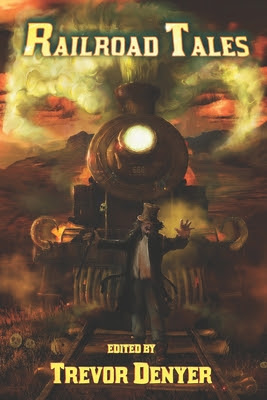
One additional thing. Seeing as we’re in short story territory today, I will also be reviewing the latest anthology from Midnight Street, Trevor Denyer’s excellent RAILROAD TALES. From that title, the subject matter probably speaks for itself, but those who know Trevor Denyer know that they won’t just be getting any ordinary antho. You’ll find said review, as usual, at the lower end of today’s post, in the Thrillers, Chillers section.

Before then, though, hope you enjoy ...


STUFFING
2

Cleghorn hit one light-switch after another as they traversed a succession of tall, drab rooms, most of them unfurnished and connected by spartan passages laid with threadbare carpets. It was warmer than outside at least, though not markedly so, and there was a faint odour of mildew.
     One thing completely notable by its absence was the festive season.
     “You don’t celebrate Christmas anymore, Mr Cleghorn?” Max asked.
     “I had a bellyful of that during the ’70s,” came the curt response.
     “Your Christmas shows are fondly remembered by the Great British public.”
     “Then more fool the Great British public. Though I don’t blame them entirely. Not given the unadulterated shite that passes for British television today.”
     Kerry groaned inwardly. If Cleghorn was one of these nostalgia buffs who firmly believed that TV was always better in the past, then he’d already found common ground with Max, and that was the last thing she wanted. Not that Cleghorn was a particularly warm or welcoming presence. Now that he’d put a few lights on, she could see him properly. As she’d already noted, he didn’t stoop or bend, or walk with an old man’s shuffle, but his age showed in his wizened hands and yellow, cracked fingernails, in his liver-spotted scalp and thin, peevish face. His eyes were rheumy and jaundiced, but seemed alert. His clothing was a suit of scruffy brown Tweed, long unpressed, and underneath that a collar and tie so grubby that it was difficult to tell what colour they were supposed to be.
     In that regard, the past-its-best room he finally led them into fitted him to perfection.
     Kerry presumed it was the lounge, and that it was located at the front of the house, but she could only guess that because though there were two large bay windows, both were screened off by drawn curtains laden with dust. In fact, dust was a common theme. The carpet was so thick with it that in the room’s corners it had curled upward into balls of fluff. It clad the lampshades too and clustered the overhead chandelier with web-like strands. Meanwhile, the furniture, while it wasn’t exactly tatty, was old and worn. Though it comprised one armchair, a sunken sofa, and alongside that, some kind of footrest, an overlarge beanbag or poof, covered with a rather disgusting furry brown material, it didn’t come close to filling the spacious room, but was arranged around a large hearth, which though it was black and sooty, clearly hadn’t been used in a long time. There was no television, Cleghorn’s main form of recreation appearing to reside with newspapers, magazines and periodicals, of which there were great numbers, some on the floor, some scattered on the sofa, some shoved into a rack.
     “Make yourselves at home,” he said, hanging his scarf from a hook above the telephone table, the landline on top of which was so dated that it almost looked Edwardian. “I hope you’re not expecting food and drink?” 
     “Oh … erm, no, not at all,” Max replied.
     “Because I don’t do that sort of thing. I mean, you can have a drink, obviously. You want tea or coffee, it’s in the kitchen. Likewise, if you want something stronger …” He nodded towards an open drinks cabinet containing a range of bottles. “But I don’t wait on people.”
     “We’re good, thanks.”
     Despite her increasing revulsion for Bernie Cleghorn, Kerry couldn’t help being intrigued by him. To date, Max had held face-to-face interviews with at least fifteen individuals who’d formerly been famous. They’d ranged widely: from a Formula 1 ace who’d lost his nerve, to a TV cookery queen who’d been busted twice for drunken driving, on the last occasion having caused an accident that nearly killed someone; from a soap opera star whose domestic violence had seen three different women divorce him, to a footballer’s WAG and aspiring chat show hostess whom it transpired had once been a working prostitute. And yet in none of these cases had there been a hint of the bitterness she sensed here. Some had been indifferent because they were now living new lives; several had been pleased by the opportunity to put their side of the story. But all had seen lucrative lifestyles crash and burn in an instant, and yet none had been as brusque and uncivil as this fellow.
     That said, in nearly all those other cases, they’d brought about their own misfortune, but the origins of Bernie Cleghorn’s trouble were murkier. Perhaps Max’s interest was understandable. What had happened to end the career of ITV’s ‘Lord of Misrule’?
     The man himself had now poured a large brandy, but true to his word, hadn’t offered anything to his guests. Perched at the far end of the sofa, legs crossed, he appeared to have relaxed, but still watched distrustfully as Max, at the other end, checked the batteries and mic on his Dictaphone, and then laid his notebook on his lap.
     Still wearing her anorak and scarf, Kerry sat on the armchair.
     As usual, Max’s first few questions were what he considered to be ‘groundwork’. In other words, he was laying the base for the real conversation to come. They covered the subject’s childhood in post-war Coventry, a city of rationing, bomb damage and fatherless boys (of whom Cleghorn was one). The impromptu comedy shows he put on for the queues at corner shops. His gradual realisation that he had a gift for it: a child like him, an urchin with short pants and dirty knees, able to make impoverished and bereaved families laugh. His first few gigs on the working man’s club circuit of the late 1950s, usually as the warm-up for better-known, better-paid comedians. His breakthrough on radio in the early 1960s, thanks mainly to Tony Hancock and Hattie Jacques, from where the obvious next step was television, though then, as now, it was less an actual step and more a monumental leap.
     Deciding that Max would be in his element listening to personal remembrances of old-time radio and TV, Kerry decided to take Cleghorn up on his offer and to make a brew. She got up and moved to the door.
     “Those were the glory days,” Cleghorn was saying. “When I was young and energetic. But you had to be energetic back then, just to keep working ...”
     Outside the room, even with the lights on, it was more difficult to find the kitchen than she’d expected. The door wasn’t closed behind her, so she could still hear their host talking, now recalling a summer season he’d done on the Central Pier at Blackpool with Ken Dodd and Frankie Howerd. Again, this would be meat and drink to Max and his podcast’s imaginary audience. 
     She let them get on with it, but the first corridor she took led her to the front door, which had several strong locks on it, not to mention a heap of unopened junk mail on its mat.
     She headed back, passing the lounge door again.
     “The amazing thing,” she heard Max say, “is that by 1968 you had Crazy House, your own TV show. For a guy in his late twenties, that was phenomenal. I mean … posh kids who’d been at Oxbridge did it. The well-connected Footlights crowd. But you had no such advantages.”
     “You have to find other ways,” came the terse reply.
      Kerry pressed on, turning left and coming to a junction of passages, all with darkened doorways leading off them. It bewildered her. How big was the place?
     At which point she again heard a loud thud.
     Another thud followed and another. Three in rapid succession.
     Almost like someone demanding admittance.
     Slowly, she headed in the direction she thought the sounds had come from, turning a corner and stepping through into the kitchen. Its worktops and most of its shelves were bare. Only a few basic pots and pans hung on the wall. When she spied the kettle, it was mottled with rust and, by the looks of it, non-electrical; it would be too much hassle making tea with that, she decided.
     There was another thud.
     Very loud.
     Quite clearly from the back door.
     Kerry moved towards it, curious. Did Cleghorn live alone? Did he have a partner, or a lodger? Realising that she at least had to look, she drew back the bolts at the top and bottom, turned the key in the middle, and opened the door. The first thing she noticed was that a breeze had picked up, intensifying the cold; it swept shockingly in on her and sent violent ripples through the ranks of decayed weeds in the garden.
     Hands in her armpits, she stepped outside. “Hello?”
     Her voice was lost in the wind. Thanks to the light from the kitchen, she could see that a few minuscule snowflakes were dancing on it.
     “Hello?”
     When something flapped and rustled, she spun right – and spied the polythene at the back of the car port. It was bellying fiercely.
     She retreated inside, closed the door and rammed the top bolt home. She backed away, feeling strangely relieved, only for the door to bang in its frame with abrupt and savage force. It was obviously the wind, but she still jumped, and it hastened her journey back, which was a lot easier as all she needed to do this time was follow Cleghorn’s voice.
     “It was getting on telly that enabled me to recruit Trudy Baker,” she heard him say, though his tone now was muffled. “Remember her?”
     “How could I forget the Saucepot?” Max replied.
     Kerry reached the lounge door. One of them had closed it, or the wind had.
     “She was brilliant, if I’m honest.” Cleghorn again. “Funny, sexy, dead busty of course, but lots of them were back then, weren’t they?”
      Kerry shook her head, wondering if those dollybird comediennes of times past might have adopted a different approach had they been given the opportunity. She opened the door and walked through, and found herself in total darkness.
     “What I really want to talk to you about,” Max’s voice said, “for obvious reasons, is Cleghorn’s Christmas Stuffing …”
     Startled, Kerry groped the wall on her left, found a switch and hit it. A dim light came on, revealing a room with bare walls and floorboards, empty except for a freestanding wardrobe.
     “Where did the idea of Huckleberry Manor come from?” Max enquired.
     Still puzzled, Kerry glanced around, and spotted what looked like a square glass panel in the upper corner on the left, though some time in the past it had clearly broken and been replaced with something like card or chipboard. Whatever it was, it didn’t block out sound.
     At least she wasn’t going mad.
     “Bing Crosby,” Cleghorn replied. “He’d been doing something similar for years with his Christmas shows.”
     Kerry saw the Crosby link, she supposed, though she was now distracted by the open wardrobe door and the red and sparkly thing hanging out. The Cleghorn Christmas specials had all been broadcast from a fantasy English mansion called Huckleberry Manor, a studio set obviously, all Tudor beams and mullioned windows looking out into fake snow.
     Despite herself, she ventured across the room.
     Each show had lasted two hours, while a succession of celebrity guests visited, all arriving at the grand front door as prospective carol singers.
    She opened the wardrobe, already suspecting what she was going to find.
     It was an amazing coincidence of course, but there was no doubt what she was looking at: red and gold parti-coloured trousers and tunic, a pair of curly-toed red and gold slippers, a jester’s red coxcomb complete with golden bells. The very same jester’s costume that Cleghorn, as Lord of Misrule, had always worn for Christmas Stuffing. But it was one of two sets of clothes hanging there. She looked at the other and gave a wry smile. Not that Bing Crosby would ever have spent his festive shows deriving mucky humour from a French maid whose main contribution was her wiggly walk and ample cleavage. Because that was the second outfit: a short, black dress with white trim, and a ruffled lace bonnet.
     Something else then caught her attention. She pushed the costumes apart and saw writing on the back wall of the wardrobe. At first, she was shocked. Because it was bright crimson and she wondered if it had been applied in blood. In truth it was probably too bright for that.
     Even so, the letters were inscribed jaggedly, almost brutally:
   
Fools that will laugh on earth, most weep in hell …
                                                                                           Christopher Marlowe

*
Kerry stood bewildered.
     She’d studied Marlowe for her A-levels, though that had been a long time ago. The only thing she remembered of his had been Dr Faustus. Not that that was the sort of classical text she’d ever associate with a performer like Bernie Cleghorn.
     A burst of laughter from Max in the next room shook her out of her reverie.
     It surprised her too. Their host was such an embittered presence that it had been difficult believing he could ever have been affable enough to strut his stuff as a comedian. Clearly though, he hadn’t lost the ability to be funny even now. Her gaze then fell on something that proved he had once been very funny. An object on the shelf over the empty fireplace was fluffed with dust, but still recognisable as a rose cast in gold and attached to a plaque. Kerry didn’t need to clean it off to know that it was the much-prized Rose d’Or, or Golden Rose award, which Max told her Cleghorn’s Christmas Stuffing had won in 1974 for one particular slapstick routine, a decorating sketch performed by Cleghorn and his pet polar bear, which, according to Variety, had “rewritten the rules of TV anarchy”.
     And speaking of that …
     “Buckleberry Bear soon became an essential part of Cleghorn’s Christmas Stuffing, didn’t he?” Max said.
     “Not just the Christmas shows,” Cleghorn grunted, sounding sour again. “It was only supposed to be in the second one, but it went down so well, it ended up in all the other shows too. Even Crazy House …”
     Kerry let herself out of the room, turned a couple more corners and found the open door to the lounge. As she went back in, Cleghorn, still seated at the far end of the sofa and nursing a large brandy, evidently a refill, greeted her with a strangely hostile smile.
     “Welcome back, my dear. Find anything interesting in the cupboards?”
     She stopped dead. “I’m sorry?”
     “Any skeletons that prove everything you suspect about me? Namely, that I’m a dirty old git who deserved his fall from grace for being sexist, chauvinist, whatever other ‘ist’ you can think of?”
     “I was looking for the kettle,” Kerry replied tartly. “But I’m not sure we’ve got time for tea, judging from the weather.”
     “In which case we’d better get on,” Max said hurriedly.
    “I can always sense disapproval,” Cleghorn said to no one in particular. “It’s in the body language.”
     Kerry eyed him with distaste as she sat on the armchair.
     “We were talking about Buckleberry Bear,” Max said.
     “Were we?” their host replied. “How unfortunate.”
     “He first appeared on your show at Christmas 1971, if my notes are correct?”
     “Hmm.” Cleghorn became thoughtful. “I’d done one Christmas Stuffing without him. They had me in fancy dress … the Lord of Misrule. Plus we had more celebrity guests than usual. But Granada TV felt we needed something else. Something to connect with the youngsters. I thought the same to be honest. Even though the Cleghorn show was a bit naughty, it wasn’t blue, and research had shown that kids were still watching. They were definitely watching on Christmas Day. So it seemed like a good idea.” He smiled ruefully. “And what do they say the road to hell is paved with?”
     Kerry didn’t bother correcting him that it was ‘good intentions’ rather than ‘good ideas’.
     “Listen!” Suddenly, Cleghorn leaned forward, his expression startlingly intense. “That bloody bear was nothing when I first acquired him! Whatever else you say in your podcast, make sure you mention that … he was nothing!
     “Erm, okay …” Max was taken aback. “I seem to recall that you first appeared with Buckleberry Bear … that wasn’t his name at the time, of course, on a television advert for a breakfast cereal.”
     “Correct.” Cleghorn shook his head at the folly of his youth. “It was a big success for them. And as I say, I was looking for something extra for the show, so I acquired ownership of him full-time …” The words petered out as he glowered into the past.
     “I understand that different people played him?” Max probed, to no response. “Sometimes, if there was dancing to be done, it was a dancer. Once, when you did an ice skating scene, it was a skater. Of course, their identities were always kept secret.”  
     Cleghorn swilled more brandy, still saying nothing. 
     “Because of his size, though, it was mostly a burly stage-hand. Even they’d have to look out through eye-holes in the neck, I suppose. But it wasn’t always difficult for them, was it? Sometimes Buckleberry was only there to be petted by some pretty girl guest. Sometimes, he’d just be clumsy … joining you in violent routines, barroom brawls or sketches in which the set was designed to fall apart. But it usually needed to be someone big and strong. Didn’t he occasionally carry guests off in a burlap sack if they’d offended him?”
     Cleghorn suppressed something that looked like a shudder.
     “It was all in jest, of course,” Max said.
     “You reckon?”
     Even Max was unsure how to respond to that. “Buckleberry getting cross with people became a key part of the comedy, didn’t it?”
     “The comedy?” Cleghorn glanced up at him. “It’s called having an ego, son.”
     “An ego?”
     “You remember he had glowing blue eyes?”
     “Erm, yes.”
     “Well … the original plan was, his eyes would be different colours to show what mood he was in. Most of the time they were blue, because he was happy. They’d flip to violet when Annette came on, because he was supposed to be in love with her. And when he got vexed, they flipped to red. Yeah … I can see you’re nodding as if you remember it. But they soon stopped turning violet, because if there was anyone he loved more than Annette, it was himself. I mean, Jesus … he was a fall-guy, a stage prop. But he didn’t understand that. Not after a while. He thought he was the sodding star.”
     Kerry found herself listening in dull disbelief.
     “But the main problem …” Cleghorn leaned forward again, belligerently, “is illustrated by the fact that even now, you’re clearly more interested in him than me.”
     “I’m …?”
     “Oh, everyone loved him. Yeah, I get that. Course they did. He was loveable. Big, cuddly polar bear. Especially on Christmas Stuffing, when he wore that daft jumper.”
     “Was this …?” Max, who was rarely tongue-tied when it came to his favourite subject, was uncertain how to continue. “Do you mind me asking, Bernie, was this antipathy to Buckleberry Bear always there? Because you wouldn’t have known it. I mean, in 1975 … you and him appeared as the Broker’s Men in Cinderella in the West End. It won all kinds of awards. Twiggy was Cinders, Tommy Steele was Buttons …”
     “And that doesn’t tell you anything?” Cleghorn asked.
     Max couldn’t reply.
     “As early as 1975, we were a double-act!” Cleghorn rubbed at his furrowed brow. “I tried to get him a solo career after that. Licensed him to do Green Cross Code commercials, attend parties in kids’ hospitals.” He shook his head. “Didn’t make any difference. In fact, it made things worse. In 1978, eight years into Stuffing’s domination of the Christmas schedules, this lavish BBC version of Alice in Wonderland was going into production. At the same time, I was one of the biggest stars on telly, especially in the so-called season of goodwill, but when I entered talks to play the Mad Hatter, I got rejected.” He arched a wispy eyebrow. “Rejected! Me! Do you know why?”
     Max shrugged. “Because you were Mr ITV and it would have been incongruous?”
     Cleghorn scowled. “You young cretin!” Despite his age, his voice was a whipcrack. Froth speckled his tight, grey lips. “Because there was no role in it for that sodding bear!
     A metallic clatter sounded out in the passage. Max and Kerry jumped, but their host reacted only casually, levering himself upright, placing his glass on the telephone table and leaving the room.
     Kerry gave Max a long stare. “So, do we call the mental health services now, or after we get home?”

*     

Hope you’re enjoyed STUFFING so far. If so, a quick reminder that PART THREE will appear right here on December 23. If you are having a good time with this material, perhaps you’ll be interested to know that, to date, I’ve published two collections of festive-themed horror stories in paperback, Audible and on Kindle. They are: IN A DEEP, DARK DECEMBER and THE CHRISTMAS YOU DESERVE. It’s probably also worth mentioning that my Victorian-era Christmas ghost story / romance, SPARROWHAWK, was shortlisted for the British Fantasy Award in the capacity of Best Novella in 2010, and that can still be acquired too.


THRILLERS, CHILLERS, SHOCKERS AND KILLERS …

An ongoing series of reviews of dark fiction (crime, thriller, horror and sci-fi) – both old and new – that I have recently read and enjoyed. I’ll endeavour to keep the SPOILERS to a minimum; there will certainly be no given-away denouements or exposed twists-in-the-tail, but by the definition of the word ‘review’, I’m going to be talking about these books in more than just thumbnail detail, extolling the aspects that I particularly enjoyed … so I guess if you’d rather not know anything at all about these pieces of work in advance of reading them yourself, then these particular posts will not be your thing.

RAILROAD TALES 
edited by Trevor Denyer (2021)

The latest anthology from British independent press powerhouse, Midnight Street, a small publishing company that has been around for quite some time now and tends to focus on contemporary horror, often with an everyday setting but invariably with strange and unsettling realities lurking just beneath the surface.

In Railroad Tales, which is surely something of a companion piece to the last Midnight Street antho, Roads Less Travelled, editor and Midnight Street owner, Trevor Denyer, takes railway lines, railway travel and railway folklore as his overarching themes, asks questions of his readers such as have they ever travelled on an empty train at night, or stood alone on a eerie platform wondering if their connection is ever going to come in, and generally (and very successfully) evokes the whole spooky culture of our railway networks: the isolated stations, the windswept junctions, the abandoned signal boxes, the level crossings where catastrophes have occurred.

Railroad Tales contains 23 stories in that vein, most of them supplied by relatively new or unknown authors, but all of them serving the Midnight Street ethos by creating an eclectic range of subject-matter (though that all important detail that it must be eerie and disturbing is never neglected).

To start with, as you’d probably expect, there is more than a handful of traditional ghostly tales in this collection. Most fans of supernatural fiction will probably be well aware how often railway lines and railway workers have featured in genuinely chilling stories, and not just in the distant past such as with Charles Dickens’ The Signal-Man (1866) or Perceval Landon’s Railhead (1908). Modern master of the genre, Ramsey Campbell, contributed to the canon in 1973 with his nightmarish The Companion, and many others have done the same since.

Continuing this tradition of hitting us with something genuinely and unambiguously frightening, Railroad Tales gives us, among other stories, The Hoosac Tunnel Legacy by Norm Vigeant, in which a rickety old cargo train breaks down in a New England mountain tunnel on a little-used track in the dead of winter, the two-man crew, one of them an addict, having no choice but to solve the problem on their own … only to then find that they aren’t alone in the icy darkness.

Similarly scarifying is Caboose by Andrew Hook. In this one, a businesswoman acquires an old railway carriage, intent on turning it into a modern diner. However, at this early stage, she knows nothing about the Edwardian-era passengers who perished inside it due to a disastrous fire.

Then we have The Pier Station by George Jacobs, which takes us to a quiet seaside village where, though the railway no longer runs here, a curious young antiquarian finds an old conductor’s badge and is then haunted nightly by a mysterious ghost train.

Ballyshannon Junction by Jim Mountfield, meanwhile, is an out-and-out ghost story though with serious undercurrents, which could easily make an episode in a spooky British TV anthology (were such programmes ever made these days). It’s one of the best in the book, though, so I’ll leave the synopsis for this until a little later on.

It’s the same thing with The Number Nine by James E Coplin. This might be the best story in the entire book, at least for me. This one would make a movie, never mind an episode of TV. Again, it’s such a treat that I’ll leave its outline until a little later on.

From the in-yer-face ghostly now to stories of a more introspective, perhaps slightly deeper ilk, because Railroad Tales has got several of these too.

The first one to mention has got to be Sparrow’s Flight by Nancy Brewka-Clark, which is set in London several years after the events of Oliver Twist have ended. In this unusual tale, Oliver, now a man of business, is convinced that he sees Nancy’s ghost at a busy London railway station. He follows her onto a train, only to discover that it  it isn’t some run-of-the-mill rail service.

Meanwhile, in the sad and thought-provoking tale, The Anniversary, by David Penn, a widow is drawn back by an inexplicable vision to the exact spot on the station platform where her worn-out husband killed himself, while another quite affecting story is Harberry Close by CM Saunders, though I’ll talk a little more about that one later too.

Of course, whatever its basic schematic, no horror anthology would be doing its job if it didn’t hit us with at least a few dollops of psychological terror. And Railroad Tales doesn’t disappoint on that front either.

In Where the Train Stops by Susan York, a disturbed woman undergoes a series of psychiatric regressions, a train journey into her past, to get to the root of her night terrors, and uncovers a ghastly experience.

Equally mysterious, and another strong contender for best story in the book, in The Samovar by AJ Lewis, a man tortured by his past agrees to deliver an important package from Moscow to Vladivostok, but finds the journey lonely and difficult, especially as the demons pursuing him are never far behind.

Though perhaps the most overtly psychological tale in this volume is provided by Gary Couzens with Short Platform. In this one, a drunken secretary is marooned overnight at an unmanned railway station. Exhausted and lonely, she regresses back through her unhappy life.

From the scary uncertainties of psychological horror, it’s probably not too much of a leap to the world of the strange and surreal, and Railroad Tales offers several particularly good examples of this.

First up, we have Across the Vale by Catherine Pugh, which is set in an alternative Britain, where two women ride an armoured train north to Edinburgh. To get there, however, they must first cross the dreaded ‘Vale’.

Then we have Steven Pirie’s Not All Trains Crash, in which we turn this entire subgenre on its head by meeting the ghosts created during a frightful multi-fatality railway accident, and feel their fear and pain as they are forced to move on when their decayed relic of a line is finally torn up.

Lastly in this particular category, we have an effective monster story in The Tracks, by Michael Gore, though once again I’m not going to elaborate on this one at this stage, as I want to talk a bit more about it later on.

There are other stories in this collection, of course, but those you’ll need to experience for yourself. Suffice to say that all the tales in this book stand up for themselves and make a significant impact on the reader. Midnight Street have done it again, producing a very neat and contemporary horror anthology, featuring a host of interesting voices and adding a whole glut of chilling new fiction to the ‘scary railway’ pantheon.

And now …

RAILROAD TALES – the movie.

Thus far, no film or TV producer has optioned this book yet (not as I’m aware), and in the current horror-free zone of British TV at least, it seems unlikely. But you never know. And hell, as this part of the review is always the fun part, here are my thoughts just in case someone with loads of cash decides that it simply has to be on the screen.

Note: these four stories are NOT the ones I necessarily consider to be the best in the book, but these are the four I perceive as most filmic and most right for adaptation in a compendium horror. Of course, no such horror film can happen without a central thread, and this is where you guys, the audience, come in. Just accept that four strangers have been thrown together in unusual circumstances that require them to relate spooky stories. It could easily be something along the lines of Dr Terrors House of Horrors, a group of passengers cooped up together in a distinctly suburban train, but finding themselves travelling endlessly through a terrifying night, or perhaps they’re all marooned in one of those soulless middle-of-nowhere waiting rooms as their connections fail to arrive and the winter mists come down outside, as in The Ghost Train. The choice is, as always, yours.

But without further messing about, here are the stories and the casts I would choose:

The Number Nine (by James E Coplin): A free-riding hobo is menaced on a night-time freight train by the ghost of a guard once famous for his use of homicidal violence …

The Hobo – Zach Gilford
Henry Hart – Dave Bautista

Harberry Close (by CM Saunders): A tired office-worker catches the wrong train and is ferried out to a strangely deserted railway station, where he immediately notices signs of brutal violence…

Tim – Timothee Chalamet


The Tracks (by Michael Gore): An outcast girl, ugly and overweight, gets an opportunity to avenge herself on her tormentors when she learns that a weird monster, the product of a curse, lives near a remote railway line and dines on rail-kill …

Clarice – Jada Harris

Ballyshannon Junction (by Jim Mountfield): In Ulster of the 1980s, a peripheral IRA figure turns informer for a local police chief, and then flees a posse of vengeful gunmen. Frightened and conscience-stricken, he arrives at derelict Ballyshannon Junction, where the many ghosts he encounters seem strangely familiar…

Marty – Ruairi O’Connor