Thursday, 5 May 2016

No place for a gentle touch in this dark web

I’ve been looking forward for ages to reviewing C.J. Sansom’s amazing crime / history / thriller cross-over, DISSOLUTION, and today is finally the day. As usual, my full review can be found at the lower end of this post. 

But before we get to that, if you’ve got the patience, I’ve got some updates regarding my own novel-writing exploits.

Folk will have seen in my last blogpost that the cover for my next crime novel, STRANGERS, was finally revealed by Avon Books (nicely in advance of its September publication). It’s quite an eye-catcher in my view, but at the same time details were also leaked concerning other projects of mine that are now being translated into German – including STRANGERS, which, as SCHWARZE WITWEN (Black Widow), hits the shelves in January.

But isn’t it fascinating the different ways that various publishers seek to sell their product?

Just compare these two exceptional jackets. They are both exactly the same book and feature the same character – brand new detective, Lucy Clayburn – and yet they could not be more different in tone.

The British edition is clearly aimed at what I suspect is a more female-oriented market, with suggestions of hearth and home under threat, hints that vulnerability can be found in the midst of the cosiest suburban domesticity, and the overall implication that danger is around at all times. And what about that shout-line?

A stranger is just a killer you haven’t met yet …

That reinforces the message big time, as far as I can see.

The cover from German publishers, Piper, however, has a much more action-oriented feel. In fact, when Piper were designing this jacket, their cover artist got in touch with me and asked for a physical description of Lucy Clayburn and various pertinent details from her biography. That’s the first time that’s ever happened to me in terms of a novel, but it gave me the opportunity to explain that, as well as a young trainee-detective based in Manchester, Lucy is also a biker girl, brave, athletic, always up for a challenge, etc.

Is there any concession in Piper’s final composition to gender or femininity? Not much at first glance, I suspect. But look a little closer, and I think you’ll see that there actually is. It’s done in black and pink, after all. And I hope that isn’t taken as a trite remark or even a crass comment. It isn’t intended as such. It’s just that I’ve never seen an action-themed cover done in pink before. Fab or what?

Anyway, I’m one happy wordsmith seeing these two incredible covers, each one presenting a different publisher’s interpretation of the same novel.

On a not entirely dissimilar matter, the jackets to two other German translations of my books are now available for your perusal.

The first of these is the Heck novella, OBSESSION, which though it has not yet been published in the UK, will come out in Germany as BESESSEN later this year (watch this space for the actual date). This is an ‘early days’ adventure from the Mark Heckenburg canon, and is set during his time as a young DC in the East End of London. This one focusses on the disturbing case of a weird neighbourhood creeper.

Here’s a brief except:

‘What you running for, eh?’ Heck demanded.
The prowler, who stank of stale sweat, shook his head dully; lank, unwashed hair swept curtain-like over his eyes. ‘I don’t … I don’t …’ He coughed as he tried to get his breath. ‘I don’t … have to say anything … I won’t be saying anything ’til I have a solicitor.’
‘Oh, you won’t? What’s your name?’
‘Bollocks, I’m not … not saying nothing.’
‘That so?’ With progressively less effort, because the guy was totally shot, Heck muscled him back across the path towards the balustrade. The prowler only realised where they were going when it was too late. He tried to resist, but they were now at the parapet, the rotted stonework falling away when Heck kicked at it, crashing noisily into the abyss underneath. The prowler sucked in a tight, terrified breath as they teetered on the edge. Some twenty feet below, a liquid surface revealed water surging fast along a deep brick channel, most likely a run-through connecting the Hertford Union Canal with the Regent’s.
‘Okay, Mr. Bollocks,’ Heck said. ‘You a good swimmer?’
The prowler said nothing, but he’d stiffened with fear.
‘How’d you reckon you’ll do with your hands cuffed?’ Heck snapped the bracelets into place, brutally locking the guy’s fat wrists in the small of his back.
‘You … you can’t!’ the prowler stammered. ‘I need my solicitor …’ 
‘That’s where you’re wrong, Bollocks.’ Heck kicked his legs apart and stamped on the back of his left calf, knocking him down to his knees. ‘What you actually need is a lifejacket!’


The second cover is something completely different.

It’s for a translation of my Christmas horror collection of 2014, IN A DEEP DARK DECEMBER. The German version, DAS GESPENST VON KILLINGLY HALL (The Spectre of Killingly Hall, out next October) clearly focusses on the longest novella in the book – The Killing Ground, and tells the tale of Ruth and Alec Whitchurch, a husband and wife detective team hired by a US movie star to protect his family one snowy Christmas from the mythical cannibal hag said to haunt his new hunting estate on the Welsh borderland. But as with the British version, it includes the other four stories too, all of which equally (hopefully) possess the festive fear factor (though it wouldn’t be right to talk too much about that now, as it’s still only May – yah!).

Even so, here is a quick excerpt:

“I’m Ruth,” Ruth said.
Now the child looked at her properly. “Like Ruth in the Bible?”
“Was there a Ruth in the Bible?”
The child looked shocked. “Aww! You don’t know your Bible. That’s bad.”
“Yeah, you’re probably right. Still, I’m a friend of your daddy’s. Maybe I can be your friend, too?”
Claudette chewed on a pen as she pondered this. “Are you going to be here for the party tomorrow night?”
“Yes. Your daddy’s asked me to stay.”
“Are you in the movies?”
“No.”
“You should be, you’re real pretty.”
“Why thank you.” Ruth saw that Claudette was drawing what looked like a woman standing in a doorway. “That’s a pretty lady too.”
“She came to see me yesterday,” the child said.
“Is she going to be at the party?”
“I don’t know, she didn’t talk much. I don’t think she’s a regular lady.”
Ruth almost laughed. “Whatever do you mean?”
Claudette recommenced drawing. “She just watched me. Through my bedroom window.”
“Through your …? Sorry honey, what did you say?”
“I was sleepy, so Anita thinks I just dreamed her.”
“Anita?”
“My maid. Do you have your own maid?”
“No, I don’t.”
“Really? Who helps you get your stuff?”
“I have a husband for that. Tell me about this lady.”
Claudette chattered on as she drew. “We’d just flown in, so I was real sleepy. Anita says I slept on the plane, but I don’t remember. I went to bed as soon as I got here. My bedroom’s cool. Do you want to come up and see it?”
“Maybe later. This lady was looking in through the window, you say?”
“I think I dreamed it. Because my bedroom’s upstairs and I don’t see how she could have got up there.”
“And she just watched you?”
“Uh-huh. But then Anita came in and called me a sleepyhead. Said I had to get my body to … adjut, adjut, what’s that word?”
“ ‘Adjust’, honey.”
“Yeah. I had to get my body to adjust to the new time-zone. Hey, that’s the first time I got it right. Is that cool?”
At first Ruth couldn’t reply. She was too busy staring down at the picture. Armed with what she now knew, it depicted a woman not standing in a doorway, but on the outside of a tall, narrow casement. She was clinging on with one hand to either side of the frame. Her clothes were long and flowing, yet even through the child’s simple sketch work there was a suggestion of dirt and raggedness. Her facial features seemed normal enough, though the dark hair that framed them was thick and matted and hung down past her waist. It was an odd yet clearly deliberate touch that her eyes had a vague hint of redness.
     

I can only say that I’m delighted with all my new jackets. It’s a great honour to be published in your native language, but when the readerships of other countries embrace it too, that’s a bonus you can normally only dream of.

*

THRILLERS, CHILLERS, SHOCKERS AND KILLERS

An ongoing series of reviews of dark fiction (crime, thriller and horror novels) – both old and new – that I have recently read and enjoyed. I’ll endeavour to keep the SPOILERS to a minimum; there will certainly be no given-away denouements or exposed twists-in-the-tail, but by the definition of the word ‘review’, I’m going to be talking about these books in more than just thumbnail detail, extolling the aspects that I particularly enjoyed … so I guess if you’d rather not know anything at all about these pieces of work in advance of reading them yourself, then these particular posts will not be your thing.


DISSOLUTION 
by C.J. Sansom (2003)

Outline
The year is 1537, and the Protestant Reformation is picking up pace. England is now a land of informers, interrogation by rack, falsified evidence, and the handing down of death sentences for the simple crime of holding an opinion.

The driving force behind his new tyranny is King Henry VIII, but his iron fist is Vicar-General Thomas Cromwell, a zealous bureaucrat hell-bent on dissolving the Catholic monasteries and dividing their lands and wealth among a grasping nobility. One of Cromwell’s prime agents in this cause is hunchbacked lawyer Matthew Shardlake, another committed reformer and a man of razor-sharp intellect. However, even Shardlake now harbours doubts about his master’s increasingly brutal and swingeing methods – more and more are going to the block, torture is ever more frequently used – so when he is assigned to investigate the murder of Robin Singleton, a fellow government official, at the remote, marsh-begirt monastery of Scarnsea, he is initially relieved.

Here should be an open-and-shut case. The monks are notoriously lax, as well as hostile to the new mood. There is no question about the righteousness of this enquiry, and Shardlake expects there’ll be suspects a-plenty – and indeed there are, because when he arrives there, Scarnsea turns out to be a den of vice and a nest of corruption.

Aided by his handsome young assistant, Mark Poer, Shardlake learns that, in addition to the murder, which involved decapitation by sword, a precious relic has been stolen and the monastery church desecrated in a weird satanic ceremony. He also uncovers evidence of fraudulent land sales perpetrated by some of the monks, dubious dealings with local smugglers, treasonous mutterings, and sexual improprieties (sodomy between men and boys, but also the molestation of serving-girls). At a purely personal level there is much here to question. While certain among the brethren are devoted to their role, others’ vocations are more doubtful: Abbot Fabian lives openly and unashamedly as a country squire; Prior Mortimus disciplines the novices with ridiculous viciousness; Brother Edwig measures everything in pounds, shillings and pence; Brother Gabriel is homosexual (a crime in that era); Brother Guy is a converted Moor; Brother Jerome is an unapologetic Catholic whose torture by Cromwell leads to him condemn the new England more vociferously each day.   

And yet, despite this catalogue of likely candidates, it is a far from straightforward enquiry. Shardlake finds that everyone here has something to hide, while almost no-one, whatever their rank, is straight with him about their true feelings for the Reformation. Even the local townsfolk have reason to be suspect, the commoners eager to curry favour with the King by loudly decrying the papists, their betters eager to acquire the papists’ land. Things are additionally complicated when Shardlake and Poer fall out over a comely serving-wench, Alice, and all the while a deep and bitter winter sets in, heavy snow virtually imprisoning our heroes in the grim and eerie structure at Scarnsea, which creates a brooding atmosphere of terror and evil when suddenly there is another murder, and then another one …

Review
What can I say? This novel works for me on so many levels.

First of all, as a straightforward murder-mystery it makes for compulsive reading. Shardlake and Poer, though possessing authority, are constantly under threat in this isolated locale – tense moments abound – while the investigation, as they work their way through a complex tangle of clues, many of them contradicting each other, is riveting. Always, it seems, there are new questions and yet fewer and fewer answers. Is the killer someone who supports the Catholic cause, or someone who detests it? Was Singleton slain because he represented Cromwell and the King, or was it a personal matter? While on one hand the mystery appears to intersect with financial misdoings, on the other it looks like something sexual. On yet another it may involve witchcraft and Satanism. Is it possible the various murders look different in terms of their motives and modus operandi because they are the work of different murderers?

Though lengthy, the tale cracks on at great pace as Shardlake penetrates determinedly through the intrigue, winning some friends on the way but also plenty of enemies, and often having to dodge danger himself. When the resolution is finally reached, is it not exactly a jaw-dropper, but it is deeply satisfying and requires no suspension of belief given the widespread brutality and injustice of that era.

Shardlake himself is a fine central character. An unlikely hero, though he initially appears as a stealthy, eavesdropping man who insists on asking awkward questions and feels no guilt about foisting his beliefs on others, he is at heart a good soul who genuinely believes that a purer, fairer world can come from the Reformist movement. He has also suffered terribly at a personal level, not just from the physical pain of his crippled body but from the humiliation and mistrust it has brought on him, which makes him hugely sympathetic. In any case, Dissolution – the first of a whole series of Matthew Shardlake novels from C.J. Sansom – sees the Tudor-age investigator commence a long, arduous journey of self-discovery, during the course of which he is ever-more troubled by the new police state he serves and the apparent innocence of so many of its victims. 

The book also provides a fascinating snapshot of English intellectual life at the close of the Middle Ages and the dawn of the Early Modern Age, clearly outlining the differences between the factions on either side of the Reformist fence, the Catholics mistrustful of a lay-aristocracy with no remit to do good and aghast that centuries of holy tradition are being torn down, the Reformers infuriated by a monolithic ecclesiastical body that empowers itself by enthralling the populace in ignorance and superstition.

It also issues a stern warning about sanctimonious idealogues who are so certain of the righteousness of their cause that they are prepared to perform vicious deed to bring it about, and that is surely a message as pertinent today as it ever was. 

Dissolution is a multi-faceted tale of great depth and interest. In some ways, it is only superficially a murder-mystery (though as I say, it works compellingly on that level too), because there is so much more to it. But all that notwithstanding, it remains an absolute must for the reading collections of any fans of crime, thriller and/or historical fiction.

As always – purely for the fun of it – here are my picks for who should play the leads if Dissolution ever makes it to the movie or TV screen (it was adapted by BBC Radio in 2012, with Jason Watkins starring as Matthew Shardlake and Mark Bonner as Thomas Cromwell).

Matthew Shardlake – Toby Jones
Thomas Cromwell – Jeremy Irons
Mark Poer – Al Weaver
Alice – Bethany Muir
Brother Guy – Don Warrington
Abbott Fabian – Matthew Macfadyen
Prior Mortimus – Andy Serkis
Brother Jerome – David Bradley
Brother Edwig – Mark Addy 
Brother Gabriel - Phil Davis

I know … big cast! What are the chances, eh?

Tuesday, 26 April 2016

The two Marks knock it out of the ballpark

Today we’re going to start on a completely self-indulgent note as I have no intention of missing this opportunity to show off the new cover for STRANGERS, my next crime novel (due for publication in September). 

Regular followers of this column will know that the German-language cover has recently been publicised as well - in fact there are two other German covers newly released aside from STRANGERS (or perhaps that should be SCHWARZE WITWEN!), but I'll discuss the new book and its various different and exciting jackets in a separate post, as the main emphasis today is to heap praise on two other novels - from the ever-trusty pens of MARK EDWARDS and MARK BILLINGHAM - which have completely caught my imagination during this month of April.   

They are both crime novels, so there is an ongoing theme here, but they amply illustrate the incredible range of styles and subject-matter that fall within the crime/thriller medium, and very adequately show just how good modern British crime-writing can be. 

So here, without further ado, is this week's ...


THRILLERS, CHILLERS, SHOCKERS AND KILLERS ...

An ongoing series of reviews of dark fiction (crime, thriller and horror novels) – both old and new – that I have recently read and enjoyed. I’ll endeavour to keep the SPOILERS to a minimum; there will certainly be no given-away denouements or exposed twists-in-the-tail, but by the definition of the word ‘review’, I’m going to be talking about these books in more than just thumbnail detail, extolling the aspects that I particularly enjoyed … so I guess if you’d rather not know anything at all about these pieces of work in advance of reading them yourself, then these particular posts will not be your thing.


THE MAGPIES 
by Mark Edwards (2013)

Outline
Love-birds Jamie and Kirsty think they’re living the suburban dream when they acquire a spacious London flat at a knock-down price. The neighbourhood is genteel, the neighbours themselves welcoming. On top of that, both Jamie and Kirsty have good jobs, he a software engineer, she a paediatric nurse. A comfortable middle-class life together beckons.

Until – slowly and subtly – things start to go wrong.

The arrival of dead rats on their doorstep could be the work of an overly industrious local cat, but why does someone keep sending the Fire Brigade to their address, who keeps ordering fast food deliveries they don’t want, and why are they deluged with peculiar and sometimes downright offensive junk-mail? It isn’t long before they start to suspect they may somehow have offended their downstairs neighbours, Chris and Lucy Newton, a slightly older and curiously unsophisticated couple. Initially, there are scant clues that the Newtons are behind this campaign of unprovoked harassment, though they do complain to Jamie and Kirsty rather a lot and often about the most innocuous things.

In the first instance there is no obvious sense of danger, but author Mark Edwards is nothing if not an expert when it comes to slowly and mercilessly turning the psychological screw.

In its most basic sense, the situation the young couple have found themselves in is the stuff of nightmares. These are pleasant, conscientious people looking only to get on with their lives. One thing they are not is adversarial. Jamie is no macho man, and neither he nor Kirsty are streetwise – if anything they are naïve. Quite clearly they’d be easy victims for a determined sociopath, particularly if this warped person decided to make them his/her new ‘hobby’ – and this is the raw and terrible nerve that Mark Edwards now relentlessly plucks.

The violations against Jamie and Kirsty’s happy world become steadily more vicious and personal, soon invading every aspect of their lives, leaving our heroes increasingly frightened and disoriented, especially as the Newtons, whenever they are encountered face-to-face, remain affable and polite, which even puts doubt in the reader’s mind that they may be guilty. But a whole new level of horror is reached when Paul, Jamie’s best friend and sole ally, is terribly injured in a go-carting accident, which again looks as if it might have been engineered by Chris Newton.

This has a devastating effect on Jamie and Kirsty, whose own relationship finally starts to suffer. Isolated and friendless, feeling besieged, the couple try to struggle on, but even this isn’t the end of it. Each new day brings ever more elaborately sadistic outrages, until soon, driven beyond despair, having lost everything, Jamie opts to take drastic action to fight back.

But his invisible opponents are no ordinary neighbours from Hell.

Up until now, civilised man Jamie has only been able to guess at the degree of wickedness that faces him here …

Review
The Magpies is a fascinating and highly intelligent psycho thriller written by an expert in low-key terror, but genuine spice is added to this hair-raising brew because the author himself experienced similar persecution in his earlier life, and that harrowing authenticity is written all the way through. It certainly explains why the torment is piled on so ruthlessly, layer after layer, each ghastly new development superseded by the next – if it isn’t rats it is spiders, if it isn’t damaging computer viruses, it is stage-managed fatal accidents – until it literally becomes overwhelming, until you, the reader, are ready to rip your own hair out, never mind the novel's hapless heroes.

However, there is more to this than mere mental torture. The mystery and suspense run deep. We are never totally convinced that Jamie and Kirsty are correct about the identity of their anonymous foes – there are several other neighbours aside from the Newtons, and some of their normal friends are less than helpful. Their increasing air of paranoia only adds to the mix; they become confused and irrational; so cleverly is the book written that at times you even wonder if anything malicious is actually going on at all.

On top of that, The Magpies is a finely-observed study of a strong relationship cracking under outside pressure. The slow deterioration of Jamie and Kirsty’s partnership is as tragic as it is frightening, and completely compelling because it is so believable. Be warned, the pain and desolation that soon fill the central characters’ lives in this book feel very real indeed. Of course, that also intensifies the reader’s desire to see justice done – or should that be revenge?

By the time you get to the end of this intense and absorbing novel, you won’t really care.

As always, purely as a bit of fun fantasy-casting, here are my picks for who should play the leads if The Magpies ever makes it to the screen:

Jamie – Ben Whishaw
Kirsty – Sophie Turner
Paul – Rupert Grint
Chris – Neil Maskell
Lucy – MyAnna Buring


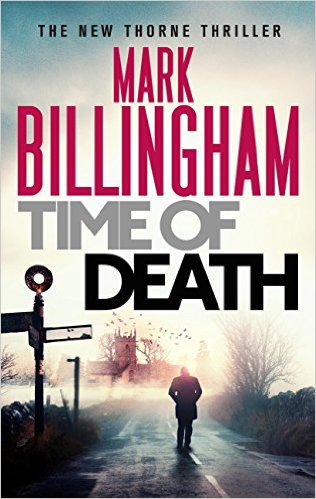
TIME OF DEATH 
by Mark Billingham (2013)

Outline
DI Tom Thorne and girlfriend, DS Helen Weeks, have taken a winter holiday in the Cotswolds, where they intend to spend Valentine’s Day together and enjoy a well-earned rest. But, as you can probably guess, from the commencement of Time of Death, the 13th outing for Mark Billingham’s gruff, no-nonsense hero, it is never going to be quite as easy as that.

Thorne, a veteran of the Murder Squad, is approaching middle-age these days, and still hasn’t entirely worked out his relationship with the relatively new woman in his life, DS Weeks. She is younger than he is, and doesn’t see the world in the same stark terms. However, it is Helen who makes the decision to suddenly interrupt their break and head north into rainy, flood-stricken Warwickshire, where an old school acquaintance, Linda Bates, is in trouble.

It seems that in Polesford, Helen’s rural but far-from-idyllic hometown, two teenage girls have been abducted, and one has now turned up in the woods, brutally murdered. In response, Warwickshire Police have laid their hands on local man, Stephen Bates – Linda’s husband – and look set to charge him with the crime.

Thorne is a little bemused as to why they are getting involved. By her own admission, Helen was not Linda’s best friend when they were kids, though they seem to share some kind of unspoken connection. On top of that, all Helen can really do once they arrive is provide a shoulder for Linda to cry on. And it’s a much-needed shoulder. Linda and her family are distraught and already being ostracised by their neighbours. Moreover, when Thorne looks into the case as an observer, it seems pretty straightforward. Even though Bates maintains his innocence, there is a mass of evidence stacked against him, and his alibi doesn’t stand up – in due course, he is charged with kidnapping and murder.

However, not all in Polesford is exactly as it should be.

Thorne isn’t won over by the loutish townsfolk, by the media who have swamped the place in a search for ever-more sensationalist news angles, or by the local investigation team, who have not been as thorough as he would like and who are increasingly resentful of his presence. When Phil Hendricks, his tattoo-covered but trusty forensics expert, joins him in Polesford, they commence an enquiry of their own – unofficially of course – and quickly start to uncover anomalies in the evidence.

Pretty soon, Thorne is convinced that Bates is innocent. But the local fuzz will have no truck with that, and in fact complain to his bosses in the Met (who attempt to call him off), while Helen is only marginally more useful. For the moment at least, the level-headed policewoman he knows and loves has vanished, to be replaced by someone who is secretive, snappy and inordinately stressed. Clearly, Helen herself has more than superficial issues with the town of her birth, and there is no guarantee they are unconnected to this enquiry.

But Thorne, the hard-nosed investigator, is now in his element. Amid foul weather and despite a storm of hostility, he battles on determinedly. Because if nothing else, he strongly suspects that the second of the two abducted girls is still in the grasp of the real killer, maybe still alive, and if so, enduring who knows what horrors …

Review
Tom Thorne is an iconic cop character in British crime fiction, and his cases are never less than totally readable. I particularly enjoyed this one, though, because it takes a new approach.

All the usual coolness of Mark Billingham’s crime-writing is there. The slick prose; the polished characterisation; the quickfire, uber-realistic dialogue; the grim tone – yet again the ‘real crime’ feel pervades this book: desolated lives, a non-empathetic public, the countless unsavoury elements that combine to create Broken Britain. This is vintage Thorne territory, but on this occasion the Met’s best bloodhound is not seeking to prove a murder suspect’s guilt, but to establish his innocence.

And it works so well.

Thorne is one of crime fiction’s top good guys, mainly because he’s believable – totally human and fallible – but at the same time he has all the attributes of a hero. He’s no angel, but he knows a dodgy situation when he encounters one, and he doesn’t care whose nose he puts out when he’s on the trail of justice. Hendricks of course – Thorne’s less conservative, happier-go-luckier other self – makes a great sparring partner, but together their combined intellect is a fearsome force. And this is the other thing about Time of Death: it is distinctly NOT a tale of brawn over brain. Don’t get me wrong; Thorne can kick arse if he wants to (and so can Helen Weeks, as this book illustrates), but this time it’s all about the minutiae of forensics, Thorne and Hendricks bouncing ideas back and forth at lightning speed as they strive to save an innocent man and rescue a tormented child.

This is raw, page-turning action, even though much of it is cerebral rather than physical.

And the background to it all is richly atmospheric too, the rain-sodden landscape a last word in winter dreariness, the support-cast almost entirely comprised of gossips and misery-merchants: metal-head taxi-driver Jason Sweeney is particularly odious and a masterwork of slow-building menace; Trevor Hare, the pub landlord and former cop who becomes Thorne’s confidant in the village, is an opinionated know-all; Linda Jackson herself ranges back and forth between sweetness, light and embittered, foul-mouthed shrewiness; even Stephen Bates is a self-centred oddball and someone you wouldn’t ordinarily root for, and yet such is Billingham’s skill that you end up doing precisely that.

This is one of the best and most unusual police novels I’ve read in quite a while, but it’s not just a procedural. Sexual misbehaviour is a key aspect of this story, especially abusive misbehaviour, and not just where extreme examples like homicide are concerned. But Mark Billingham is a serious writer – he doesn’t do pulp fiction – and as such he handles these heart-rending subjects with a deftness of touch and understanding that elevate the entire thing way above the level of routine tawdry suspense thriller.

Time of Death is an intriguing but grown-up mystery, played out at breathless pace and yet never once straying beyond the realms of the completely authentic. An excellent read.

And here again, just for fun, are my selections for who should take the lead roles if Time of Death ever makes it to the screen (Thorne is no stranger to TV of course; Sleepyhead and Scaredycat – Thorne #1 and #2 – both made it in 2010, and for me David Morrissey and Aiden Gillen were perfect in their respective parts, so I’d see no reason to change that now):

DI Tom Thorne – David Morrissey
DS Helen Weeks – Lorraine Burroughs
Phil Hendricks – Aiden Gillen
Linda Bates – Felicity Jones
Stephen Bates – Arthur Darvill
Trevor Hare – Trevor Eve
Jason Sweeney – Cillian Murphy
Aurora Harley – Anya Taylor-Joy

Wednesday, 20 April 2016

Nightmarish world of ghosts and monsters


I almost feel honoured this week to be reviewing BROKEN MONSTERS by Lauren Beukes, which is surely one of the most astonishing horror/fantasy/thriller novels I’ve read in many a year. But as usual, that’s for a little later – you can find my full review of it at the lower end of this column. Feel free to scroll your way down there right away if you so wish, but for those with more time on their hands, I’m first going to talk a little about the Jamesian elements in my TERROR TALES series, and am also honoured – I’m doubly honoured today, it seems – to be able to include the whole of a rather spiffing review of the series as written by the legendary Rosemary Pardoe in that Bible of all things MR James, the GHOSTS & SCHOLARS newsletter.

First of all ... what is the definition of Jamesian fiction?

Well ... lots of us would love to have a final, decisive answer on that. Such a thing would certainly aid with our own ghost stories. But I think that overall it’s a pleasingly elusive concept. Montague Rhodes James (left) is one of the most important writers of supernatural fiction in literary history, as relevant in the field now as he was during his lifetime (1862 – 1936). Readers of all cultures and creeds adore his work and get many different things out of it, so I don’t think it’s possible to lay out a definitive set pattern of requirements.

However, to try and be at least a little bit specific, I think there are some key ingredients to Jamesian fiction which you can sort of rely on ...

Firstly, the setting needs to be quite distinctive. Often it’s some fine old building of religious or scholarly antiquity: a cathedral, an abbey or a university, though seaside villages are also acceptable so long as they are – well, Jamesian in tone (sorry … not much help, I know). Rural towns in Europe and Scandinavia are not unknown, though it helps if they are also seats of arcane knowledge and ancient ritual.

Secondly, the cause of the trouble will often be the recovery after many centuries of some ancient, eldritch thing: the discovery of a long lost tomb or hidden room, or the retrieval of an old book or scroll, or some other dusty and mysterious artefact.

Thirdly, the supernatural entity invoked by this impertinence will be horrible and merciless. Call it a ghost if you wish (and sometimes it will be – as in an ancestor who returns), but that isn’t a prerequisite.

It could be a demon, a vampire, a ghoul, an animated church statue; Hell, it could be nothing we have a name for, but it must be real and it must be on its way already – coming fast to enact vengeance for the trespass or to reclaim the pillaged item (and quite often it won’t be seen in its grisly entirety until the final awful moments of the tale, though readers will get the nod that it’s on its way long before it arrives).

Fourthly, the hero is often a mild-mannered, intelligent but rather asexual character, a clergyman or university don, an amateur archaeologist or some other kind of scholar; someone learned in the field but unusually innocent in general terms – this innocence will quite often be his undoing, as he plods happily into the most appalling danger.  

Fifthly, the story is FRIGHTENING. This is probably the one non-negotiable element. Forget your nice, funny or whimsical English ghost stories, forget those voices from beyond that seek only to assist. MR James had no time for that nursery room gentility. His tales are still among the most chilling ever written, usually with savage outcomes, and you’re not doing the tradition any justice if you try to write Jamesian ghost stories of your own and don’t make them extremely scary and/or disturbing.

As you can probably tell, I’m a long-time lover of the Jamesian tale. Not that I’ve written too many myself – one or two at the most – but as editor of the TERROR TALES series, I have tried to include more than a few in the final line-ups, or at the very least have commissioned new work from contemporary ghost story writers who are strongly associated with the Jamesian school – Reggie Oliver, Steve Duffy, Roger Johnson, Helen Grant and Peter Bell, among many others.

Even if I hadn’t been a Jamesian fan, it would be near enough impossible to edit a series of supernatural horror anthologies based on and inspired by British regional folklore without including at least a few stories of that persuasion, the late MRJ also strongly influenced by eerie rural locations, village mysteries, hidden secrets, isolated coves, etc.

As such, and as I mentioned at the start of this post, the series has now come to the attention of Rosemary Pardoe at GHOSTS & SCHOLARS, and she was good enough to include this lengthy assessment of it in her March edition. In case you missed that, Rosemary has now, very kindly, granted me permission to reprint her review in full on this blog.

And so here we go (many thanks, Ro):  


TERROR TALES OF…
Edited by Paul Finch
Gray Friar Press 
Reviewed by Rosemary Pardoe

Paul Finch has been editing his Terror Tales series of paperback anthologies for Gray Friar Press on a roughly twice-yearly basis now since 2011.  

To date there have been nine volumes: Terror Tales of London, Terror Tales of East Anglia, Terror Tales of the Cotswolds, Terror Tales of the Lake District, Terror Tales of the Seaside, Terror Tales of Wales, Terror Tales of Yorkshire, Terror Tales of the Scottish Highlands and most recently Terror Tales of the Ocean. All of them are still available (print on demand) and all contain a mixture of (mostly) new stories with a few reprints by (mostly) current writers, set in the relevant areas, interspersed with little vignettes of local mythology, folklore and history.  

There are stories for Jamesian aficionados in the majority of the collections; and tales by authors whose names will be familiar to readers of Ghosts & Scholars, Haunted Library publications and the G&S Books of Shadows.

Thus, for instance, in the Scottish Highlands book there are stories by Helen Grant, Peter Bell, John Whitbourn and D.P. Watt, as well as a reprint of Sheila Hodgson's ‘The Fellow Travellers’. Similarly in Yorkshire, Chico Kidd and Christopher Harman feature; in Wales are Steve Duffy (‘Old as the Hills’, reprinted from G&S 33), Reggie Oliver and John Llewellyn Probert; at the Seaside are Ramsey Campbell, Reggie Oliver and Christopher Harman; in London, Roger Johnson's superb London that was Rome-influenced ‘The Soldier’ is a highlight; in the Cotswolds we find Ramsey Campbell, Christopher Harman, Reggie Oliver and John Llewellyn Probert; and in the Lake District are Ramsey Campbell, Reggie Oliver and Peter Bell. 

Of course, not all of these authors contribute Jamesian stories, while some of the writers who might be less familiar to G&S readers do. To illustrate the mix, and for obvious reasons, I've picked Terror Tales of East Anglia (2012) to look at in slightly more detail. 

It contains thirteen stories with twelve non-fiction vignettes; the latter are a mix of the familiar (the Murder in the Red Barn, the ghostly knight of Wandlebury Camp, the Rendlesham Forest UFO) and the unfamiliar (the mutilated torso that haunted Happisburgh, the demon of Wallasea Island, the giggling ghost of Dagworth Castle). 

Most of the tales are original to the volume, although some have since been reprinted elsewhere. 

The first Jamesian story is ‘The Watchman’ by Roger Johnson, reprinted from The Best of Ghosts & Scholars (1986). When a statue on the west front of Stockbridge Minster in Suffolk is replaced by one of St Michael and All Angels, it becomes clear that the former was sculpted from the life; and anyone who attempts to steal from the Minster is running a considerable risk. ‘The Watchman’ isn’t Roger at his best (which, as we know, can be very good indeed), but it’s a decent, workmanlike, if predictable, antiquarian tale. 

I would say the same about Edward Pearce’s ‘The Little Wooden Box’, which again deals with the perils of stealing from an ecclesiastical building. 

Steve Duffy’s ‘The Marsh Warden’ (originally published in Midnight Never Comes, 1997), set in and around an inn on the Essex marshes, is also traditional in plot, involving plague pits and haunted wells. But it’s so immaculately and atmospherically written that it’s a joy to read and (although I admire him for being his own man and going his own way) it makes me regret that Steve no longer seems to write Jamesian fiction. 

‘Wolferton Hall’ by James Doig (originally in Shadows and Silence, 2000) is another tale that deals in the standard James themes: an academic researches family papers in a Norfolk country house, and is disturbed by a fresco depicting a "man being pursued by [a] curious scarecrow figure". Yet a story like this, when written with the skilful scholarly touch that is characteristic of James Doig, remains extremely effective and satisfying. Johnny Mains’ ‘Aldeburgh’, a sequel to ‘A Warning to the Curious’ as the title suggests, is more unusual. Or at least it starts that way as a murder mystery, with the intriguing premise that the events in the story were based on fact, and were inspired by the death of one Mr Payton. His demise was witnessed by MRJ himself, and Mr Payton has a son who accuses MRJ of killing his father. 

Unfortunately the tale peters out with an ending that doesn’t live up to the promise of the start (it’s also a problem that the character of MRJ in the story isn’t in the least like the real one). Another story set in (a renamed) Aldeburgh is Reggie Oliver’s excellent ‘The Spooks of Shellborough’. 

This is not exactly a ‘Warning to the Curious’-connected tale, and yet it takes certain motifs from that story: the distant figure which haunts the narrator's golfing companion; and also the description of the two bodies at the end, found with their mouths choked by sand. 

The final image of the revenant is Jamesian enough, and shocks because the rest of the tale is so restrained. I also like ‘Double Space’, Gary Fry’s smart variant on the ‘Casting the Runes’ style curse that rebounds on its sender.

Non-Jamesian stories are by the likes of Christopher Harman, Paul Finch and Simon Bestwick, but my favourite of these is Mark Valentine's superb ‘The Fall of the King of Babylon’ (reprinted in Seventeen Stories, 2013). Mark rarely tackles out-and-out horror, but this is an exception. Set in Ely in the medieval period when that city acquired its name from its thriving industry in the harvesting of a certain sort of fish, this story demonstrates that one should never get on their wrong side. As an eel-phobic, I never really doubted that, but non-phobics will get a chill from the tale too, and everyone can appreciate the wonderfully evoked, dark setting and atmosphere.

Happily, there is no end in sight for the Terror Tales series. 

The latest, Terror Tales of the Ocean (with contributions from Stephen Laws, Steve Duffy, Adam Golaski, Adam Nevill, Lynda E. Rucker, etc.), continues to the same standard, although by its nature there are few if any Jamesian stories in this volume. 

Paul Finch already has plans for Terror Tales of Cornwall, Terror Tales of the Northwest, Terror Tales of the Home Counties, Terror Tales of the Midlands and Terror Tales of the South Coast.  He won't even be stopping when Great Britain is fully covered, the idea at that stage being to venture over the seas to Europe and possibly beyond. 

With such a good stable of authors regularly participating, I don't foresee any drop-off in quality either. Inevitably not every story will please everyone (some by no means please me) but other anthologists will struggle hard to reach the consistent standard of these books, which G&S has neglected for too long ...


Again, many thanks to Rosemary. You can hook up with Ghosts & Scholars and discover all you need to about Jamesian fiction both old and new by either following this LINK. Or alternatively, contact Rosemary Pardoe directly at dandrpardoe@gmail.com and she’ll be happy to send you an info/order form.

The images used in this section of the blog, from the top down, are: Lost Hearts (BBC, 1973); MRJ himself; Whistle and I'll Come to You (BBC, 1968); The Tractate Middloth (BBC, 2013); The Stalls of Barchester (BBC, 1971); G&S #9, cover illustration by Tony Patrick; G&S #28, cover illustration by Paul Lowe; G&S #32, cover illustration by Paul Lowe; G&S # 19, cover illustration by Douglas Walters; and Terror Tales of the Ocean, artwork by Neil Williams.

*

THRILLERS, CHILLERS, SHOCKERS AND KILLERS

An ongoing series of reviews of dark fiction (crime, thriller and horror novels) – both old and new – that I have recently read and enjoyed. I’ll endeavour to keep the SPOILERS to a minimum; there will certainly be no given-away denouements or exposed twists-in-the-tail, but by the definition of the word ‘review’, I’m going to be talking about these books in more than just thumbnail detail, extolling the aspects that I particularly enjoyed … so I guess if you’d rather not know anything at all about these pieces of work in advance of reading them yourself, then these particular posts will not be your thing.

BROKEN MONSTERS 
by Lauren Beukes (2014)

Outline
The time is now. The place is Detroit, a city in its post-industrial death throes.

This is a landscape that is not just physically decayed, but morally bereft: where there are more citizens without jobs than with; where the homeless almost outnumber the residents; where over-worldly youngsters drink, take drugs and swear; where underage girls tease online paedophiles just for kicks, and high school kids are more interested in filming their friends being bullied than in helping them out; a place where graffiti and ruin-porn pass for art; where any hipster careerist thinks he/she can be a sculptor, or a musician, or a writer, or a journalist, or a social commentator, and yet somehow all of them finish up being vapid, vacuous wannabes.

In the midst of this urban ooze, cop and single mom Detective Gabi Versado finds herself investigating a particularly distressing case.

The fusing of a dead boy’s torso to the hindquarters of a deer sparks the commencement of a sadistic and gratuitous murder spree – the handiwork of a killer soon known as the ‘Detroit Monster’ because of the grotesque public displays he makes of his victims.

All the monumental complexity of a massive homicide enquiry follows, with various colourful but complex characters getting in on the act. For example, Layla is Gabi’s neglected yet spirited daughter, one of those brattish modern teens who can’t seem to live if she isn’t constantly active on social media, and yet who in this case is irrepressibly likeable; Jonno Haim is a failed New York writer-turned-blogger, a minimally-talented chancer looking to kick-start a career he hasn’t earned by shouldering his way into the Detroit arts scene; Thomas ‘TK’ Keen is an amiable hobo, a father figure to his fellow homeless, but a guy haunted by his own tragic and violent past; and then we have Clayton Broom, another failure – all these lives are broken in this land of broken dreams! – a skilled artist who struggles to support himself when his work doesn’t sell, and as such lives in a slum, absorbedly dwelling on his bizarre visions … which leaves him open to some very pernicious influences.

And this is the point where, for some readers at least, this novel’s wheels have come off.

Fans of Lauren Beukes, particularly those familiar with her stunning tale of magical realism, The Shining Girls, will probably expect Broken Monsters to enter the territory of the unreal at some point, and – well, that’s precisely what it does. Quite unapologetically. So be under no illusion. Despite first appearances, this is NOT a police procedural or even a traditional murder mystery.

At a relatively early stage, the identity of the felon is given away, but he quite literally is not himself. Call it what you will – an alien intelligence, a ghost, a demon, a faerie, an ancient god – but some powerful, unknowable and insane entity has awakened inside this already damaged soul, driving him to commit terrible deeds, each time intensifying the horror and savagery in its vain efforts to create better things, to entrance and heal the suffering public, and usher in a new age of wonder and enlightenment through the chalk doorways it motivates him to inscribe on walls near the scenes of his crimes.

And this is the real narrative, not the internal fantasy of a madman. The closer our various heroes come to resolving this case, the ever more bizarre, lurid and warped the realities they encounter, until we reach a point where you know in your bones that normality can never resume. It builds to such a crescendo of the weird and horrific that the annihilation of some of the good guys – or at least the annihilation of their sanity – seems inevitable …

Review
I hate pigeon-holing in literature, but in this case it serves a valid purpose. Broken Monsters may not be your run-of-the-mill crime thriller. But neither is it your standard urban horror story. In fact, if the vague term ‘dark fantasy’ ever had a living embodiment, this is it. And so what if certain readers were not happy about that? That is down to their own preconceptions – they thought they were reading cops ‘n’ robbers when all the blurbs said otherwise.  

For me, in this case if none other, the quality is more important than the content. Because this is far and away one of the most readable novels I’ve ever picked up. It doesn’t just move at electrifying pace, it is exquisitely written. The loving descriptions of the half-abandoned city are intense and detailed – you can almost smell the oil and filth, the rotted steel, the rain-soaked concrete. The characters are rich and multi-layered, all forlorn, all struggling, all in many ways annoying, and yet on occasion funny and loveable too, and as such, so real that it is easy to form emotional connections with them. Even the killer is the star-turn in one achingly sad scene where, in an unwitting attempt to head off his ghastly future, he tries to reacquaint with the mother of his child, a slatternly ‘roadhouse mom’ – who casually and spitefully rejects him.

For all these reasons, Broken Monsters gets my highest recommendation. Yes, the change of gear (the ‘thriller to horror’ moment) is a bit of a jolt for those who didn’t anticipate it, but this is truly excellent stuff: compelling and fascinating, at the same time both depressing and uplifting. The depth and imagery of the ruined city and the raddled folk living therein is almost seductive; the soullessness of the internet age will horrify you; the constant madness of mass-communication, mass profanity, mass insolence, mass embarrassment – the whole damn thing is amazing and infuriating and scary and intoxicating all at the same time.

You may not love this novel (unlike me – I did, as if you can’t tell!), but I can damn well guarantee that you’ll be totally overwhelmed by it.

And as always – purely for a laugh, you understand – here are my picks for who should play the leads if Broken Monsters ever makes it to the movie or TV screen (which is surely very likely given the adaptation clamour that greeted The Shining Girls). 

Detective Gabi Versado – Salma Hayek 
Layla  – Amandla Stenburg 
Thomas 'TK' Keen  – Chris Chalk 
Jonna Haim  – Jonathan Rhys Meyers 
Clayton Broom  – Peter Stormare