Monday, 6 November 2023

Check out the final artwork for Battle Lord


Today, I’m delighted to be able to reveal the final cover for BATTLE LORD, which is Volume 2 in THE WULFBURY CHRONICLES, and now slated for publication in January next year. I’ll be talking a little more about that further down. In addition to that, I’ve got an announcement to make regarding my Thrillers, Chillers series, which I feel is finally approaching the end of its natural life. More about that later on, as well.

In the meantime, though, on the subject of thrillers, chillers and other writings of that ilk, I’ll be posting another detailed review, and this week it’s the turn of KIN by Kealan Patrick Burke.

As usual, if you’re only here for the book review, you’ll find it at the lower end of today’s blogpost. Feel free to jump straight down there and check it out. Before then, though, let’s roll back the centuries to …


Darker Ages

I’m guessing that most people reading this column will be familiar with my recent diversion from the world of crime and thrillers into the land of historical adventure fiction, as initially seen in my book of last April, USURPER, which told a blood and thunder tale set during the Norman invasion of England.

It wasn’t a total diversion, by the way; there’ll be more crime-thriller news from the Côté de Chez Finch in the next few weeks.

USURPER seems to have done pretty well. It got some good reviews and garnered some very pleasing
thumbs-ups from a range of respected authors …

An action-packed, coming-of-age, adventure set against the upheaval and battles of 1066 … Matthew Harffy

Fearsome battles, believable characters, uncommon valour. A relentless page turner … David Gilman

An authentically blood-soaked historical epic to rank with the best … Anthony Riches

With all the brutal power of a battle-axe to the head, Finch brings 1066 to life in new and vivid ways … Steven A McKay

Well, as mentioned, next January, the second volume in the Wulfbury saga, BATTLE LORD, will hit the bookshelves, though it’s available for pre-order right now of course. Here’s a quick thumbnail outline:
It’s October 1066. The battle of Hastings is over, and King Harold and the flower of his English army lie slaughtered. But the Normans have suffered too, and from this point on, can only advance with caution. Though this doesn’t stop them harrying the English people: burning, raping and pillaging.

The prisoners they have taken are equally mistreated. One of these is Cerdic Aelfricsson, second son and sole surviving heir to the earldom of Ripon, whose extensive holding in the north of England is centred around the hill fortress of Wulfbury.

Wulfbury is the only reason Cerdic is alive. He has teased his captors with information that this earldom and all its treasures can now be theirs, though he makes no bones about the fact that they must first steal it back from Wulfgar Ragnarsson, a Viking warlord whose private army splintered away from Harald the Hardraada’s invasion force and captured it for themselves.

The household of the Norman count, Cynric of Tancarville, is the particular group in whose chains Cerdic resides. Not trusting their duke to give them their due reward, they are strongly tempted to march north, but they know that will be through enemy territory, while the Viking opponent awaiting them grows stronger every day.

Before then of course, they still have duties to discharge for their duke, namely the capture of the Saxon fort at Dover, and England’s religious capital, Canterbury, then the hardest nut of all to crack, London. Only then of course, can the duke genuinely claim the crown of England.

All through this ordeal of chaos and war, Cerdic can only use his wits to survive. At the same time, though, he becomes increasingly close to a fellow hostage, Yvette d’Heimois, the English-speaking daughter of a Norman count currently living in exile, and two Norman knights, Turold and Roland, the former whose mother was English, the second whose adherence to the code of chivalry leads him to show compassion to the prisoners.

That said, the benign presence of Yvette, Turold and Roland is counterbalanced for Cerdic by several ferocious adversaries: Joubert, Count Cynric’s cruel and uncontrollable son, Yvo ‘the Slayer’ de Taillebois, his personal attack-dog, and Duke William himself, an implacable tyrant, who hasn’t yet earned his epithet ‘Conqueror’, but is currently known for all sorts of reasons as ‘the Bastard’.


If you like the sound of BATTLE LORD, as I’ve already said, you can pre-order it right now. Or, if you need further persuasion, check out a few reviews and see what you think on it on its day of publication, January 8, next year.

Thrillers, Chillers no more

It’s my sad duty to report that my Thrillers, Chillers, Shockers and Killers column, which I’ve been running on this blog since 2015, and in which I think I’ve now reviewed several hundred books, will shortly be finishing.

I should say straight away that airing my thoughts publicly and extensively on those works by other authors that I have particularly enjoyed has been one of the great joys of my life in recent years. But, for various reasons now, I need to bring this to a close.
Most people who are familiar with this blog will probably recognise that I offer very detailed reviews of these novels, anthologies and story collections. Some might say I actually go into too much detail, and that writing hundreds and hundreds of words each time is an OTT response and maybe too much for the average internet browser to bother reading.

In truth, I suspect this latter may be the case.

Many’s the time sadly when I’ve had only a very limited response to these reviews, which is a huge amount of time wasted. Don’t get me wrong … I’ve not been doing this so that people will discuss my book reviewing skills (such as they are) online, though it’s nice if an author responds, and that happens quite a lot, but ultimately it’s an exercise in trying to spread the word about a great piece of fiction that has made an impact on me personally, and it’s too often the case that I’ve seen no evidence I’m achieving that … so, what’s the point?

Of course, what it really boils down is that, even if each of these reviews generated a waterfall of chatter, they’ve simply become too time-consuming an exercise. I have my own writing to do – two more novels are in the offing, with more to add, while I also have several short story commissions – so it’s just not possible to keep taking out two or three days twice a month to write continuous book reviews. (On top of that, it does take the enjoyment out of reading, having to make copious notes in a pad while you’re working your way through a damn good book).

I won’t be putting it to bed straight away. I’ve still got several reviews in the barrel, which I’ll post over the next couple of months, and I’ll always post a quotable paragraph on social media if I really like a book, but I suspect that 2024 will be the first year in quite some time when the Thrillers, Chillers, Shockers and Killers section of this twice-monthly blogpost is basically no more.

And now, speak of the Devil …


THRILLERS, CHILLERS, SHOCKERS AND KILLERS …

A series of reviews of dark fiction (crime, thriller, horror and sci-fi) – both old and new – that I have recently read and enjoyed. I’ll endeavour to keep the SPOILERS to a minimum; there will certainly be no given-away denouements or exposed twists-in-the-tail, but by the definition of the word ‘review’, I’m going to be talking about these books in more than just thumbnail detail, extolling the aspects that I particularly enjoyed (I’ll outline the plot first, and follow it with my opinions) … so I guess if you’d rather not know anything at all about these pieces of work in advance of reading them yourself, then these particular posts will not be your thing.
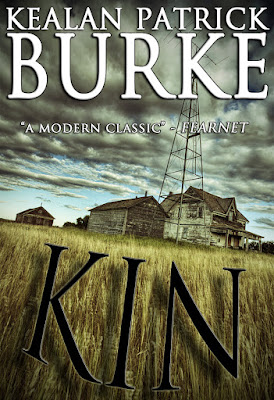
KIN by Kealan Patrick Burke (2012)

Outline
When Claire Lambert is found on the side of the road near Elkwood in rural Alabama, raped, mutilated and blinded in one eye, Jack Lowell, the black farmer who discovers her, knows immediately who’s to blame. A local hillbilly clan, the Merrills, controlled by their fearsome father, Papa-in-Gray, and their odious, deranged mother, Mamma-in-Bed, have been terrorising the district for ages. While content to leave their neighbours alone (mostly), they are always ready to waylay visitors, not just robbing, torturing and killing them, but cannibalising the remains afterwards. And by that, I mean literally cannibalising them, as in cooking and eating them, and burning what’s left-over on huge, greasy bonfires.

Claire’s small group of happy-go-lucky hitchhikers has suffered exactly this fate, but Claire herself escaped and in the process managed to kill one of her captors.

None of this, by the way, has happened ‘on camera’. We learn all about it through Claire’s dazed recollections and the few things she manages to say to her reluctant rescuer and then to a retired doctor, who patches her wounds but is hesitant to publicise the incident because both he and Lowell now know that the Merrills won’t rest. One of their victims has escaped, someone who can now implicate them in multiple homicides. Not only that, she slew one of their own.

Lowell’s dim-witted but good-natured son, Pete, drives Claire away when she’s fit to travel, and only just in time, the vengeance of the Merrill family then falling ferociously on both the farmer and the good-hearted medical man, the latter taking the blame posthumously when local lawman, Sheriff McKindry, finds fragments of Claire’s friends scattered in his cellar.

The story of the mad, murdering doctor is accepted by the state police, and Claire is despatched home to her sorrowing family in Ohio, unable to persuade anyone that it was a whole group of men who attacked them. Her older sister, Kara, won’t listen, because she hopes the terrible issue is now over. Relatives of the other victims feel much the same way. With one exception.

Thomas Finch, the brother of Claire’s deceased boyfriend, and an ex-boyfriend, himself, of Kara’s, is a veteran of the Iraq War. As such, he’s now an embittered, introspective man, whom Kara doesn’t like or trust anymore, and who seems to be constantly on the verge of doing something self-destructive. Secretly, he’s tortured by the memory of shooting an innocent Iraqi woman and her child, and later covering his back by lying that they were suicide bombers, though no one else knows about this except his old combat buddy, Beau. Finch does believe Claire that the real murderers down in Alabama have got away scot free, and seeks permission of the bereaved families to go and look for them. Most don’t want anything to do with him; they are comfortable middle-class citizens, so even though ravaged by grief, they can’t conceive of a vigilante rampage. One, however, a wealthy chap, agrees to bankroll Finch’s mission of vengeance, which allows him and Beau to buy high-power weapons.

Young Pete, meanwhile, is also ready to get payback. Despite his endless good humour, with his Pa dead and his home burned, he’s been left with nothing but the family truck. He heads north to Detroit, to try and hook up with Louise, his former stepmom, but Louise, though she’s glad to see him, is currently dealing with a wannabe gangster boyfriend and all the trouble that brings, and eventually is severely wounded just trying to prevent Pete from getting involved himself.

Pete thus drives to Ohio, to check on Claire. He really is an innocent soul. It never enters his head that she might regard him as a real-life reminder of her terrible ordeal rather than the friendly kid who helped her. But Claire, who’s been strictly forbidden by Kara from accompanying Finch and Beau back to the South, now sees Pete as a new kind of salvation. Because, the moment Kara looks the other way, he can drive her down to Alabama. And whatever revenge is going to be had on the diabolical Merrill clan, she can have a piece of it too …

Review
Back in 2012, I would have wondered how much more an author could have wrung out of the ‘hillbilly horror’ genre. Much earlier, in 2001, I attended World Horror in Seattle and heard opinions from various US writers that they felt this particular neck of the literary backwoods was now thoroughly explored.

However, Kealan Patrick Burke gives it a new lease of life in his rural thriller, Kin, though not in ways you might expect.

Yes, the terror of the malformed and the inbred is all there, the extreme sexual violence is there, the distortion of religious belief, the deep, dark woodland filled with dense, thorny undergrowth. The Southern Gothic atmosphere pervades it from the start. We are in a familiar world, and a familiarly ominous one, where local law enforcement pay lip service to their badges, doing no more for visitors than offering friendly advice that they ignore such and such a wooded back-road; where said roads inevitably lead to mysterious ramshackle farms, heaps of junked, rusted machinery, loads and loads of seemingly abandoned cars; and where hairy bad guys in dungarees are likely to leap out of the trees at any second, armed with hatchets, knives and bows.

But I say it again, Kin is what I’d call a ‘rural thriller’ rather than a traditional ‘hillbilly slasher’, Burke setting up the brutal attack on the innocent band of hikers before the novel has even started, and instead of focussing on their appalling and protracted suffering, choosing to analyse the events that follow (and inevitably spin out of control).

I’ve often wondered when watching movies like The Texas Chainsaw Massacre, Wrong Turn or The Hills Have Eyes, how the few survivors of such ordeals would ever have been able to get on with their lives afterwards. We got a hint of it in Deliverance and Wolf Creek, where, in the former, the very least they could expect were repeated sweat-soaked nightmares, and where, in the latter, there was a general disbelief that such events could ever have happened, the survivors themselves coming under suspicion of murder.

But in Kin, Kealan Patrick Burke takes it a whole lot further – and here’s the really clever bit, because when this author is talking about ‘kin’, he isn’t just talking about the cannibal clan at the heart of the horror, he’s also talking about the response their atrocious act elicits from the siblings of those slain. In fact, that’s what he’s talking about mainly. So often in this kind of tale, we meet a tightknit group of uneducated killers living in rural isolation, fearing and hating the rest of the world, and subsequently prepared to die for each other even though there is much abuse and cruelty among them. Well, newsflash! – other ordinary folk, the ‘men of the world’ as they are referred to in this book, care about each other too, and in Kin, the Merrill clan of Elkwood are about to learn that the hard way.

Even so, the author doesn’t use this as a reason to simply drag us through a gutter of depraved self-justifying violence. Fighting back against deadly criminals with equal deadly force would be a big step for any civilised person to take; not just a terrifying prospect, but a moral quandary all of its own. And this is the key aspect of Kin. If your life was genuinely ruined by an act of such horrific violence as this, and the outrage was compounded by the indifference or incompetence (or both) of local police forces – so much that you felt there was no option but to take the law into your own hands – what kind of agonies would you go through as you, firstly, sought to convince yourself that this was the only solution, and, secondly, then had to persuade sufficient others to form an effective posse?

Even in America, where there are guns aplenty, it takes the war veterans Finch and Beau, two men used to conflict and whose lives, on the whole, have already ended, to light the touchpaper. Pete only gets involved because he too has nothing left in his life: his Pa is dead, his home incinerated, his erstwhile mother, Louise, a woman with serious problems of her own. Even Claire, the most damaged character in the story, only goes back to Elkwood because she is being so smothered with care and concern (and at the same time subjected to anger and annoyance for having brought this tragedy on their family) that she knows she’ll only be able to cut loose by taking direct action of her own. And even then, they all follow hard and bumpy roads reaching these conclusions.

I’ve seen some critiques of Kin that take issue with its middle section, where the killers themselves are off the page and, instead of watching them commit more heinous deeds, we ruminate painfully with their stressed and indecisive victims. Of course, what may be boring to some, to others (to me, for instance) is the thing that marks this novel out as more of a thriller than a horror, because it means that we’re dealing with things ultra realistically, a sad, grave tone that is maintained throughout the narrative.

Kin might be a story that we’ve seen before, but rarely will we have seen it done in as grown-up fashion as this. For example, the Merrills are not simply mad, bad and dangerous to know because they come from the country. There are other country folk in here, like Jack Lowell and even Mamma-in-Gray’s brother, Jeremiah Crawl, who, while both from the boondocks, are not evil.

The Merrills are the way they are because Papa-in-Gray, their patriarch, is hopelessly insane, a paranoid religious maniac who has consciously sought segregation and raised his family with such fear and suspicion of the rest of society, treating its corruptive influence as literal poison, that it will only lead to one thing when they encounter it. (I should say that though we’re in authentic serial killer country here, our main antagonist so overwhelmed by delusion that he might as well get what he can from his fellow men because he’s completely dehumanised them in his own mind, the cannibal element feels perhaps a little unnecessary. I can’t help thinking this brings a degree of lurid sensationalism into the novel that it doesn’t really need).

The other thing that impresses me about the Merrills is that they’re not indestructible. We’re a world away from Michael Myers or Jason Voorhees, who just keep coming no matter what you do to them. The Merrills are brutal bullies, but they’ve never squared up to combat vets before, and the result of that is inevitable and foreseeable. Not only that; they aren’t totally solid with each other: son Luke, for example, has developed a conscience, and Papa, though he cruelly and horribly punishes the boy, remains wary of him for the rest of the book.

On the whole, though, you almost start to feel for the Merrills in the end, mainly because their simple understanding of what they believe to be an ultra-hostile world has so failed to prepare them for reality that, at times, they are more like silly children than deadly criminals (though you don’t linger with that misconception for long). When their demise occurs, it’s deserved but inevitable, and they almost seem to feel this themselves, predicting the end of their world with a sad, fatalistic air. Papa remains in denial until the end, of course: Mama was a saint, God is still on their side, he’ll find another woman and have new sons, all will come good. It’s all so pathetically deluded. Not that he doesn’t thoroughly deserve the biblical end that awaits him in the final pages.

In terms of the other characters, Sheriff McKindry is an equally complex villain. It’s an old trope, the corrupt southern lawman who’ll go out on a limb to keep things just the way they are. In this version, he’s as much a thief and scavenger as the Merrills, but he too is finally aware that he’s got in over his head, and he genuinely regrets this, as well as the sufferings of all those others caught up in the Merrills’ web, which up until now he’s turned a blind eye to.

I was less enamoured by Finch and Beau, who, dare I say it, are a little bit stock, and like so many veterans in modern day fiction, spend a lot of time talking about how nothing seems to matter anymore, though once again they have clear, defined voices and as we’re still in the real world, neither of them, thankfully, is Rambo.

That leaves only Pete and Claire of our main cast, who, between them, are a very different pair of heroes from the norm, and each very engaging in his/her own way. Claire would normally be fetchingly pretty; she was once, but now she’s been gruesomely disfigured, and switches continually between sweetness and anger. Pete, a young black kid with learning difficulties but a cheerful outlook, lives in a tragi-comic fantasy, where just because he was in the truck that picked Claire up when she was first hurt means he’s destined to be her boyfriend. He’s no hope on this score, of course, but one of the most attractive things about him is, even when he starts to realise this, he never lets it diminish his positive outlook.

As you’ve probably realised, I enjoyed Kin immensely. It was a quick read, though very well written – almost lyrical at times. I do think there are perhaps one or two moments of introspection too many, when we lose the thread of the action because characters are thinking deep, immersive thoughts. But to other reviewers this is a good thing, even steering the book in a literary direction.

Ultimately, of course, it’s all in the eye of the beholder. I’d just say this: read Kin. It doesn’t do what it says on the tin, but for that reason I think you’ll thorough enjoy it.

As I so often, and so ill-advisedly do after reviewing books on this blog, I’m now going to attempt to cast Kin on the off chance that it gets made into a movie or TV series. So many of the books on here should get that treatment, but never seem to. But in this case, as with all others, here’s hoping. (And remember – the one good thing about this is that I have no limits on how much I can spend on my actors).

Claire – Kara Hayward
Pete – Tyrel Jackson Williams
Papa in Gray – Dennis Quaid
Luke – Josh Hutcherson
Louise – Gabrielle Union
Finch – Sean Faris
Beau – Omari Hardwick
Sheriff McKindry – Scott Glenn

Tuesday, 3 October 2023

Haunted house horrors: a very cool Top 20

Welcome to October, everyone. The true beginning of what I suppose you could call the Haunting Season. Halloween is still a few weeks off, and Christmas even further, but with the darker evenings, longer nights and that sudden, distinctive nip in the air, you at last know that you’re into the waning of the year and your thoughts turn instinctively to all things eerie.

So, today, just for a lark, I’ll be selecting 20 classy haunted house books to talk about. In addition to that, on an only indirectly connected note, I’ll be offering a detailed review of Chris Ewan’s Halloween thriller, DARK TIDES.

If you’re only here for the Ewan review, you’ll find it as always in the Thrillers, Chillers section at the lower end of today’s blogpost. Feel free to shoot on down there straight away. In the meantime, before any of that …

Podcast city

As summer came to an end, I was the grateful recipient of several invitations to participate in podcasts. The first of these was ROCK, PAPER, SWORDS, a regular series from top historical authors Matthew Harffy and Steven A McKay, which focusses on historical action fiction and rock music. 

That concept alone ticks a number of important boxes for me, especially as my most recent novel, USURPER, falls into the historical action-adventure category (as will the sequel, BATTLE LORD, out next January) so I was delighted to guest for them. You can find that one HERE.

In addition to that, composer and podcaster Ian Cleverdon invited me to join him on HALF HOUR MENTOR, an ongoing series featuring regular interviews with people who are deemed to be sources of inspiration within their chosen fields. I was particularly flattered to be asked onto this show, as you can imagine, especially as Ian deemed the final interview so worthwhile that he ran it to an hour rather than half an hour. So, if you’re interested, you can find this one in two parts, ONE and TWO on the same site next Saturday.

And now, as promised earlier, onto …

Houses of the unholy
(All you rock fans, see what I did there?)

Old scary house stories are always going to be something of a mixed bag. They aren’t always effective, mainly because there have now been so many of them, and yet the haunted house story seems to have a lasting appeal, which ranges right across a whole variety of genres.

To start with, they are meat and drink to the world of the crime thriller; take JB Priestley’s Benighted, also published as The Old Dark House (1927) or Agatha Christie’s And Then There Were None (1939) and Hallowe’en Party (1969), all adapted as major Hollywood movies (the latter relocated from the English Home Counties to Venice by Kenneth Branagh). 

Evil old houses have also provided key focal points in science fiction: HP Lovecraft and August Derleth’s The Lurker at the Threshold (1945) and William Hope Hodgson’s The House on the Borderland (1908). Even the world of comedy has had fun with scary old houses. Take, for example, Oscar Wilde’s The Canterville Ghost (1887) and Josephine Leslie’s fantasy rom-com, The Ghost and Mrs Muir (1945), while from Hollywood there were two classic Bob Hope vehicles, The Cat and the Canary (1939) and The Ghost Breakers (1940). (Who could forget Hope’s immortal one-liner: ‘I’m familiar with big empty houses. I used to do vaudeville’).

But, understandably, it’s the world of horror fiction where the haunted house as a concept has most made its mark.

In fact, it’s now a sub-genre of supernatural fiction all on its own, and it never seems to get old. I’m not sure exactly why that is, but I’d hazard a guess that a house is invariably someone’s home, and homes are supposed to be places of comfort and refuge, safety zones where the occupants should feel warm and secure, and from where they can easily repel the woes of the world. Subsequently, when these places are invaded, even by human adversaries, it has a horrible impact. So, imagine the impact when the incursion is by some malevolent nether-being, a ghost or demon. No wonder it preys on all our minds.

At the same time, of course, haunted houses don’t just exist in myth or fiction. They are actually supposed to be real. Even those of us who don’t go looking for ‘true’ ghost stories, have encountered hundreds of tales of houses that were ‘not quite right’ or were reputed to be troubled or disturbed. If you live here in the UK, near enough every neighbourhood boasts one, but there are some cases so celebrated that they make international news.

The so-called Enfield Poltergeist, an entity that supposedly terrorised a suburban house in North London (pictured right) in the mid-1970s, some of the manifestations captured on live news cameras, became the epicentre of an international paranormal enquiry. 

Likewise, the centuries-old haunting of Glamis Castle in central Scotland is reputed far and wide and allegedly has hit both occupants of the grand old estate and visitors to it with every type of terrifying phenomena.

I could list these examples endlessly, but the point is that we’re all familiar enough with the concept of the haunted house story to enjoy it thoroughly whenever one comes along, and there has been no shortage of writing on this very subject. Dark fiction specialists from the earliest days got in on the haunted house act: Edgar Allan Poe with The Fall of the House of Usher (1839), MR James with Lost Hearts (1895), Henry James with The Turn of the Screw (1898) and Algernon Blackwood with The Empty House (1906). But for today’s purposes, coming forward a little closer in time, I’ve selected 20 haunted house novels by some of the best writers on the more recent market.

The first ten I’ve already read and heartily endorse. The second ten I’ve yet to read, so in those cases I’ve simply offered the blurb from the back of the book. If nothing else, this second list will hopefully provide interest and temptation.

Very quickly though, before we get into that, this being my own blog and all, I hope it’s not too remiss of me to mention that I too have contributed to the canon, with two haunted house novellas of my own: 1) In The Killing Ground (2008), most recently included in my Christmas collection, IN A DEEP, DARK DECEMBER, a man-and-wife private eye team are hired by a film star to investigate a possibility that the medieval spectre supposedly roaming the precincts of his new home on the Wales/Herefordshire border is responsible for the disappearance of several local children. 

2) In The Stain (2007), which most recently appeared in another Christmas collection of mine, THE CHRISTMAS YOU DESERVE, a bunch of wannabe film-makers seek inspiration from a sprawling manor house in the New Forest, where an infamous horror movie of the 1960s was shot, the mere filming of which has allegedly invoked a demonic presence that was never there previously. (This one’s been optioned twice by different film companies, but – surprise, surprise – it’s never made it to development as yet).


And now, the plug over and done with, today’s main event:

20 HAUNTED HOUSE NOVELS TO SHED DARKNESS INTO YOUR WORLD OF LIGHT


BOOKS I STRONGLY RECOMMEND …

1 The Amityville Horror by Jay Anson (1977)


The alleged true account of a terrifying haunting, which caused such sensation that it spawned numerous sequels and imitations, and a whole series of movies. Though there is huge doubt as to whether any of the events it reports happened, journalist Jay Anson hit gold when he recounted the story of the Lutz family, who claimed that a demonic presence had influenced the real-life mass murder that had occurred in their pleasant Long Island home in the early 1970s, and the subsequent horrific haunting that finally caused them to flee. Primarily, this was down to Anson’s spare, journalistic style (it all comes at us in diary form) and the absolute conviction of its tone. Whether you believe in it or not, it’s still one of the scariest reads on the market and a landmark in haunted house fiction.

2 The Haunting of Hill House by Shirley Jackson (1959)

Made three times now for the screen, The Haunting of Hill House was inspired by a road-trip Shirley Jackson took to recce the most haunted houses in her native New England. It seems that she heard some very spooky stories en route, and yet with this masterpiece, trimmed her finished product down to the basics, relying on suggestion rather than
outright manifestation, leaving the group of paranormal investigators staying in isolated Hill House confused about whether they were genuinely in touch with dark forces or being duped by the psychological torment of one of their own number. The first movie version, The Haunting, filmed by Robert Wise in 1963, was by far the closest in spirit to this unforgettable original, but read the book too.

3 The Elementals by Michael McDowell (1981)


The Southern Gothic slams head-on into haunted house horror of the first order. With an affluent Alabama family, handsome men, beautiful women and heated passions, we’re surely in Tennessee Williams territory here, and that’s how it feels, but that’s the late lamented Michael McDowell’s plan from the outset, as he plunges us into a supernatural nightmare. The haunted spit of land on which the family take their annual vacation, the mysterious unclaimed holiday home gradually sinking into the sand next door, and the obscene but unknowable entities reaching out from it, all make for a Deep South-flavoured devil’s brew, which starts slowly but builds to a fearsome climax. Poppy Z Brite didn’t call it ‘one of the most terrifying novels ever written’ for no reason.

4 The Shining by Stephen King (1977)

It’s probably more difficult to disassociate this novel from the film adaptation (three years later) than almost any other, but it’s vital to do so, as they are very different. Stanley Kubrick made his mark in horror cinema history with his movie of the same name, but it’s crucial to remember that though this was only Stephen King’s third published novel, it’s probably the one that most put his name on the map. It’s the same basic story as the film, a caretaker and his family marooned by snow in a secluded hotel in the Colorado Rockies, but in the novel, the hotel itself is the source of the evil rather than the many ghosts that walk its corridors, with Jack’s son, Danny, who takes the pivotal role, battling the intangible being through his telepathic powers. A classic.

5 Burnt Offerings by Robert Marasco (1973)


Most of the books in this list came before the movie versions, though in the case of this one it was almost the other way round, playwright Robert Marasco penning the screenplay first, even though the project wouldn’t appear on celluloid until three years after the novel was published, (and by then the original script had been dispensed with). If it sounds like a familiar story – a nice New York family moving out of town into a glorious residence that they just can’t believe they got for such a bargain price, only to discover increasingly disturbing oddities – I urge you to read it all the same, as the malignancy here is of a very unique and unexpected sort, and the slow build-up of tension as the family gradually succumb to it is disturbingly convincing. Very scary.

6 The House on Cold Hill by Peter James (2016)

In this age of ‘TV ghost hunters’ many may leap to the conclusion that the average haunted house will comprise creaky floorboards, orbs and maybe the odd door opening on its own. For most, that would be enough to keep them away, so how do you react if your new pad is found to contain hellish supernatural entities, mysterious unknown beings who are hell-bent not just on scaring you and your family, but on terrorising you all to death and beyond? Thriller writer Peter James throws everything but the kitchen sink at us in this non-stop assault by the dead upon the living, refusing to hold back on the horror, even turning the most modern hi-tech appliances to the cause of evil. A traditional ‘haunted houser’ given a very updated spin.

7 Hell House by Richard Matheson (1971)


A parapsychology team is recruited by a dying millionaire to find proof that the afterlife exists, and so are despatched to the Belasco House on the coast of Maine, now closed up and shunned because it is reputedly the most haunted in the world … so haunted in fact that several previous attempts to investigate it have led to a number of unexplained fatalities. The four individuals assigned to the case all have different skills and strengths, but it is through their weaknesses that the undead intellect in the mansion begins to subtly influence them for the worse, slowly turning them against each other. It may sound like a recognisable concept now, the haunted house where the greatest threat lies within ourselves – but old hand Matheson does it excellently.

8 The Sentinel by Jeffrey Konvitz (1974)

Often regarded as a key component of the 1970s Satanic horror cycle, The Sentinel, which was published only one year after The Exorcist, is undeniably a part of that sub-group, but it belongs in the world of the haunted house thriller too, with its story of a neurotic fashion model, who finds her new life in a venerable old New York apartment house increasingly disrupted by the eerie presence of a blind old priest on the top floor, hallucinations seemingly connected to nightmarish events in her childhood, and the unwelcome presence of nosy neighbours who she later learns don’t even exist. This is another one that is wonderfully frightening and, as you may have guessed, we’re not talking here about a simple case of ancestors who’ve returned. Far from it.

9 The Little Stranger by Sarah Waters (2010)


One of the best ghost stories I’ve ever read, though it’s actually a lot more than that. No-one could expect a stylish literary writer like Sarah Waters to pen a supernatural novel with no more intent than to frighten her readers. This detailed study of Britain’s landed gentry decaying away in postwar England, as viewed through the lens one particular family, and in the ambition of a local country doctor to marry into them, is deceptive in that the horror elements at first seem inconsequential – who cares if the family are cursed or if their dead daughter keeps returning, when their vast rural estate needs to be saved! – but they rapidly move to take centre-stage, terrifyingly so, and yet the main thrust of the novel, which is dark enough in itself, remains starkly present right to the end.

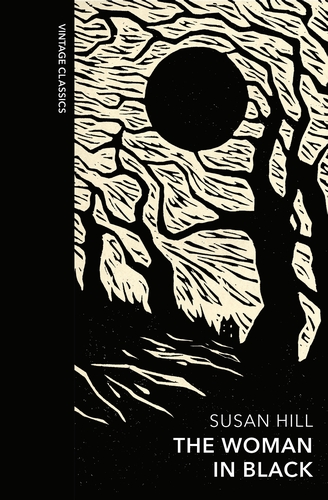
10 The Woman in Black by Susan Hill (1983)

One of the true masterclasses in haunted house fiction. This story of a trainee lawyer, during whose weekend sojourn to the lonely coastal edifice that is Eel Marsh House, where he needs to sort out some papers, he faces constant and malicious harassment by the spirit of an embittered former resident, has to be read to be believed. Once again, subtlety is the key. There are few flashes and bangs in in this Gothic bone-chiller, but the sheer hostility of the main antagonist emanates from every page, while the sense of loneliness and isolation is unbelievably oppressive. Again, if you’ve already seen the stage or screen versions, I still urge you to read this book, which as well as being an extraordinarily frightening ghost story, is an intriguing mystery too.


BOOKS I’VE YET TO READ …

(As blurbed by their publishers)

1 Wylding Hall by Elizabeth Hand (2015)


After the tragic and mysterious death of one of their founding members, the young musicians in a British acid-folk band hole up at Wylding Hall, an ancient country house with its own dark secrets. There they record the classic album that will make their reputation but at a terrifying cost, when Julian Blake, their lead singer, disappears within the mansion and is never seen again. Now, years later, each of the surviving musicians, their friends and lovers (including a psychic, a photographer, and the band’s manager) meet with a young documentary filmmaker to tell his or her own version of what happened during that summer, but whose story is the true one? And what really happened to Julian Blake? 

2 How to Sell a Haunted House by Grady Hendrix (2023)


Every childhood home is haunted, and each of us are possessed by our parents.

When their parents are both killed in a car accident, Louise and Mark Joyner are devastated but nothing can prepare them for how bad things are about to get. The two siblings are almost totally estranged, and couldn’t be more different. Now, however, both with equally empty bank accounts, they don’t have a choice but to get along. Their one asset? Their childhood home. They need to get it on the market as soon as possible because they need the money. Yet the house has morphed into a hoarder’s paradise, and before they died their parents nailed shut the attic door ...

Sometimes we feel like puppets, controlled by our upbringing and our genes. Sometimes we feel like our parents treat us like toys, or playthings, or even dolls. The past can ground us, teach us, and keep us safe. It can also trap us, and bind us, and suffocate the life out of us. As disturbing events stack up in the house, Louise and Mark have to learn that sometimes the only way to break away from the past, sometimes the only way to sell a haunted house, is to burn it all down

3 A House with Good Bones by T Kingfisher (2023)


In this ordinary North Carolina suburb, family secrets are always in bloom.

Samantha Montgomery pulls into the driveway of her family home to find a massive black vulture perched on the mailbox, staring at the house.

Inside, everything has changed. Gone is the eclectic warmth Sam expects; instead the walls are a sterile white. Now, it’s very important to say grace before dinner, and her mother won’t hear a word against Sam’s long-dead and little-missed grandmother, who was the first to put down roots in this small southern town.

The longer Sam stays, the stranger things get. And every day, more vultures circle overhead …

4 The Night House by Jo Nesbo (2023)

In the wake of his parents’ tragic deaths fourteen-year-old Richard Elauved has been sent to live with his aunt and uncle in the remote town of Ballantyne.

Richard quickly earns a reputation as an outcast, and when a classmate named Tom goes missing, no one believes him when he says the telephone booth out by the edge of the woods sucked Tom into the receiver like something out of a horror movie.

No one, that is, except the enigmatic Karen, who encourages Richard to pursue clues the police refuse to investigate. He traces the number to an abandoned house in the woods. There he catches a glimpse of a terrifying face in the window. And then the voices start.

When another classmate disappears, Richard grapples with the dark magic that’s possessing Ballantyne to try and find them before its too late ...

5 The House of a Hundred Whispers by Graham Masterton (2021)


All Hallows Hall is a rambling Tudor mansion on the edge of the bleak and misty Dartmoor. It is not a place many would choose to live. Yet the former Governer of Dartmoor Prison did just that. Now he’s dead, and his children - long estranged - are set to inherit his estate.

But when the dead man’s family come to stay, the atmosphere of the moors seems to drift into every room. Floorboards creak, secret passageways echo, and wind whistles in the house’s famous priest hole. And then, on the same morning the family decide to leave All Hallows Hall and never come back, their young son Timmy disappears - from inside the house.

Does evil linger in the walls? Or is evil only ever found inside the minds of men?

6 The Spite House by Johnny Compton (2023)

Eric Ross is on the run from a mysterious past with his two daughters in tow. Having left his wife, his house, his whole life behind in Maryland, he’s desperate for money - it’s not easy to find steady, safe work when you can’t provide references, you can’t stay in one place for long, and you’re paranoid that your past is creeping back up on you. When he comes across the strange ad for the Masson House in Degener, Texas, Eric thinks they may have finally caught a lucky break. The Masson property, notorious for being one of the most haunted places in Texas, needs a caretaker of sorts. The owner is looking for proof of paranormal activity. All they need to do is stay in the house and keep a detailed record of everything that happens there. Provided the house’s horrors don’t drive them all mad, like the caretakers before them. The job calls to Eric, not just because there’s a huge payout if they can make it through, but because he wants to explore the secrets of the spite house. If it is indeed haunted, maybe it’ll help him understand the uncanny power that clings to his family, driving them from town to town, making them afraid to stop running.

7 Slade House by David Mitchell (2016)


Turn down Slade Alley - narrow, dank and easy to miss, even when you’re looking for it. Find the small black iron door set into the right-hand wall. No handle, no keyhole, but at your touch it swings open. Enter the sunlit garden of an old house that doesn’t quite make sense; too grand for the shabby neighbourhood, too large for the space it occupies.

A stranger greets you and invites you inside. At first, you won’t want to leave. Later, you'll find that you can’t.

This unnerving, taut and intricately woven tale by one of our most original and bewitching writers begins in 1979 and comes to its turbulent conclusion around Halloween, 2015. Because every nine years, on the last Saturday of October, a ‘guest’ is summoned to Slade House. But why has that person been chosen, by whom and for what purpose? The answers lie waiting in the long attic, at the top of the stairs ...
 
8 Hare House by Sally Hinchcliffe (2022)

Hare House is not its real name, of course. I have, if you will forgive me, kept names to a minimum here, for reasons that will become understandable ...

In the first brisk days of autumn, a woman arrives in Scotland having left her job at an all-girls school in London in mysterious circumstances. Moving into a cottage on the remote estate of Hare House, she begins to explore her new home. But among the tiny roads, wild moorland, and scattered houses, something more sinister lurks: local tales of witchcraft, clay figures and young men sent mad.

Striking up a friendship with her landlord and his younger sister, she begins to suspect that all might not be quite as it seems at Hare House. And as autumn turns to winter, and a heavy snowfall traps the inhabitants of the estate within its walls, tensions rise to fever pitch.

9 Home Before Dark by Riley Sager (2021)


What was it like? Living in that house.

Maggie Holt is used to such questions. Twenty-five years ago, she and her parents, Ewan and Jess, moved into a rambling Victorian estate called Baneberry Hall. They spent three weeks there before fleeing in the dead of night, an ordeal Ewan later recounted in a memoir called House of Horrors. His tale of ghostly happenings and encounters with malevolent spirits became a worldwide phenomenon.

Now, Maggie has inherited Baneberry Hall after her father’s death. She was too young to remember any of the events mentioned in her father’s book. But she doesn’t believe a word of it. Ghosts, after all, don’t exist.

But when she returns to Baneberry Hall to prepare it for sale, her homecoming is anything but warm. People from the pages of her father’s book lurk in the shadows, and locals aren’t thrilled that their small town has been made infamous. Even more unnerving is Baneberry Hall itself - a place that hints of dark deeds and unexplained happenings.

As the days pass, Maggie begins to believe that what her father wrote was more fact than fiction. That, either way, someone - or something - doesn't want her here. And that she might be in danger all over again ...

10 The House Next Door by Anne Rivers Siddons (2007)

Thirtysomething Colquitt and Walter Kennedy live in a charming, peaceful suburb of newly bustling Atlanta, Georgia. Life is made up of enjoyable work, long, lazy weekends, and the company of good neighbors. Then, to their shock, construction starts on the vacant lot next door, a wooded hillside they’d believed would always remain undeveloped. Disappointed by their diminished privacy, Colquitt and Walter soon realize something more is wrong with the house next door. Surely the house can’t be haunted, yet it seems to destroy the goodness of every person who comes to live in it, until the entire heart of this friendly neighborhood threatens to be torn apart.


THRILLERS, CHILLERS, SHOCKERS AND KILLERS …

An ongoing series of reviews of dark fiction (crime, thriller, horror and sci-fi) – both old and new – that I have recently read and enjoyed. I’ll endeavour to keep the SPOILERS to a minimum; there will certainly be no given-away denouements or exposed twists-in-the-tail, but by the definition of the word ‘review’, I’m going to be talking about these books in more than just thumbnail detail, extolling the aspects that I particularly enjoyed (I’ll outline the plot first, and follow it with my opinions) … so I guess if you’d rather not know anything at all about these pieces of work in advance of reading them yourself, then these particular posts will not be your thing.

DARK TIDES 
by Chris Ewan (2015)

Outline
In most of western culture, Halloween Night is the scariest night of the year. The time when the worlds of the living and the dead are closest, when the dividing lines between the universe of light and the universe of darkness are thinnest. On the Isle of Man, however, it’s all that and a little more.

Hop-tu Naa is the Manx Halloween, a time when, if the rumours are true, there are much eerier things going on here than anywhere else in the UK. It’s a time for divination and fortune-telling for example, even for the passing of hexes.

For young Claire Cooper, a Manx native, this is all par for the course. She loves the dressing up and the turnip jack-o-lanterns. Until the Hop-tu Naa of 1995, when she is only eight years old, and her mother inexplicably disappears.

Dark Tides is basically the story of what happens next, told over several decades.

It’s not a linear tale. We bounce back and forth from when Claire is a child, to her teenage days, and eventually to her adulthood as an Isle of Man police officer. But always it’s Hop-tu Naa, and always we are embroiled in this same complex and deeply worrying mystery.

As the years roll by, Claire is increasingly convinced that her mother’s disappearance was the work of Edward Caine, her wealthy and singularly unpleasant employer. Claire didn’t like Caine from the off, finding him a cold, sneery presence, though she never felt the same way about his sickly son, Morgan, who seems to be all the things his father is not.

Forced to grow up without a mother, in the care of a father who has never been the same since his wife vanished, Claire eventually falls in with a rough but exciting crowd. Callum, David, Mark and Scott are more than just the local bad boys. At least a couple of them, Mark and David, are fanciable, and they get up to all kinds of enjoyable antics. Claire is initially brought into their company as a timid little mouse, but her sponsor in this is Rachel, the coolest girl at school, and pretty soon the two lasses are at the very heart of a lively gang who, as much as it’s possible on the Isle of Man, live life on the edge.

One game they play happens each Hop-tu naa, and involves a different member naming a new and elaborate dare, which they all must participate in. Of course, each year the dares get riskier and scarier.

One year, when they’re all older teenagers, Mark, who is now sweet on Claire (even though she mainly has eyes for David), dares them to take action against Edward Caine. Claire herself isn’t happy with this. She still hates and suspects Caine but compared to the others she is increasingly a straight-player and is very aware that Caine’s responsibility for her mother’s disappearance has never been substantiated. Mark advises her that, though the dare will involve them breaking into Caine’s property, there’ll be no violence, but that Caine will be absolutely scared to death and that it might even flush him out as the abductor (and maybe the murderer) of Claire’s mother.

Claire finally goes along with it but inevitably it doesn’t go according to plan. The supposed non-violent scheme turns very violent indeed. Terrifyingly violent even.

Years later, as a serving cop on the island, Claire is still haunted by the memories of that night. No one died, but ghastly injuries were inflicted, she and most of her friends only getting away with it because they were masked at the time, and because Mark – who was caught – kept his mouth shut.

Now a detective, and working routine CID cases, she doesn’t expect that she’ll hear anything about the incident again (or at least this is what she hopes, even though Mark is still in jail). Until, to her horror, another Hop-tu naa comes along and one of the original group is killed in what looks like a nasty accident.

Though it only looks like that to Claire’s fellow police officers.

To her, it looks like something else.

Some carefully concealed evidence actually suggests that her friend was murdered, though only Claire sees this because it relates directly back to that awful Halloween night when they were teenagers. Obviously, she can’t bring this to her fellow investigators’ notice for fear that it will rebound on her. And she is faced by exactly the same problem when the next Hop-tu Naa comes along and another friend dies, and so on for year after year.

They are now being butchered one by one. And still she can’t say anything about it. Though her own time is coming, she feels. She too will become a victim of this unknown killer. Either that, or she comes clean to her bosses, and faces long years in prison. The one option left is to catch the killer herself …

Review
The only real brickbat I have with Dark Tides concerns the many reviews of the book rather than the book itself. In the days leading up to reading it, I heard constantly how it draws on the unique customs and folklore of the Isle of Man. The fact that we were going to be talking about Hop-tu Naa rather than the standard Halloween seems to have impressed legions of reviewers, though to me, from my own reading at least, there doesn’t seem to be much difference between the two.

In addition, though the wild and woolly outcrops of the island are very nicely portrayed in this book, I never really felt as if Chris Ewan uses that remote hump of land in the middle of the Irish Sea to its best effect. The Isle of Man (or Mann, as is the correct name) is steeped in its own mythology. It’s a land of ghosts, faeries and bogey beasts, and though I wouldn’t expect any of that here – this is a crime novel after all, not a horror – there isn’t a strong hint of that esoteric flavour.

Though, as I say, this is more a criticism of the book’s many misleading reviews rather than of the book itself, because as murder mysteries go, this is a fine piece of work.

It veers a little towards the slasher end of the genre, which doesn’t bother me at all, in that the many killings are often depicted from the viewpoint of the killer – in movie terms it would be a POV camera with ‘heavy breathing’ soundtrack accompaniment – and nearly all are complex, gory and well-constructed set-pieces. It’s a bit ‘by the numbers’ in that we have a finite cast list who we realise from an early stage are going to get chopped one by one, and whatever protocols they take to protect themselves, we know the killer will continually be one step ahead and always able to find yet another ingenious and fiendish way to get to them. But that didn’t worry me either. It’s not exclusively a slasher trope anyway. Agatha Christie did the same thing with And Then There Were None back in 1939, and as in that original classic, Dark Tides provides convincing rhyme and reason for the mayhem, which we know will all be made clear in due course. It’s a traditional but timeless set-up for an absorbing thriller.

The characterisation is also interesting.

Chris Ewan set himself a difficult task here by jumping about between the decades and yet always dealing with the same bunch of people. That might be easily manageable if it was one or two, but here it’s six or seven, and yet he does it very effectively, keeping a tight rein on everyone. At no stage did I feel that any of the characters had veered off in an unbelievable direction, even though, as the years roll by, more and more slow-emerging facts add essential detail to their personalities and backgrounds.

Claire’s ongoing relationship with David in particular needed to be very deftly handled, not just because there’s a romance angle here, but because there’s a considerable degree of mystery too, and yet it completely satisfies.

Claire herself is a likeable heroine. In many ways a bit of an everywoman. A goodie two-shoes when she was a youngster and a police officer when older – so maybe that marks her out a little – but as a copper, not especially great at the job and not someone you feel is destined to go a long way in law enforcement. Which makes a nice change from the haggard, time-served detective who’s still able to run with the best.

This unremarkable nature is all the more compelling, of course, when you consider that, like her friends, Claire is harbouring a terrible guilt over a vicious act that she sleepwalked into and which was completely out of character for her, but which nevertheless had a serious outcome and at any time, even years and years later, could ruin her life. That would take some effort to deal with even for a more conventionally heroic lead, so the author has a lot of fun depicting Claire Cooper’s tortured struggles.

We don’t go immensely deeply into Claire’s other friends, but there is enough there, in all cases, to see them, to hear them, to believe in them.

That said, the book’s secondary characters provide a couple of bumps in the road. Claire’s police boss is a throwback to the ‘good old days’, a gruff wideboy who never plays by the rules and is, dare I say it, a little bit of a cliché. While Edward Caine, one of the main villains of the piece, is a cruel, creepy control-freak of a millionaire, who has no obvious redeeming features; another type that we’ve seen several times before (Mr Burns, anyone?). Again, though, they all fit neatly into the plot, and neither really grated on me.

Did it scare me, though?

Dark Tides was billed as ‘Truly chilling,’ by The Observer, as ‘A chilling read,’ by The Guardian, and as ‘a bone-chilling mystery’ by My Weekly.

Well … I’m afraid I can’t agree with those assessments, though there is one scene, which I won’t spoil for you, which I’d describe as a claustrophobe’s nightmare and personally found toe-curlingly horrific. But otherwise I suspect I’m immune to being scared by novels now, having read so much dark fiction.

Don’t be put off, however. Dark Tides packs enough pace and tension, and continues to ask such intriguing questions that it keeps you reading right through to its enjoyable climax, which you might just conceivably have seen coming, but which in my case at least was still a great way to wrap up a dark romp of a crime story.

Moreover, this one was a welcome change of scene for me. It was a relief to get way from the crime-ridden inner city or the bleak moorlands of Northern Britain. It was also refreshing that we weren’t seeing this series of murders through the eyes of an investigating copper, but from the perspective of a potential victim and someone so torn by their own nightmarish secrets that they are almost completely isolated. The sense of jeopardy was much higher as a result, and the overall experience infinitely more thrilling. An excellent autumn thriller all round.

You’ll be aware by now that I always like to end these book reviews with my own ‘just-for-fun’ casting session for those actors I envisage taking the lead roles, but today I’m making an exception. Most of the characters travel back and forth in time, from being young children to young adults, and visiting several stages in between. Even the most skilled and experienced casting director would find that a challenge, so imagine my pathetic chances.

(If anyone owns the scary house image at the top of this column, which I found floating around online, just give me a shout and I will happily post a credit, or will remove if that is required).

Wednesday, 20 September 2023

During dark days in the autumn of the year


Today, I’m delighted to be able to show off the stonking cover for my next historical novel, BATTLE LORD, which is out in January, and which as those interested may have guessed, is a direct sequel to USURPER, published last April. You’ll find that a few paragraphs down, where I’ll also give a brief intro to BATTLE LORD.

In addition this week, because I’m reminded with each passing day by the slowly turning weather and leaves, that we’re now into the last quadrant of the year, I’ll be giving another plug to my autumn novella, SEASON OF MIST (hopefully in an imaginative way, which will be more than just a straightforward advert), and in addition to all that, in the Thrillers, Chillers section, which you’ll find at the lower end of today’s post, will be reviewing and discussing Max Brooks’s terrifying tale of the Pacific Northwest, DEVOLUTION.

So, lots to get through today. But before anything else, as promised, here’s the jacket art for my next historical novel, BATTLE LORD, the sequel to USURPER, which will be published on January 8. I’m sure you’ll agree that it’s pretty damn eye-catching.

I’ll be talking a lot more about BATTLE LORD in the coming weeks and months, but very quickly for those who are intrigued already, it picks up only a couple of days after the point where USURPER ends, with 17-year-old Cerdic Aelfriccson, the sole surviving son of Earl Rothgar of Ripon, and one of the few English survivors of the battle of Hastings, now wounded, disoriented and riddled with despair. He is a prisoner of the Normans and already being mistreated to the very edge of death. However, Cerdic is determined to survive. Not only that; he is determined to win back everything he has lost.

His family’s home in Swaledale, in Northumbria, and their central fortification, Wulfbury, were captured by a splinter-group from the Viking army of Harald ‘the Hardraada’ Sigurdsson, a Norse leader of great renown. However, though the Hardraada was slain shortly afterwards at the battle of Stamford Bridge, those who captured Wulfbury still hang onto it, bent on making it the centre of their own Northern English powerbase.

Cerdic is already formulating a plan for their destruction, but first he must somehow get past this latest horde of invaders, the near-invincible army of William the Conqueror.

As I say, BATTLE LORD, though it’s available for pre-order right now, is only published next January, when it will be available in ebook, paperback and on Audible. If you like your medieval adventures red as raw meat, filled with blood and thunder, this one should be for you, though of course, if you haven’t tried USURPER yet, which is the first in the series, I strongly recommend that you make a beeline for that one straight away.

And now, on a somewhat different note, let’s dive into some …

Autumn chills

People who read a lot of my work may be aware that one of the pieces I’m most proud of is the novella, SEASON OF MIST, which was first published in the collection, WALKERS IN THE DARK, in 2010, (now long out of print) but was re-released as a stand-alone publication by Brentwood Press in 2019.

A horror/thriller set in 1974, it is partly autobiographical, and it follows the fortunes of a small group of school-age children in an industrial Lancashire town, who are increasingly convinced that the serial killer currently targeting the town’s young is an evil spirit resurrected from a nearby derelict coal mine, known simply as Red Clogs. (It is NOT, by the way, a story for child or YA readers).

Rather than rabbit on about the story itself (there are plenty of reviews online to take care of that), I thought that today it might just be fun to have a look at the season of mist itself, the autumn (or fall, to our buddies across the Atlantic), and try to work out what it is that induces this need in us (well … certainly in me) both to read and write scary stories.

However, what I’m not going to do is repeat myself by waxing lyrical about winter being ‘the dead time’, when even the land itself appears to be in the grip of malignancy (so obviously there must be ghosts and goblins about!), or ‘the dark time’, a tradition going back millennia, when, with the harvest collected and no real work to do until early spring, all there was left was to sit around the long-hall fire, drinking mead and regaling each other with tall tales.

Primarily, this is because I’m not talking about the winter, I’m talking about the autumn.

Now, okay, let’s not split hairs. Autumn is the gateway to winter. We all know that. But it’s in the autumn when the nights start lengthening, the vegetation withers, the mist rises and all of a sudden even a walk in the woods seems a lot creepier than it did a couple of weeks earlier.

Autumn has a flavour all of its own.

So, bearing SEASON OF MIST in mind, I thought I’d take a look at this time of year – to be specific, the months of September, October and November – from my own perspective, and try to work out what it is about that period that so inspires authors of dark and fantastical fiction.

To do this, of course, I’ve got to go back to the age before the internet. The reason is simple: in the world of mass media, the autumnal horror tradition has become the whole story. You can’t go online from mid-September onward now without seeing links and adverts plastered with jack-o-lanterns, ghost faces, skulls and witches. The retailers have got involved. Even here in the UK, we’ve now adopted the full-on, Americanised version of Halloween … and in some ways, more power to its elbow (I’m not going to try to pretend I don’t love it). 

But I’m not here today to talk about that. As I say, I’m looking at a time when we were NOT force-fed ghostly stuff at this time of year, to try and establish exactly what it was about the SEASON OF MIST (see what I did there: plug, plug … sorry, I’m as bad as the rest of them) that made it the natural home of the spook story. So, backwards we go now, to those long ago ...

Happy days

Well … I may refer to my childhood experience of the autumn in such terms, but the truth is that it wasn’t always happy. Not in early September.

Just think about it.

All those sun-soaked summer days of limitless pleasure, dressed only in shorts and t-shirts, riding your bikes along leafy woodland paths, going with your mates on the train to Blackpool or Southport, playing cricket or footy all day in the park, two piles of your packed lunches providing the goal posts. Only coming home after ten o’clock, because it was that late when the sun finally went down, but getting up again at the crack of dawn, because it was already broad daylight, and doing the whole thing again … and all without a worry in the world. But then, almost overnight, (and it was overnight, because one day it was August, and then suddenly it was September), you were going back to the world of school and homework, the weather worsening around your ears, the long dark nights drawing in, the green and pleasant land of your long, rambling summer holiday slowly and systematically obliterated.

That said, kids being kids, we didn’t let it get us down for long. Once the autumn got going, you automatically became aware that it had its own delicacies.

Looking back on it, there were some curious traditions. I remember that, during the early 1970s, it was always in or around September when we started to play marbles and trump cards. The obvious explanation is with the weather deteriorating, we kids were forced to find indoor distractions. Meanwhile, the other big autumn sport when I was young was conkers, which apart from the bit where you got rollocked by adults for battering the neighbourhood’s horse-chestnut trees with sticks and stones, was the best fun ever.

(I understand that kids are not allowed to play conkers anymore; I’m sure there’s a valid reason for this in the eyes of some, but frankly, the mind boggles. How can you have the autumn and not have conkers?)

Ultimately of course, conkers and marbles had nothing whatsoever to do with the spooky side of the autumn (I merely mention them to provide some period colour). Much more relevant to this post were the special events of the season, but not perhaps in the order some might expect.

For instance, during my childhood, the main festival at this time of year was not Halloween, but November 5, Bonfire Night.

Don’t get me wrong. We were aware of Halloween, and we did celebrate it, but Halloween parties in our day tended to be organised by kids themselves, with minimal adult involvement and almost no money spent, costumes usually homemade or improvised, and tin cans with faces cut into them standing in for pumpkins and turnips. 

But for Bonfire Night, things were different. 

That was the occasion when all the stops got pulled out, when you’d intone rhyming couplets about it at school – Remember, remember, etc – when your mum would get the black peas and the treacle toffee ready, when the gruesome safety adverts would fill you with genuine horror, and on the big night itself, when the sky would glitter with pyrotechnics, and everyone’s back yard was alight with blazing piles of timber, the air thick with gunpowder smoke and echoing to whistles and shrieks …

There were so many signs in autumn that all this excitement was approaching, even as early as September.

Fireworks started appearing in every corner-shop window. You could buy them individually in those days, not just in Government-approved boxes, and chucking bangers at each other was a very popular pastime, though much frowned-upon by parents and the authorities. Pyramid-shaped bonfires, or ‘bommies’, would sprout on every scrap of wasteland, each usually with its own quota of rubber tyres on top, and would be zealously defended by those who’d built them. 

But most relevant of all to today’s post, the penny-for-the-guy gangs materialised. Bunches of eager youngsters who’d shove their Guy Fawkes effigies from door to door in wheelbarrows, asking for money, or would wait in prominent places in town centres or on the corners of housing estates.

The Guys were very strange objects: straw or newspaper-stuffed mannequins, often wearing garish masks to cover the blankness of their real faces. There was invariably an air of the grotesque about these limp and ragged replicas of humanity, not least because you knew they represented an arch-traitor who had died a barbarous death, and because they themselves would shortly be consumed by flames, to the encouraging roars of a joyful crowd.

Did this feed into the eerie side of the season?

I personally think it did. I’ve already mentioned that we marked Halloween as well. The two celebrations were only a week apart, so often your Halloween stuff was stored in the same shed as your bonfire stuff. Lifeless dummies, ugly masks and dark, dingy clothing briefly became part and parcel of the season.

But don’t assume the rough-and-ready nature of these preparations spoiled anything. For example, the cheapness of the British Halloween in that era was often compensated for by the lack of adult supervision, which meant you could get away with an awful lot. Trick or treating could sometimes get out of hand, though the main advantage of having no mums or dads around was that you could up the stakes when it came to scaring the bejeezus out of each other.

The first time I ever heard the synopsis of The Exorcist was during one of our Halloween Night ghost story sessions – bear in mind that I was about 10 at the time – and as we were all sitting around in the darkness of some dilapidated garage on the edge of derelict industrial land, it scared me half to death. Equally, we improvised a range of terrifying games: Scream Inn, Slaughter in the Dark, Werewolf By Night, which were all designed to take advantage of the opaque blackness and drifting mist on evenings in the lonesome October.

That brings me to the other key factor: the way the environment subtly changed during the autumn.

The verdant landscapes of summer (even in Wigan we had some of those) slowly morphing into something distinctly more sinister, the sun-dappled greenery becoming hanging mats of decay, tides of fallen leaves obscuring the paths and footways, scabrous, fungus-riddled tree-trunks emerging from the lank, brown foliage. Even the air smelled different. It was colder, damper. Get out into the woods and wasteland, and there was a constant reek of mildew.

It was the perfect setting for horror stories and horror games. My particular group of friends, who, frankly, were significantly braver (or more reckless) than many others of our age, would venture far from the streetlights, probing into the shadow-filled ruins of collieries and factories, or along redundant railway lines where you literally couldn’t see your hand in front of your face, all the while telling each other more terrifying tales – about escaped lunatics and mass murderers, about the ghosts of long-dead, horribly mutilated pitmen still wandering the coal tips (yes, Red Clogs was a genuine legend of that time and place, a vengeful spectre who allegedly haunted every Lancashire colliery from Giant’s Hall, near where I lived, to Sutton Manor in St Helens), or about Nanny Green Teeth, who swam the flashes and canals looking to drown unwary youngsters, and even the Pendle Witches, whose evil souls still rode the high winds, screeching with angry glee.

But even if we hadn’t been of that inclination, the uncanny transformation of the land would have worked its spell on us, would have made us think dark thoughts whether we liked it or not.

Here’s a brief but hopefully appropriate snippet from SEASON OF MIST:

     In 1974, it was Dom’s suggestion that we hold the Halloween party in the garage at his house. That seemed like a good idea to me. It was separate from the main house, at the end of a secondary drive, and surrounded by thick evergreen shrubbery. It didn’t have any power connected to it, and even its wooden door, which was covered in flaking blue paint, had to be lifted manually to enable you to get inside. It also meant that we’d have to spend at least a few days around Dom’s house, sorting things out, and that might bring me back into the orbit of his sister, who I hadn’t seen for the best part of a month.
     I know it sounds ridiculous: on one hand excitedly planning a childish party, and on the other lusting for the attention of a shapely, dark-haired nineteen-year-old. But these juxtaposed emotions were real. I was on the cusp of manhood and didn’t realise it. We’d no idea that within a year we’d no longer be having Halloween parties in darkened garages, would have minimal interest in fireworks, and would view Christmas mainly as an opportunity to steal kisses from girls in class and sneak bottles of cider from our parents’ festive stock. Perhaps that’s one of the reasons why 1974 was one of the greatest and yet at the same time most terrible years of my life. I lived every moment of it with huge intensity, as though unconsciously aware that it was my childhood’s last fling. Even now, so many years later, I remember every sight and sound of that last autumn of innocence, every star-spangled night, every mist-wreathed woodland, every twisted shape watching coldly from the shadows …

That was the autumn of my childhood, which extended from the late-1960s to the late-1970s, and it may go some way to explaining why even now, at the age of 59, I still consider these later months of the year to be so satisfyingly scary. Even without the preponderance of Halloweenorama that now gets rammed down our throats on TV and online, they would have that same effect.

And I suspect I’m not the only one. Here, for your delectation, is a quick, off-the-top-of-my-head list of some of the best ghost and horror stories in which the autumn is a key player (all predating the huge Halloween retail operation that we see today). Check out:

The Fall of the House of Usher – Edgar Allan Poe
The Beckoning Fair One – Oliver Onions
Something Wicked This Way Comes – Ray Bradbury
The Guy – Ramsey Campbell
Eyes – Charles L Grant
The Black Pumpkin – Dean Koontz
Dark Harvest – Norman Partridge

And so on and so forth. Even after a quick experimental mind-scan, there are far too many to name, which is vindication of a sort, I suppose.


THRILLERS, CHILLERS, SHOCKERS AND KILLERS …

An ongoing series of reviews of dark fiction (crime, thriller, horror and sci-fi) – both old and new – that I have recently read and enjoyed. I’ll endeavour to keep the SPOILERS to a minimum; there will certainly be no given-away denouements or exposed twists-in-the-tail, but by the definition of the word ‘review’, I’m going to be talking about these books in more than just thumbnail detail, extolling the aspects that I particularly enjoyed (I’ll outline the plot first, and follow it with my opinions) … so I guess if you’d rather not know anything at all about these pieces of work in advance of reading them yourself, then these particular posts will not be your thing.

DEVOLUTION 
by Max Brooks (2020)

Outline
Thirteen months have passed since Mount Rainier, an active volcano in the Cascade Mountains, in America’s Pacific Northwest, erupted with devastating consequences. Among the many casualties recorded at the time was the majority of the population of Greenloop, a small town in a remote corner of Mount Rainier National Park, which was completely destroyed during the disaster. All of its occupants’ bodies were recovered later, with the exception of one, a certain Kate Holland, who has never been seen since.

When a local reporter is contacted by Kate’s brother, one Frank McCray, who tells him that the population of Greenloop didn’t die in a mudslide or from poisonous volcanic fumes, or anything of that sort, but in fact were murdered by a Bigfoot clan, having itself been displaced by the eruption, the newshound undertakes to investigate, first of all by studying Kate’s journal, but also by holding in-depth interviews with McCray himself and National Park ranger, Josephine Schell.

The narrative that follows has been cobbled together from these various sources, in addition to items drawn from earlier works of Bigfoot research, and it tells a terrifying tale …

When Kate Holland and her husband, Dan, first arrive in Greenloop, they find it a place of many inconsistencies. The creation of wealthy techno-czar, Tony Durrant, it is on one hand a site of communal living, a purpose-built, eco-conscious hamlet far out in the wilderness, allowing its residents to give up safely on urban living and get back in synch with the natural world (for example, its dwellings are environmentally-friendly cabins, its backup power resources courtesy of solar panelling and biogas generators), but at the same time it is entirely dependent on modern tech, everything here automated and controlled by apps on its occupants’ laptops, phones or iPads, while essential supplies are air-lifted in by drones and wi-fi delivered by fibre-optic cable. If that isn’t enough, Seattle, which is only 90 miles away, is easily reachable by the nearest highway.

On top of all that, Greenloop is an expensive place to live, only really available to moneyed academics who can afford to give up on the rest of the world. It doesn’t go uncommented on that folk like these, who’ve rarely, if ever, got their hands dirty doing real outdoors work, are likely to be among the least able to survive off the grid in the event of some kind of disaster. They don’t possess anything as useful as an actual tool, never mind a weapon, and they certainly lack the muscle-memory to use one.

In truth, it’s a pretence at ‘going green’ rather than the real thing, an elaborate form of virtue signalling, minus any actual hardship, but it would be untrue to say that life in Greenloop is not, in its unique way, quite attractive.

Kate Holland herself is very much a creature of the modern world, a hyper-stressed executive type, who is here to try and decompress, and with the aid of a journal, which her therapist insists she keeps in detail and regularly updates, is seeking to reorganise her entire approach to life.

She’d particularly like to fix her relationship with husband, Dan, though this feels as if it will be quite a challenge.

It’s through Kate’s journal that we follow her initial interactions with other Greenloop residents, all of whom are, in their different ways, well-heeled oddballs, none seeming to possess even the most basic life skills, with the exception of the acerbic artist Mostar, who, it gradually becomes obvious, has led a far more lived-in life than any of the others, including Kate and Dan.

Few of the residents really get on, but for the sake of peace, efforts to be civil to each other are mostly successful. However, when Mount Rainier erupts, it is a real and serious problem. The community, though undamaged by the fall-out from the volcano, find themselves completely cut off from the rest of the country. What’s worse, the Washington State infrastructure has been hugely disrupted, while wholesale civil disorder has broken out in Seattle, the sum total of which is that rescuers won’t be coming along any time soon.

Tony, the de facto leader of the community, even though he’s somewhat uninspiring in that role, suggests that they only need to sit tight and help will arrive at some point. Mostar, who we later learn was in the Balkans during the war of the 1990s, makes practical suggestions, not just about rationing food, but in terms of educating themselves in matters of basic maintenance. At first, the townsfolk respond constructively to the crisis, but gradually, as their isolation continues, the supplies diminish and conditions get harder, and people who, despite initial brief comradeship, really don’t like each other, soon start to display it.

To make matters worse, Kate increasingly suspects that some kind of hostile animal lurking in the woods nearby is taking ever greater interest in them. More and more evidence of this emerges, and when she is one day chased back into the compound by a huge apelike creature, she is drawn to the conclusion not just that Bigfoot is real, but that he’s here, finally driven out of hiding by the eruption.

Of course, no one believes her at first. Most likely she encountered a bear. Typical townie. How would she know the difference? But the beasts now encircling Greenloop are getting steadily bolder, and when the townsfolk start hearing blood-chilling, ape-like shrieks in the woods, and find their bins and compost containers ripped open, they realise that it isn’t just one enormous hominid they are facing here, but several. Eco-conscious retiree, Vincent Boothe, attempts to make contact, but is rewarded by a shower of heavy stones, which do massive damage and clearly illustrate that their as yet (mostly) unseen opponents are very antagonistic.

Still feeling that this is all some massive misunderstanding between species, Vincent volunteers to go out of town on foot and literally hike his way to civilisation. Mostar advises against this, but he won’t listen … and that night they are all wakened by his screams of agony. Despite Mostar’s warning that it’s a trap, Kate and Dan also risk venturing out.

All they find left of him is scattered meat and bone. Whatever the giant apes dined on previously has evidently now been denied to them by Mount Rainier. So, they’ve found something else to eat. The community thus defers to Mostar, who prepares it for war …

Review
Anyone who knows their great apes knows they are not to be trifled with. Once you are out there in the wild, our closest relatives on the evolutionary scale can be our most dangerous enemies. Intelligent, ferocious, incredibly strong and aggressively tribal, the ape and monkey species of the world can pose a very serious threat to any human who, intentionally or otherwise, wanders into their domain. This is a fact of life as we know it. But now imagine that they each stand to about eight or nine feet tall and weigh in at about 490lbs, and that you are deep in their territory but can’t get away because Nature has conspired against it.

This is the premise of Devolution, Max Brooks’ latest epistolatory horror-adventure. And it’s a genuinely terrifying one, even more so as the human enclave soon being encroached on by the sasquatch clan is weaker than you might normally find. This is the land of gun ownership, but they don’t have any guns. This is the land of the outdoorsman, but there are no outdoorsmen here. Greenloop is all about sustainable living, but it can’t sustain itself even for a week when its power has been cut.

As I worked my way through the first half of the book – which is a real ‘slow burn’, I have to say – all these facts were gnawing on me. It struck me from the outset that this deluded techno-hipster community was vastly more vulnerable than even its most enlightened member realised. That it was, in fact, ripe for the plucking. Of course, it only makes things worse that, even though the residents of Greenloop don’t know about it, we readers are well aware – because we’ve been told in advance – of the savage forces gathering in the encircling forest.

I found that idea alone intensely frightening. And it doesn’t get any easier the more the Greenloop residents realise what they are up against, because there is nothing they can do about it anyway. Nothing obvious, at least. When the battle commences, it’s every bit as violently one-sided as you would expect, though the humans increasingly show ingenuity and aggression of their own, slowly but surely evening the score.

And it’s this that makes Devolution more than just another scary creature-feature.

As with Brooks’ thumping first success, World War Z, the author, while he’s undoubtedly keen to tell a rattling good terror tale, is also interested here in how humanity would respond to such an assault (in effect, how quickly and effectively they could and would go to war). In the first book it was the world-scale response. In this one, it’s the world in miniature.

The Greenloop community comprises a diverse assortment of interesting characters, all with their own strengths and flaws. Some reviewers have accused Brooks of wasting time with this.

‘We know they’re all going to die anyway, so why bother building them up?’

But for me that’s missing the point. First of all, Brooks, as all good fiction writers should, is ensuring that these characters in peril are characters we care about. If they’re just blank sheets it won’t matter if they get torn apart. Secondly, and this I think is his real aim, he’s putting us – mankind – in the frame. It takes all sorts to make a human community, with the usual exception of deadly fighters and square-jawed heroes. Because let’s be honest, in how many communities in the world do those people actually exist? One response to Devolution has been to sneer at how ineffectual this bunch of latter-day middle-class hippies actually are, to laugh at how easily they are picked off by monstrous brutes with far lower intellects, to say smugly that this is the outcome of easy living and over-reliance on technology. But how many of the rest of us don’t fall into that same category? How many of the rest of us wouldn’t make it out of the wild woods alive if we were abandoned there, with or without the presence of giant, man-eating apes?

However, this isn’t a situation that will remain unchanged.

It’s a near certainty that humans, when they are under attack, will eventually counterattack. We are a notoriously belligerent race in our own right. We mastered the beasts when we had very little to fight them with save sticks and stones. So, in Devolution, the hominids don’t have it all their own way.

By this, I don’t mean to say that Max Brooks goes all The Hills Have Eyes on us. It’s not the case here that those who are seemingly innocent at the start of it eventually are so abused that they become abusers themselves. That said, they demonstrate a significant degree of devolution. Particularly Kate Holland, whose disappearance at the end of the narrative may not be down to the predators having dragged her off into the trees.

The big question is does it all work?

Well, for me the answer is a resounding yes, for various reasons.

Not all reviewers have appreciated the epistolary style, which, as I’ve already mentioned, was also used in World War Z, but for me it adds a classic horror vibe. The presence of Bigfoot in the North American backwoods is still a matter of debate. Is he there, or isn’t he? It’s an age-old mystery with its roots in Native American lore, a definitive answer still elusive thanks to the sparsity of hard evidence. And this novel simply adds to that.

Is Kate Holland’s journal for real? Did these things genuinely happen, or was she driven crazy by horror and despair at the deaths of her friends during a volcanic catastrophe? No certain answer is possible, so ultimately, along with all those bits of grainy film and curious late-night audio recordings we can these days check out on YouTube, it can never be anything more than yet another fragment of a clue, the authenticity of which can only be guessed at.

This also puts it in the category of ‘found footage’ horror, or perhaps ‘found text’, though that in itself is nothing new; it harks back to the classic days of Bram Stoker, HP Lovecraft and Weird Tales. However, it also serves a functional purpose. Though I strongly doubt that anyone could recollect conversations of days earlier so perfectly word-for-word that you could reproduce them in a diary and they’d read as smoothly as they do here, which is perhaps one overarching weakness of Devolution, I’m prepared to give leeway because I can’t help thinking that telling this story as a straight narrative, particularly as so much of the first half of it concerns Greenloop world-building, I can’t help thinking it would drag too much in the build-up.

All round, Devolution is a superior horror novel, a good old-fashioned monster story, with a strong Man v Nature subtext, which is particularly pertinent in this age, when we all unquestioningly support green issues, and yet should perhaps be cautious that we don’t get exactly what we wish for. It’s a wild world out there; we’ve conquered a lot of it, but it wouldn’t take much for it to conquer us back.

For once, I’m not going to bother with my homegrown casting choices for a movie version of Devolution, as Legendary Entertainment optioned it on publication, and, according to the Hollywood Reporter last year, had appointed James Ashcroft to direct (mockumentary style, by all accounts), and that trailers may hit the internet before the end of this year.

(As always, most of the artwork on this post has been snaffled while it was floating around on the Internet uncredited. However, the upright image of the autumn woodland was created by Johnny G. If any of the others would like to step forward, I will be delighted to credit them as well, or, if required, take the pictures down).