Wednesday, 26 April 2023

It's always a battle, but our books make it


I’m delighted to announce that today, my novel, USURPER, is published in paperback, on Kindle and on Audible. I’ve done a lot of talking about this over the last few weeks, and I’ve probably bored people to death with the endless numbers of excerpts and snippets that I’ve been posting on Twitter and Facebook, so today I’m going to let the book itself do most of the talking.

I’ll say one or two minor things, and then I’ll be posting a short video of me reading what I hope is a brief but juicy extract from the book (yeah, you’ll be getting the glory of me in person as well), so you can actually hear how it sounds and won’t just have to take my word for it.

There’s other book news to share today too, and that will move us away from the historical adventure milieu where USURPER dwells, back into the realm of suspense/horror, which I know is close to the hearts of a lot of people who check in here. That also means it’s okay for me to review another dark thriller this week, which I will be doing, though this one has got a bit of history (of a sort) attached to it as well (see what I did there?).

It’s THE GIRLS by Emma Cline, a very compelling study of a murderous cult. It’s a work of grim fiction but based closely on infamous real-life incidents.


If you’re only here for the Cline chat, that’s fine as always. Just nip straight down to the lower end of today’s column, the Thrillers, Chillers section, where all my book reviews dwell.

In the meantime though, if you want to hear USURPER, read by moi, let’s roll with …

A dark and terrible past

I’m obviously chuffed to bits that USURPER is hitting the bookshelves today. As I’ve already said, you can get it either in paperback, Kindle or on Audible. I’m not going to say much more than that, though, because it’s time to let the book speak for itself. I’ll just quickly reiterate that it’s my first ever historical novel that doesn’t feature fantasy elements (it does feature horror, though it’s horror of the human variety rather than anything supernatural).

It’s set during the autumn of 1066, at the commencement of the Norman Conquest of England, and tells the story of Cerdic, a young Saxon noble, who loses everything during the firestorm that soon engulfs his country, including his home and family. Left lost and wandering in a once-happy, prosperous realm, which has now been reduced to a corpse-strewn wilderness, he must somehow find it inside himself to win back his birthright. But he’s had no training for that. He was destined for the Church rather than warriorhood. He hasn’t even got a sword. 

All he possesses is his will to survive, and to succeed, and he’s going to need both of these, because the alternative is a quick death courtesy of foreign steel, or the lingering torture of enslavement, starvation, mutilation, maybe even castration. With slaughters and massacres at every turn, there’s no hope of reversing this terrible tide of history, but Cerdic is determined that he won’t be a victim of it. He’s going to live, and reclaim what once was his, and if a further lake of blood must be shed in the process, he’s adamant that his own won’t be mingled with it.


As a footnote to this tale, you might be interested to know, especially if you live in the Lake District area, that I’ll be discussing USURPER with top crime novelist M.W. Craven at Waterstones, Kendal, on the evening of July 4. 

Mike will be presenting his new action thriller, FEARLESS, so we’ll have plenty to talk about and lots of blood and thunder notes to compare. The previous event Mike and I did together was a sell-out, so, if you’re interested, my advice is to get your tickets early. Get more info HERE (or pop into the store itself and enquire at the counter).

When fiction becomes myth

Here’s the other book stuff I promised to chat about today.

We all of us dream that there’s a place, somewhere out there, just out of sight, where, if we could only reach it, all our problems would be solved, and all our worries would whisper away like summer mist. It’s so close that we can smell it. But we just can’t get to it, and we know to our deep sadness and regret that we likely never will, not in this life.

Call it Heaven, call it Eden, call it the Blue Remembered Hills … or call it Neverland.
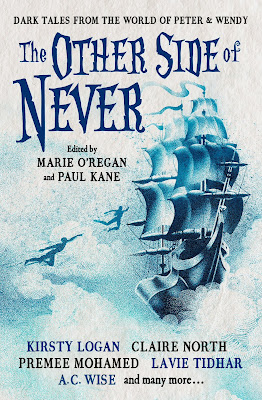
Because that is the theme, at least of my story, in the imminent new Titan anthology, edited by Marie O’Regan and Paul Kane, THE OTHER SIDE OF NEVER. I may have mentioned this in previous blogposts, but at last I can give a little more detail, as the editors have finally, officially released the Table of Contents. As you may have guessed, THE OTHER SIDE OF NEVER is a collection of short stories based on or drawing inspiration from the adventures of JM Barrie’s Peter Pan.

All the tales are new and exclusively fantastical and/or horrific and/or thrilling in nature (yep, I told you we were back into the world of dark fiction with this one). Here, for your delectation, is the full list of contributors.

Foreword by Jen Williams
A Visit to Kensington Gardens by Lavie Tidhar
Manic Pixie Girl by AC Wise
Fear of the Pan-Child by Robert Shearman
And On ’til Morning by Laura Mauro
The Other Side of Never by Edward Cox
The Lost Boys Monologues by Kirsty Logan
A School for Peters by Claire North
Chasing Shadows by Cavan Scott
Saturday Morning by Anna Smith Spark
The Land Between Her Eyelashes by Rio Youers
Boy by Guy Adams
Never Was Born His Equal by Premee Mohamed
The Shadow Stitcher by AK Benedict
A House the Size of Me by Alison Littlewood
Silver Hook by Gama Ray Martinez
The Reeds Remember by Juliet Marillier
No Such Place by Paul Finch
Far From Home by Muriel Gray

I’m sure you’ll agree that there are some very august names on there. All these years on, I never take it for granted, appearing in rollcalls of this magnitude. I obviously can’t talk about any of the other stories, not having read the book yet, but my own tale, No Such Place, is set in the smoggy ruins of post-war London, and follows the fortunes of a veteran-turned-murder detective, who finds himself on the trail of a very real group of lost boys.

And that’s all I’m going to say about it, except to add that THE OTHER SIDE OF NEVER is published on May 9. Ah yes, it’s only two weeks before you can go and grab it off a bookshelf somewhere (or alternatively, get your pre-orders in right now).

See you soon.


THRILLERS, CHILLERS, SHOCKERS AND KILLERS …

An ongoing series of reviews of dark fiction (crime, thriller, horror and sci-fi) – both old and new – that I have recently read and enjoyed. I’ll endeavour to keep the SPOILERS to a minimum; there will certainly be no given-away denouements or exposed twists-in-the-tail, but by the definition of the word ‘review’, I’m going to be talking about these books in more than just thumbnail detail, extolling the aspects that I particularly enjoyed (I’ll outline the plot first, and follow it with my opinions) … so I guess if you’d rather not know anything at all about these pieces of work in advance of reading them yourself, then these particular posts will not be your thing.

by Emma Cline (2016)

Outline
Evie Boyd is an uninspired and uninspiring California woman, middle-aged and drifting between jobs and relationships. While house-sitting for a friend, Dan, she meets his teenage son, Julian, who prides himself on being a drugs courier for local dealers, and his sad, rather needy girlfriend, Sasha. 

When Julian remembers that Evie was once part of a notorious hippie cult, whose crimes made national headlines, we are projected back to the summer of 1969, when Evie was only 14 and already something of a lost soul.

The summer vacation has just started, and Evie doesn’t know how she’s going to get through it, especially as she is bound for boarding school when it’s over. Her home life, while wealthy (her late grandma a former Hollywood actress), is unsatisfying, while her parents, who are newly separated, rarely connect with her on an emotional level. Evie is aware that social change is going on elsewhere, but as a young teen has no real interest in any of that. In fact, her mother’s many New Age interests, all very expensive of course, evoke pity in her rather than enthusiasm, because she views them as pointless middle-class fads. As such, she hangs around a lot with her friend, Connie, a typical soon-to-be high school kid, who is mainly interested in gossip magazines and beauty products, and moons after Connie’s older brother, Pete, who already has a girlfriend, the gorgeous Pamela.

Thoroughly bored and annoyed at the way Pete is nice to her because he thinks her a kid, Evie is then fascinated to spot some ragged teenage girls behaving recklessly in the town centre, dumpster-diving for food and exposing their breasts for their own amusement. A black-haired girl in particular, the seeming leader of the group, really catches her eye. A short time later, after Evie and Connie fall out, Pete having left home with the pregnant Pamela, and Connie, somewhat irrationally, blaming her friend, Evie meets the black-haired girl again, and this time buys some toilet paper for her after she is caught trying to shoplift.

The girl, who’s called Suzanne and drives around with the others in a scruffy black bus, enters the narrative a second time after Evie, having fallen out with her mother, rides off on her bike and gets marooned when the chain breaks. This time, Suzanne takes her back to ‘the ranch’ where she and the others, having rejected the phoniness of ordinary life, live in a hippie commune. In truth, the place is a filthy hole, rubbish everywhere, the children unwashed brats, every possession looking as if it was scavenged or stolen. However, the girls, Suzanne included, are captivated by their leader and guru, a wandering musician called Russell Hadrick, who seems to have mesmerising powers of persuasion and espouses numerous revolutionary philosophies. Evie isn’t quite so enthralled by him, especially as almost the first thing he has her do is give him oral sex, but Suzanne is, and Evie is strongly attracted to Suzanne, so she joins the group as a kind of associate member.

She visits regularly throughout the summer, always telling her mother that she’s staying with Connie, and gradually getting to know other members, the oafish Donna, the pretty Helen. Russell remains a mystery to her – he has immense charisma, that is certain, and he can make damaged people feel good about themselves, and more importantly, wanted – but she doesn’t really care about Russell as long as she can be close to Suzanne.

There are many warning signs: the group talks a lot about love, but gets about by using multiple stolen credit cards; there is rampant drug abuse; the children in the commune are being raised in conditions of dirt and neglect; while the girls are all expected to provide either sex, or a waitressing/cleaning service for Russell, his brawny henchman, Guy, the occasional bikers who roll in, and Mitch Lewis, a successful guitarist and singer so besotted by the ‘California myth’ of freedom and irresponsibility that he too has been seduced by the group’s lifestyle. Evie sees all these problems for what they are but ignores them because this unconventional world is different from anything she’s been used to and because, if nothing else, she gets a feeling of belonging here. She even steals money from her own mother to provide for the group’s needs.

Only on one occasion does Evie get physical with Suzanne, and this occurs when Russell, trying to persuade Mitch to secure him a record deal, ‘rewards’ the guy by sending Suzanne and Evie back with him to his expansive seafront property. They indulge in a threesome, which Evie doesn’t enjoy especially, though mainly because of Mitch, who’s pleasant enough but a total stoner. A short time later, still ready to do anything Suzanne asks of her, the two of them break into Evie’s mum’s neighbours house, but Evie is spotted and recognised.

Sent to live with her father as punishment, Evie makes friends with Tamar, his much-younger girlfriend, but eventually realises that Tamar is interested only in getting what she can from her wealthy lover, and so hitchhikes back to the ranch. A nerdy guy from Berkeley, called Tom, drives her the last part of the way, but is appalled at the state of the place and the people who live there, and asks her to come away with him. Evie refuses but recognises that there is now a bad atmosphere in the group. It seems that Mitch has told Russell once and for all that the record company won’t take him on as an artist, and has cut ties. Russell, furious, has been harassing him and talks of nothing but revenge.

That very night, it seems, Suzanne, who still idolises Russell, is setting out with some of the others on a mission, the purpose of which she won’t divulge. When Evie begs to come along, Suzanne reluctantly agrees, but tells her to ‘wear dark clothes’ …

Review
The Charles Manson story has been done to death, but never quite like this. Because this is the version that looks at it from the perspective of his acolytes, or at least from one of them, an adolescent girl coming of age in a tumultuous era, though not really aware of that as the struggle to make the shift from infancy to adulthood is overwhelming enough.

Obviously, in The Girls, we are not talking about the Manson Family per se. But rather, a very similar group of mostly female hippie cultists centred around a highly manipulative male leader, and the path they eventually take, which leads to a horrific mass-murder.

With hindsight, we all know what an imposter Charles Manson was. An intelligent but hardened criminal, he had great powers of persuasion and control, and when he came out of prison in 1967, after serving half his 32 years behind bars, and found himself in California in the Age of Aquarius, it was like unleashing a fox into the henhouse. Within a year, he’d recruited a band of willing followers, many of them young women with emotional difficulties or lost and confused by the rapidly changing times.

Delighted by the ‘free love, free drugs, free everything’ mantra of the hippie movement, Manson, fully adopted the guise of the counterculture and created a commune based on principles of equality, sharing and love. He wasn’t the only one to do that, of course. On every streetcorner in San Francisco’s Haight-Ashbury there were spaced-out people with flowers in their hair, strumming guitars tunelessly and singing strange songs. The difference was that in Manson’s case, it was a façade from behind which his female acolytes could prostitute themselves, prowl for new recruits, deal drugs, steal, and provide him and his friends with sex on demand. Above all though, the group’s main objective was to secure for their sage, who at heart was a frustrated musician, a lucrative record deal. When that failed, Manson’s coked-out buddy, Dennis Wilson of the Beach Boys, having provided no assistance, the cult leader’s true nature burst through … and the infamous Tate-LaBianca murders were the outcome.

As I say, we are not in this exact territory, but we are very close, Emma Cline, in this, her dazzling debut novel, inventing a near-identical scenario and populating it with imaginary characters, though I reiterate, it’s the women she’s mainly interested in. Two in particular. Evie Boyd, who we’ve already met, an immature and directionless seeker, typical of the sort the real-life Manson preyed on, and the much more ‘together’ Suzanne.

Of all the characters in this novel, Suzanne most closely resembles her real-life 1960s counterpart, Susan Atkins (aka Sexy Sadie). She obviously shares a first name with the original, but her physical description is similar too. Likewise, she is unquestioningly loyal to her leader, (the original Susan Atkins, in a bizarre recreation of Mary Magdalene’s second encounter with Jesus, is said to have fallen down on first meeting Manson and washed his feet with kisses), performs a ‘sergeant-major’-type role within the group itself, and is the one who’ll take the lead when the final bloodbath commences.

Suzanne is the first member of the group whom Evie sees, she is the first one she actually meets, and the first one she converses with. Even when she is finally introduced to Russell Hadrick and he attempts to weave his personal mysticism around her (as well as demanding an immediate act of fellatio), it is Suzanne whom she remains intrigued by, because, while she maybe doesn’t trust Hadrick, Suzanne is the kind of freewheeling, independent spirit that Evie herself desires to be.

Almost from the start, a ‘puppy love’ relationship exists between the two girls, even though Evie is only fourteen and Suzanne not yet twenty, the younger one attracted to the older one sexually as well as intellectually, though she is too inexperienced to work out exactly what this means. One thing Evie does know is that her home-life doesn’t satisfy her. Her mother is a bored rich woman, more interested in getting something – anything! – from her cool new hobbies than in her daughter, while her best friend, Connie’s main ambition is to be a hot chick, who when she’s old enough will appeal to moneyed guys.

Compared to these two living, breathing examples of utter vacuousness, Suzanne is the real deal.

The common sense side of me would have argued at this point that I didn’t buy it. That even someone like Evie, whose life is so spiritually dysfunctional, would not have been so easily seduced by what this cult appears to be offering, especially as Emma Cline doesn’t stint in describing the filth and degradation that awaits her in and around the ranch, and even more especially as she’s unimpressed by Russell Hadrick himself.

I might have dismissed the whole idea out of hand … if it hadn’t happened in history.

In the actual Manson trial, members of the group like Linda Kasabian, who either gave evidence against the murderers or wrote about it later in books and magazine articles, described various very innocent people, euphoric about the changing times but with judgement fuddled by drug use and the prospect of the hippie Nirvana that Manson and his ilk promised, simply giving up lives of privilege and becoming little better than brainwashed slaves.

You can’t deny facts.

But even if none of this had happened for real, The Girls is written with such intensity of feeling and a narrative drive that makes you want to keep reading even though you kind of know how it’s going to end, that it all feels completely plausible.

On that same note, the lack of the actual ’60s in this book adds genuine authenticity, which is all the more remarkable given that Emma Cline, only 26 when she wrote it, was born in 1989. I, on the other hand, was a youngster in the 1960s. I remember it well, and yet at no stage did I think ‘Wow, this is the ’60s, man!’ Wherever I turned, I didn’t see 1960s-type things happening. For most ordinary folk, it was just everyday life.

Cline gets that completely in The Girls, though of course the turbulent age isn’t that important to Evie Boyd’s reminiscences anyway.

If I’ve any brickbats to throw at The Girls, it’s a minor concern I have with the wraparound narrative, wherein the older, listless and mostly uninteresting person that is the middle-aged Evie, spotting a like-minded lost soul in Sasha, whose boyfriend already thinks it’s cool to be on the edge of serious criminality, needs to make a decision about whether or not to offer words of experience.

The problem with this is that, quite early on in the book, it shows us that Evie will emerge unscathed from the final horror (bear in mind that only one of the real Manson murderers has ever been released from prison, and it wasn’t Susan Atkins, who died while incarcerated way back in 2009).

There are several reasons for Cline’s decision to do it like this, I suspect. Firstly, the way it plays out (but no spoilers here, so don’t ask), to give Suzanne a final shot at redemption. Secondly, to point up the unchanging nature of troubled adolescence and perceived empty futures. And thirdly, to remind us that The Girls isn’t really a mystery-thriller, but more a study of the human condition at that time of life when it’s most vulnerable. But I still think that some element of uncertainty about Evie’s fate might have served it better.

For all that, The Girls gets my strongest recommendation. It’s blisteringly well-written, and completely engrossing, which is a real achievement considering the well-known tale it is based upon. It’s no surprise that Emma Cline’s star is rising so fast. You’ll definitely read it and want more.

A movie adaptation of The Girls is supposedly in the works, but after an (admittedly shallow) dive in search of it, I haven’t been able to find any such project green-lit at this stage. So, on the basis that casting operations have yet to commence, here are my suggestions:

Evie – Millie Bobby Brown
Suzanne – Zendaya
Russell – James Franco
Mitch – Chad Michael Murray


Sunday, 16 April 2023

In a land and time where life had no value


I’m on the verge of breaking into completely new territory, and frankly, it’s leaving me nervous.

My first real historical novel, USURPER, is published in 10 days' time. Yes, I can count it now in days rather than weeks or months. Today, I’m going to be talking a little more about this book – why I wrote it, why I’m nervous about it, and such. I’ll also be hitting you, as I do, with some of the rather splendiferous endorsements I’ve received for it from some of the true masters of the historical novel.

I also want to talk a little bit about two other books of mine, both of them medieval in atmosphere. They now belong firmly in my distant past, though their presence in my back-catalogue may explain why I continually say that USURPER will be my first REAL historical novel.


In addition to all this, and there’s no link to any of the other subjects I’ll be discussing today (except maybe that one of my older medieval books concerned a war against the undead!!!), I’ll be reviewing Edward Lee’s blood-soaked horror novel, BRIDES OF THE IMPALER.

If the Lee review is the only reason you’re here, you must feel free to skip down to the lower end of today’s blogpost, where my reviews usually lurk (in the Thrillers, Chillers section). However, if you want to hear a bit more about USURPER, stick around and let’s …

Mine the past

I’m sure those who follow my fictional output will agree that USURPER, a historical adventure set during the Norman conquest of England, is a complete right-turn on my usual subject matter.

I freely admit that I’m much better known for my crime thrillers. And I should probably even add that, though there’ll be more historical novels to come, this does not signal any kind of permanent changing of the guard. I’ll continue to write thriller novels (and horror stories) hopefully for many years to come, and with luck, readers will see them published concurrently with my all-new period pieces.

However, the origins of USURPER probably need some explanation.

There’s no doubt that most of my thinking-time, the productive part of it anyway, is still wrapped up in worlds of contemporary darkness. What thoroughly unpleasant villainy can I dream up today? What scene of horror can I envisage in this blighted corner of Broken Britain?
 

Usurper is an action-packed, coming-of-age, adventure set against the upheaval and battles of 1066. Finch gives us Cerdic, a troubled hero thrown into the maelstrom of events outside of his control, and we follow him breathlessly as he deals with brutal Vikings, familial rivalries, unrequited love, invading Normans and more!
Matthew Harffy


But USURPER had to come from somewhere, right? It wasn’t just a one-off moment of inspiration.

It may surprise readers to know that, as a novel, it’s actually been a long time in gestation. I’ve been a huge fan of Dark Age and medieval history for ages. It’s always seemed to me that that era, especially here in Britain (that’s inevitable, I suppose, as it’s British history that I know about best), was born and bred for the telling of adventurous stories. I mean, you’re talking a landscape that was still mostly wild, a population that was thinly spread, a relatively ignorant society, much of which lay at the mercy of ruthless criminal elements, most of them fast-moving, many of them well-trained, a significant portion of them members of the ruling class itself.

In all honesty, the Wild West has got nothing on Medieval Britain.


Usurper propels the reader from the very first page through a dark and desperate age when Britons fought for their survival. Fearsome battles, believable characters, uncommon valour. A relentless page turner. 
David Gilman


Then of course, you’ve got the major events of history taking place – the invasions, the civil wars, the rebellions – causing huge political and cultural convulsions, leading to murder, mayhem and the destruction of land and property on a massive scale, with almost zero comeback against the perpetrators. No comeback that was lawful, anyway.

So, how could I, as a writer who enjoys pitting his characters against edificial evil, throwing them headfirst into a land where life seems to have no value at all, not want to get in on an act like this?

Thus was born USURPER.


The grim world of Anglo Saxon England is brought evocatively to life by master storyteller Paul Finch as he thrusts the reader deep into the cold and mud and blood of a country teetering on the brink of a devastating war for survival. Usurper is a must-read for any lover of history, capturing all the rich detail of a turbulent time and stitching it through with powerful emotion. 
Mark Chadbourn / James Wilde


It was almost a decade ago when I first hatched an idea about the teenage son of a great Saxon lord, who has lived an almost cossetted life thanks to the law, order and prosperity his father has brought to a remote corner of Edward the Confessor’s England, suddenly finding himself thrown out with the rubbish because the Norse army of Harald Hardraada has killed everyone he knows and loves and confiscated every last possession he once called his own, while the new Norman hegemony, maleficent in its triumph, has no time at all for the remnants of a culture they now plan to erase from history.


What kind of road back to normality can he find, this inexperienced lad? A kid who was actually training for the clergy and who had never picked a sword up in real combat, and yet now is friendless and lost in a devastated country he can no longer even recognise as his own?

I always knew there had to be a novel in that story. But for years and years, because I had many other commitments, all I could really do was sketch it down in note-form and knock out a few ideas, which I thought I might at some point be able to string together into an exciting narrative.


Finch has written an authentically blood-soaked historical epic to rank with the best.
Anthony Riches


And then came the pandemic, and the world seemed to stop. Now, don’t get me wrong. I had lots of work to do during lockdown. There were still books I was contracted to write, but gradually, because it dragged on for such a tediously long time, and because it had such a mammoth impact on the publishing industry, delaying book launches, delaying the associated publicity drives, delaying responses to even the most simple questions that a writer might routinely pitch to his/her publishers, I found myself with less and less that I actually needed to do.

Throughout this period, though perhaps inevitably, USURPER was on my mind. I began to see the long periods of inertia imposed by lockdown as an opportunity not just to catch up with some reading, but to do some speculative writing. And my proposed Saxon/Norman epic was top of that list.


With all the brutal power of a battle-axe to the head, Finch brings 1066 to life in new and vivid ways. Packed with blistering battle scenes and believable characters, this is a superb historical novel. 
Steven A. McKay


In almost no time – mainly because I’d been thinking about it for so long already – I’d written a 40,000-word chunk. It seemed to flow smoothly, but of course I was unsure. It was new territory for me after all. Not completely new, but I’ll talk about that later. So, I sent it off for a second opinion from my wonderful agent, Kate Burke, at the Blake Friedmann Literary Agency, and even though this was an unexpected submission, Kate got back to me amazingly quickly, and seemed delighted with it. Even though it was new ground for us, she said she was impressed enough to send it out … assuming I was happy to take a break from my normal contemporary thrillers and write this novel in full should someone be interested.

I certainly was. I didn’t expect the second half of this book to take me very long, because the first half hadn’t. Thankfully, the series of stop-start lockdowns we had to endure at the close of the pandemic was finally coming to an end, so I was hoping that things in the publishing world would speed up again, but I never would have imagined what happened next to happen so quickly.


An authentic and vivid depiction of life in England in 1066, and a brutal, blood-soaked thriller that will be loved by fans of Cornwell's Last Kingdom. 
Alex Gough


The first publisher the manuscript was sent to was Canelo, who accepted USURPER for publication almost by return post, but as two books rather than one, and to add icing to the cake, then commissioned an additional historical adventure series, a second duology, set later on, in the twelfth century, the details of which must at present stay under wraps.

It was a strange feeling, all of these exciting developments coming to fruition so quickly when this idea had been germinating in the back of my mind for so many years, and often was pushed out of memory range entirely by the awful events that were happening in the real world at the time (even on those occasions when I remembered I wanted to write it, it struck me that no one might want to read about an apocalypse in 1066 when we seemed to be going through another in 2020).

Anyway, all that is thankfully now over, and the long and short of it is that the first book in this new series, USURPER, Vol One in the Wulfbury Chronicles is published in paperback and on Kindle and Audible on April 27, and then you good people can judge for yourself whether it was worth all that effort. As I say, I’m a tad nervous because it’s completely new ground for me. But then, as you’ve hopefully already seen in this column, quite a few august names in the historical adventure fiction industry given it the thumbs-up. So, let’s see what the rest of you think.

Early trips back

I mentioned earlier that I’ve written a couple of medieval novels before. Well, I don’t want to waste too much of your time, so I’ll just quickly outline them here.

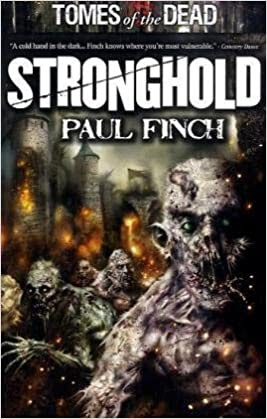
STRONGHOLD was published by Abaddon Books in 2010, and is a horror / fantasy / alternative history, which sees the outbreak of a zombie apocalypse in the 13th century. It follows the fortunes of a ruthless company of English knights, under the control of a merciless marcher-lord, who commit much repression in Wales in the days following the battle of Maes Moydog in 1295, and then take possession of one of King Edward I’s mighty castles, only for the local druids to make use of the fabled Cauldron of Regeneration, one of the Thirteen Treasures of Britain, to raise an army from all those slain by the English during recent atrocities. The besieged knights soon find themselves battling relentlessly against an apparently numberless horde of the undead.

Reviewers described it variously as ‘a very gory and bloody book, highly recommended’, as ‘fantasy military zombie porn - page after page of lavish description of the gruesome undead inflicting and receiving gruesome wounds’, and ‘a veritable dictionary of anatomical terms as body parts are skewered, severed, chewed and burnt in increasingly bizarre ways … It's all excellent fun delivered in the worst possible taste.’

So, I think you know what you’re getting with that one.

Then, also from Abaddon, we have DARK NORTH, published in 2012. This one was also a medieval fantasy rather than a medieval novel per se. It is set in Dark Age England, in this version called Albion, and instead of being a real-life scenario of hill forts, long-halls and muddy roads connecting small villages in otherwise trackless realms of forest, is basking in the Arthurian golden age, a landscape more reminiscent of the 14th century, full of lords and ladies, fairy tale castles and lush pageantry. However, the happy kingdom is now under threat from the reinvigorated Roman Empire, which, under the control of an aggressive new ruler, is determined to regain all its lost territories in Western Europe. A major war results, which provides the perfect cover for Sir Lucan, the Black Wolf of the North, one of the darkest characters ever to sit at the Round Table, to set off in pursuit of his wife, Trelawna, who abandoned him for a Roman officer, though he’s unaware that she’s now under the protection of the fearsome Malconi clan, who have the power to raise demons.

Reviewers described this one as ‘a heady mix of violence, intrigue and some good old-fashioned knight-on-a-reckless-mission action, oh and some monsters thrown in too - this is a cracker of a book,’ along with ‘knightly fervour and noble deeds meet ruthless empire-building at full tilt’.

Personally (though I’m admittedly biased) I think these short pitches sound great (and it doesn’t surprise me that STRONGHOLD spent a year or so under option for movie development), but I’ll be the first to admit that they aren’t traditional historical novels, though they’re still available to buy if anyone’s interested.


THRILLERS, CHILLERS, SHOCKERS AND KILLERS …

An ongoing series of reviews of dark fiction (crime, thriller, horror and sci-fi) – both old and new – that I have recently read and enjoyed. I’ll endeavour to keep the SPOILERS to a minimum; there will certainly be no given-away denouements or exposed twists-in-the-tail, but by the definition of the word ‘review’, I’m going to be talking about these books in more than just thumbnail detail, extolling the aspects that I particularly enjoyed (I’ll outline the plot first, and follow it with my opinions) … so I guess if you’d rather not know anything at all about these pieces of work in advance of reading them yourself, then these particular posts will not be your thing.
 
BRIDES OF THE IMPALER
by Edward Lee (2013)

Outline
No-one would know to meet Britt Leibert and Cristina Nicholl that they’d shared a terrible childhood. The former a high-ranking New York social worker, the latter a successful designer of creepy dolls, they are not just firm friends, they are also a pair of beautiful, sophisticated women, cultured, fashion-conscious and well regarded among the Manhattan elite. Even more impressively (to some at least), they are engaged to two partners in a Manhattan law firm specialising in property and real estate, and financially at least, the sky is the limit.

In all this, the two women have done incredibly well, because as juvenile foster-sisters they were subjected to horrific abuse at the hands of their so-called guardians, a depraved duo who are now serving life prison sentences.

They each handle this awful heritage in their own way, though their methods are to an extent self-evident, Britt working professionally to assist those suffering abuse in the present day, Cristina channelling the horror of her memories into the creation of her cute but macabre toys.

Aside from that, there are few clouds on their horizon. Husbands-to-be, Paul and Jess, are legal carnivores who think nothing of having basically conned the Catholic archdiocese out of a palatial townhouse (which Paul and Cristina now occupy), but that goes with the lawyer territory. Besides, while you don’t get the feeling these two men are instinctively loyal to their women, on the whole they are kind and loving.

At the same time, local Homicide detective, Hal Vernon, has gone from having relatively little to do in this affluent part of town to dealing with a ghastly crime in which a drug addicted prostitute was impaled on a sharpened broomstick mounted in a Christmas tree stand. There is little to go on except that the body has been written on with marker pen, arcane and indecipherable lettering inscribed in black, green and red. He soon comes to suspect a gaggle of homeless women who have been seen around the district, allegedly in the company of a curvacious nun (yes, you heard that right!), though no-one seems able to locate any of these curious characters when the police want to speak with them.

Meanwhile, things are not exactly hunky dory in Cristina’s life. One of her dolls was found in the pocket of the recent murder victim, which in due course will bring her into the police spotlight. But before then, she finds herself increasingly subject to erotic dreams and fantasies, which pumps her sex-drive up to the maximum – to the point where it begins to interfere with her everyday activities. What’s particularly worrying, though, is that many of these fantasies seem to involve a ravishing, sexually aggressive nun, whose vampire-like presence in Cristina’s new house, particularly in the cellar, where up until now she has ignored the strange inscriptions and the odd atmosphere, is increasingly tangible.

It probably isn’t giving too much away to say that this mysterious nun is, in fact, Kanesae, a subcarnate succubus who was formerly the lover of Vlad the Impaler. The homeless women, whom she has mesmerised and who are now committing numerous crimes on her behalf, including desecrating the local church and impaling yet more unsuspecting victims, are her coven – or, as they see it, her ‘convent’, she being their ‘New Mother’. Even the nervous Father Rawlins, a Catholic priest who lives close by, was once custodian of the building in which Cristina now lives, and who knows about the dangerous relics buried underneath it, is unsure what action he can take, if any. Because though it may all seem like a frenzied erotic nightmare – and yes, the priest is also affected by Cristina’s beauty and her increasingly wanton behaviour! – he knows perfectly well that the sum of these horrors, in the very near future, will most likely be the second coming of Dracula …

Review
I wasn’t sure what to expect when I picked up Brides of the Impaler.

Previously, I’ve been familiar with Edward Lee as a writer of extreme horror, a skilled wordsmith whose prose is often a delight and yet who nevertheless takes gruesomeness to new graphic levels which even a hardened horror-hound like me can sometimes find difficult to stomach. I should therefore state straight away that Brides of the Impaler is not like that. From the outset, it has the air of a traditional vampire story, focussing on magic, mystery and esoteric history rather than excessive violence. And Lee maintains that quaint atmosphere almost all the way through; it is strongly redolent of those latter-day Hammer vampire movies of the 1970s (though unfortunately not always in a good way, and a bit more about that shortly).

In this one, the vamps are seductive killers from the past, thoroughly wicked and immoral, regularly communing with the demonic, and now, having been resurrected through arcane rites, imposing their blasphemous, predatory ways on a modern society that has cheerfully done away with religious belief and is therefore completely unprotected. Very thankfully indeed, Lee has jettisoned all those embarrassing teenage notions about vampires being some tragic nobility of the night who want only to be loved.

It’s also a relief to see that we’ve moved away from Bram Stoker’s concept of Dracula. While there are some similarities here, such as the Lord of the Undead hailing from Eastern European aristocracy, having earned his vampire state as a punishment for evil deeds, Edward Lee is much more interested in the history of Vlad Tepes than he is Stoker’s fictional count. While Stoker plundered Wallachian history for little more than the name, Lee goes all out to give us a full-blooded ‘Impaler’ backdrop, weaving myth and fiction with fact (Kanesae, for example, appears in no actual records) to tell the vivid tale of a medieval despot driven to acts of horrific criminality through his perilous circumstances and finally embracing evil for its own sake because by then he’d gone too far to stop.

These ideas have been promoted before, of course, mainly by patriotic Transylvanians, who can’t stand the thought of their national hero being defamed as an irredeemable villain, but Lee doesn’t stint in his portrayal of Dracula and his mistress as being themselves despicable, the former a deranged individual ripe for exploitation by the Devil, the latter a scheming demoness with one role only, to create Hell on Earth.

With the actual narrative set in present-day Manhattan, you might think all this a tad anachronistic, but not a bit of it. When the streets are littered with the homeless and addicted, there are acolytes aplenty for the empowering vampire cult. With ruined buildings on every side, many connected by forgotten tunnels, there is a ready-made underworld by which the fiends can pass invisibly among us. With maniacs and weirdoes at large on a daily basis, what are a few impalement murders for the cops to deal with? With voracious, shark-like lawyers on the prowl, can’t New York already boast a ruling class of monsters who are just waiting to take charge?

It’s all very clever, and a fun romp to boot, filled with wonderfully macabre details (Cristina’s creepy line of dolls, for instance, which includes such splendidly ghoulish specimens as Leprosy Linda, Hypothermia Harriet and Gutshot Glen) and some great innovations on the general theme … like the homeless ex-prostitutes forming a convent of vampiresses under the guidance of a devilish Mother Superior, and hero Hal Vernon killing one of them by repeatedly shooting her, but only because his bullet holes form the shape of a cross.

At the same time, Lee pays homage to several of his horror heroes, lawyers Paul and Jess close in name to Spanish cult movie-makers, Paul Naschy and Jess Franco, while the Ketchum Hotel, which also figures in the narrative, reminds us of the late, great US horror author, Jack Ketchum.

Yes, it’s all good fun, but it’s not good clean fun. If there’s a downside to Brides of the Impaler, it’s the sex. Frankly, there’s far too much of it and it’s far too explicit. Admittedly, students of the genre may not consider that a major problem, but in a mainstream horror novel in the 21st century it jars badly. And, dare I say it, at times it almost seems juvenile.

To start with, all the females are heavily sexualised. Granted, our heroes and heroines have to be attractive, but it goes to a whole new level in this one. Cristina and Britt – and bear in mind that these two women were badly abused when they were children! – are a pair of stylish, sensual beauties who are repeatedly depicted having sex with their boyfriends, and regularly described as having cleavage exposed or going out minus panties, and who as Kanesae’s influence spreads – particularly where Cristina is concerned – become ever more sexually insatiable (to a point where it verges on the ridiculous).

Kanesae herself, meanwhile, is the ultimate throwback to 1970s Hammer, as I mentioned previously: a gorgeous, voluptuous succubus, who, just to add to the kink, wears a revealing nun’s outfit and uses sex at every opportunity to overwhelm both friend and foe alike.

And it doesn’t end there. Even the homeless women, though shown as emaciated, gap-toothed harridans with crusty hair and foul body odour, are frequently portrayed in a pseudo-sensual way, and shown to be experts at various sex acts. Even though this is supposed to be the influence of Kanesae, who destroys her victims’ souls as well as their bodies, it still feels tasteless to me. Even a middle-aged kindergarten teacher is referred to by the cops as ‘Bouncing Betty’ because she is so well-endowed, while we also hear repeatedly, for no gain, that a female student and a female security guard, both of whose main role in the book is to die unpleasantly, have similar advantages.

Brides of the Impaler was published in 2013, so Lee doesn’t have the same excuse that the latter-day Hammer horrors did (namely that it was the product of an unashamedly raunchy age) and even for a reader like me, who’s pretty easy-going, this seamy side of the book soon becomes repetitive and boring.

But this is the only real problem with the novel.

Overall, Brides of the Impaler is a time-honoured kind of vampire story given an effective and entertaining modern twist. As always with Lee, it’s excellently written, taking you straight into the heart of the modern city and yet convincingly underwriting it with an evil, supernatural netherworld. Hal Vernon as the affable, middle-aged cop makes a good-natured hero, while Cristina Nicholl, even if she’s completely oblivious to her overt sexiness, makes for an appealing and (relatively) innocent heroine. And I say it again, at least it takes us right away from these Goth/teenage vampire farces in which the dividing lines between good and evil are naively blurred. In that regard, this is a very welcome addition to the vampire fiction cycle.

As usual, I’m now going to attempt some fantasy casting just in case Brides of the Impaler ever gets put on film, though it won’t be easy given that we no longer have an Ingrid Pitt or Susan Denberg to play Kanesae. The only solution is to assume that the sex, or some of it at least, will be toned down a bit. On that basis, here we go:

Cristina Nicholl – Margot Robbie
Britt Leibert – Camille Belle
Paul Nasher – Kyle Gallner
Jess – Christopher Mintz-Plasse
Hal Vernon – Stanley Tucci
Father Rawlins – John Amos
Kanesae – Lena Gercke

Thursday, 30 March 2023

When swords and axes ruled the battlefield


For the next few weeks, we – as in Canelo Books and me – will be moving full tilt towards publication of my first ever serious historical novel, USURPER, published on April 27. I don’t want to give too much away, though by now, if you’ve been reading any of the advance material, it’ll be plain that the story is set during the autumn of 1066, against the backdrop of the dual invasion of England by both a Viking army and a Norman army at the same time.

If you’ve been checking things out online, you may have noted that the book has already accrued a number of glowing endorsements by some very respectable authors of historical action-fiction. Several comments I’ve received from these august wordsmiths have mentioned the battle scenes, which they appear to have appreciated greatly.

In honour of that, this week I thought I’d cast an eye over the ten best pre-industrial age battle scenes that Hollywood has thus far attempted. Please feel free to agree with my choices, or disagree, as you see fit, in the comments section or on Facebook, Twitter or wherever. In addition, on the subject of war, and bringing things forward somewhat worryingly close to our modern era, I’ll be reviewing Steve Alten’s sci-fi military epic, GOLIATH.


If you’re only here for the Alten review, that’s no problem. You’ll find it as always at the lower end of today’s column in the Thrillers, Chillers section. Just shoot on down there straight away. For the rest of you though, assuming you’ve got a spare moment or two, why not check out some of …


CINEMA’S GREATEST ‘SWORD AND SPEAR’ BATTLES

Again, just a bit of fun, this item. Something we can chat idly about over a brew. Basically, I’ve picked ten pre-gunpowder era battle scenes from movies I admire. But there are certain criteria I’ve imposed on myself. 

To start with, they can only be recreations of named battles that really happened in history. So, that rules out the likes of Lord of the Rings (2001/3), Game of Thrones (2011/19), Excalibur (1981), The Warlord (1966) and even the amazing opening sequence in Gladiator (2000), which was basically an amalgam of many battles and skirmishes fought by Rome’s frontier legions in the Danube region during the 170s AD rather than one single individual action.

I’ve also stipulated for myself that I can only call on battle scenes that made at least an attempt to be realistic. So unfortunately, that also discounts the battle of Thermopylae as portrayed in Zack Snyder’s 300 (2006), because artistically brilliant though it was, it owed far more to Frank Miller’s original graphic novel than actual history. 

Likewise, it sidelines Anthony Mann’s colossal epic of the Reconquista, El Cid (1961), as the real battle that drove the Berber horde back from the city of Valencia in 1094 was on the inland plains, not the coast, and even Mel Gibson’s multi Oscar-winning Braveheart (1995), which, while it recreated two major historical battles – Stirling Bridge (1297) and Falkirk (1298) – is infamous the world over for its lack of historical correctness (the Stirling Bridge sequence is stupendously blood-soaked, but it doesn’t even include a bridge).

As a final rule, the movies I choose should also have been made in the English language. Please don’t get on my case about that. Though in polite company I always discuss classic motion pictures like Alexander Nevsky (1938), Kagemusha (1980) and Red Cliff (2008) as if I know what I’m talking about, the truth is that I’m no expert on foreign films and it won’t pay to pretend that I am.

Okay … them’s the rules, as they say. In order of preference, let’s get cracking.

1. BATTLE OF SHREWSBURY (1403)
Chimes at Midnight, 1965


One of the greatest battles ever committed to celluloid, and all the more impressive because of its shoestring budget. Director/star Orson Welles condensed several of Shakespeare’s plays into this single account of the Northern Earls’ Rebellion, which threatened the stability of the entirety of mainland Britain. Shrewsbury was a bloody affair indeed, an estimated 12,000 dying on the field, Welles recreating it with incredible ingenuity, using swirling mist, flying mud, blood and splintered shields to mask his relatively limited numbers, yet it remains eye-poppingly intense.

2. BATTLE OF THE RIVER SELE (71 BC)
Spartacus, 1960


Everyone remembers the ‘I am Spartacus’ moment, but it wouldn’t have been as effective if it hadn’t come directly after the Battle of the River Sele, which in real life was fought upland and saw the heroic leader of the slave army confronted by three of Rome’s most proficient generals, Pompey, Lucullus and Crassus (with Julius Caesar in attendance as a junior officer). Hollywood legend Stanley Kubrick (still only 32) gave us one of cinema’s most realistic ever portrayals of Roman legionary tactics, and got up close and personal with burnings and hackings galore.

3. BATTLE OF JERUSALEM (1187)
Kingdom of Heaven, 2005


Though as a prelude to this massive engagement, the Christian army of Outremer suffered the greatest defeat in its history at the hands of Islam’s ablest general, Sultan Saladin of Egypt, at Hattin, it was the follow-up action at Jerusalem that caught the eye of regular epic film-maker, Ridley Scott. Though much maligned thanks to the incomprehensible truncated version of this movie released by the studio, the director’s cut remains a visual feast, and culminates in one of the most impressively mounted battles against a bastion that Hollywood has ever given us.

4. BATTLE OF GAUGEMALA (331 BC)
Alexander, 2004


Though poorly received overall, Oliver Stone’s Alexander rises to some memorable battles, and it’s fitting that one of the most important in the Ancient World is given such prominence. Briefly at least, the unending tussle between Greece and Persia was settled when Alexander pitted his numerically inferior but better trained army against the vast but mostly indentured forces of Darius III. The outcome was in doubt to the end, and Stone sticks to that narrative, emphasising the Macedonian king’s ability to make key strategic changes even in the midst of mayhem.

5. BATTLE OF AGINCOURT (1415)
Henry V, 1988


The scale of England’s victory over France in this most famous battle of the Hundred Years War is staggering even now. Henry’s hungry, dysentery-ridden 8,000 overcame the flower of French chivalry, who were closer to 30,000, laying 10,000 of them dead in the mud of that bitter October day, losing only a few hundred in return. It was a triumph for discipline over enthusiasm, for the longbow over plate armour. But Ken Branagh’s version doesn’t glorify any of it, those left alive on the corpse-strewn field at the end shattered husks of the men they’d been.

6. BATTLE OF EDINGTON (878)
The Last Kingdom, 2015


Though much of The Last Kingdom owes mainly to Bernard Cornwell’s imagination, in which most of the early English state’s best wins over the Vikings are attributed to his semi-fictional hero, Uhtred, rather than the real leaders, at least this TV adaptation’s version of Alfred the Great’s mightiest victory is as close as damn it to the true event. The hideous meat-grinder of two hefty shield-walls clashing repeatedly over piles of butchered corpses, so characteristic of Saxon and Viking age warfare, is captured perfectly in this brutal bloodbath of attrition.

7. BATTLE OF ORLEANS (1429)
The Messenger: The Story of Joan of Arc, 1999


Some may argue that Joan of Arc’s greatest triumph lay in her personal martyrdom for what she considered a holy cause, but in purely tactical terms, it was her defeat of the English forces entrenched in the fortified city of Orleans, which turned the tide of the Hundred Years War, so it’s perhaps no surprise that it took a French director, Luc Besson, to give us a committed and realistically workmanlike portrayal of this crucial military enterprise, in which all manner of medieval artillery is used, the English defences falling section by section as a direct result.

8. BATTLE OF KADESH (1274 BC)
Exodus: Gods and Kings, 2014


One of the earliest battles we have a written record of, Kadesh saw the celebrated pharaoh, Ramesses II, strike a heavy blow against Egypt’s great rivals of that era, the Hittites. Whether it belongs in a movie about Moses is another matter, but both Ramesses and Kadesh are referred to repeatedly in non-Biblical texts, and it seems entirely fair that Ridley Scott should have featured this epic struggle in his most religious movie. To add authenticity, he gives the Egyptian chariot force a leading role, for it was this mobile arm that swung the battle in Ramesses’ favour.

9. BATTLE OF LOUDOUN HILL (1307)
Outlaw King, 2018


Often overlooked for its bigger, noisier cousin, Braveheart, Outlaw King shows us the early days of Robert the Bruce, focussing on one of his first successes. Director David Mackenzie makes much more effort than Mel Gibson did to depict the era as it was, dispensing with any notion of Bronze Age face-paint and 16th century tartan, to tell a more emotionally and factually complex story, the whole thing culminating at Loudoun Hill, where the fighting, while it borrows some detail from the later victory at Bannockburn, is tactically accurate and appropriately grim and desperate.

10. BATTLE OF ASHDOWN (871)
Alfred the Great, 1969


The first major victory for an English army over the seemingly unstoppable Viking horde that invaded Britain in the mid-9th century. Alfred the Great, then only a prince, won the day by luring the overconfident Danes into an ambush, which was very neatly depicted in Clive Donner’s ‘warts and all’ 1969 account. And while the presence on the battle site of the Uffington White Horse is ahistorical – no one knows for sure whether the colossal figure was cut into the hillside before or after this war – it makes for a truly atmospheric location.


THRILLERS, CHILLERS, SHOCKERS AND KILLERS …

An ongoing series of reviews of dark fiction (crime, thriller, horror and sci-fi) – both old and new – that I have recently read and enjoyed. I’ll endeavour to keep the SPOILERS to a minimum; there will certainly be no given-away denouements or exposed twists-in-the-tail, but by the definition of the word ‘review’, I’m going to be talking about these books in more than just thumbnail detail, extolling the aspects that I particularly enjoyed (I’ll outline the plot first, and follow it with my opinions) … so I guess if you’d rather not know anything at all about these pieces of work in advance of reading them yourself, then these particular posts will not be your thing.


GOLIATH by Steve Alten (2002)

Outline
Tough and efficient female naval officer, Commander Rochelle ‘Rocky’ Jackson, is participating in ocean manoeuvres on board the USS Ronald Reagan when something unprecedented happens. Without warning, the US fleet, one of the most well-equipped and professionally managed fighting forces in the world, is attacked from below by Goliath, a US-developed, manta ray-shaped super-sub, a gigantic, futuristic undersea battle-platform armed with every kind of missile and torpedo, including multiple nuclear warheads.

It is a remarkably one-sided fight. The US fleet is totally destroyed, with Rocky Jackson one of the few survivors. Some 8,000 men go to watery graves.

Naturally, the world convulses in shock. Initially, the US military think the Chinese responsible, as it was the Chinese who acquired the blueprint for Goliath at an early stage due to the actions of senior engineer and former spec ops hero, Gunnar Wolfe. Wolfe, fearing an imbalance of power in the world, committed treason by handing over state secrets, and was subsequently sent to Leavenworth. But it actually isn’t the Chinese. They went ahead and built the Goliath prototype, at phenomenal cost, even installing ‘Sorceress’, a highly advanced biomechanical nano-brain – only for the vehicle then to get stolen from right under their noses by Simon Covah, a former Soviet sub-commander and a military and mechanical genius.

Driven mad by the murder of his family at the hands of Kosovan terrorists, and the general state of a world riven apart by tyranny and fear, Covah, now aided by a cohort of physically and emotionally disfigured partisans, is in possession of the deadliest weapon on Earth, and takes refuge with it at the bottom of the ocean. A stealth-craft, Goliath is undetectable even near the surface and so is completely invisible down in the abyss, from where its new controller attempts to blackmail humanity, threatening nuclear devastation if his long list of terms is not met.

As these terms include the public executions of known despots, the dismantling of various police states and the disassembly of everyone else’s nuclear arsenals, the US realises that it can’t bargain with Covah. But neither can it defeat him in a straight fight. The US also knows that he’s as good as his word; it isn’t long before atomic destruction is raining down on certain selected targets.

A team of experts is swiftly put together to try and countermand the madman. Rocky Jackson, who worked on Goliath during its early stages, is one of them. Another is her ex-boyfriend now turned reviled traitor, Gunnar Wolfe, as he too was involved in the development programme. Naturally, they are antagonistic to each other, though for the time-being at least they must put their differences aside.

It still seems like the tallest order imaginable, and things are only going to get worse. Because the real problem on board Goliath is not the deranged Covah, but Sorceress. The hi-tech computer has finally developed AI and is quietly hatching its own coldly logical and vastly more terrifying strategy …

Review
At best, Goliath is a high-octane techno-thriller with some lightweight political stuff woven in, a few warnings about the dangers of state-of-the-art computer science, and numerous of Steve Alten’s trademark gripping action sequences. It’s basically a load of fun. The reason you’ve probably not heard about it though is because, with almost indecent speed after publication, it was overtaken by real-life world events.

It first hit the shelves in 2002, a time when, though there was constant trouble in the world, particularly in the Middle East, it hadn’t reached anything like the catastrophic state of affairs that exists today. This doesn’t mean you won’t enjoy the book, especially if you view it as a kind of alternate history, though the unfolding events of the 2000s in Goliath take a very different direction from those in our own experience, so it jars quite hard on first reading. That said, in some ways, the book is worryingly prophetic. Both Saddam Hussein and Colonel Gaddafi die violently during the course of it (though probably less horribly than they did in reality in 2003 and 2011 respectively).

Another slight problem – and this perhaps is being picky – is that in Goliath the US is once again the hero nation, the team of good guys that sets out to save the planet and ultimately succeeds in bringing down this most monstrous manmade threat with minimal help from anyone else. Okay, it’s not quite as simplistic as that. For the most part, Alten adopts a mature approach, and incorporates lots of Machiavellian intrigue, with various senior politicians and military men putting their own interests first, failing to see the bigger picture – all that kind of thing. But ultimately in this day and age, whether rightly or wrongly, not everyone on Earth views the US as their inevitable friend and saviour.

That’s hardly Steve Alten’s fault, of course. He’s an American writer and he writes about his own people first. No quibbles there. But this may be one other reason why the book is not widely regarded as a classic action romp. Because I’ll be absolutely honest … Alten has a prodigious talent for writing about modern-day technology, weaponry, military uniforms, military procedures and the like, and I don’t think he’s ever done it as well as he does it here. It’s all incredibly vivid and accessible. On top of that, it’s a lightning read. You can see and hear everything that’s happening easily and coherently, and yet Alten sacrifices none of his narrative’s pace or energy to achieve this. It’s almost like a well-written movie script, and it wouldn’t surprise me if Goliath had perhaps commenced its life in that format. It’s got ‘blockbuster action film’ written all over it, though as I say, real historic events suddenly ran way ahead.

On the downside, the characters are perhaps a little clichéd. Rocky Jackson, an archetypical GI Jane, and Gunnar Wolfe, the tough guy with a conscience, are made-to-measure heroes: handsome, athletic, highly qualified, unfeasibly skilled in a massive range of disciplines. The back-story about Wolfe’s betrayal is interesting in terms of setting up their fire-and-water relationship, but it starts to intrude after a while, and, being frank, he did commit treason. It’s difficult not to empathise a little bit with those former colleagues who don’t trust him enough to bring him back on board, and I couldn’t help wondering why certain others, including Rocky’s dad, General ‘Bear’ Jackson, who at one time nearly became Gunnar’s father-in-law, would.

It would also be wrong not to mention that a sentient but crazed computer is not a new concept. Just off the top of my head, I can think of two earlier examples: Colossus by DF Jones (1966) and of course 2001 by Arthur C. Clarke (1968); so, while Alten gets plaudits for exploring our increasing paranoia about advanced AI, it isn’t monumentally original.

But hey … this is sci-fi fantasy, and it’s tackled by the author with an immense, contagious gusto. I freely admit that I found myself devouring Goliath, racing through the pages as we progressed from one high point to the next, a succession of huge, thunder-flashing, hull-crunching, metal-splintering action sequences, not a single one of which disappointed me.

Just treat it as the rip-roaring undersea (and oversea) yarn that it is, and it should keep your attention until the very last page.

As always – purely for the fun of it – here are my picks for who should play the leads if Goliath is ever adapted for film or TV (though it would need some significant rewriting in terms of its plot first – and that never happens in Hollywood, does it!):

Rocky Jackson – Zoe Saldana
Gunnar Wolfe – Jensen Ackles
Simon Corvah – Mark Rylance
General ‘Bear’ Jackson – Ving Rhames

Sunday, 12 March 2023

Twenty high points of horror in British TV


Well, I’m still in a holding pattern at present with regard to blogposts. There are several announcements I want to make, but simply can’t. So, perhaps you can indulge me and we’ll just have a fun post this week. 

Today therefore, purely for a laugh, I thought I’d give you My TOP 20 SCARIEST BRITISH TV HORROR MOMENTS.

Note that I said ‘TV’, not cinema. However, we’ll also be venturing into the world of literary horror today, because in addition to that, I’ll be reviewing THE DEVIL TAKES YOU HOME by Gabino Iglesias, a fascinating and terrifying crime novel, which ranges much further into the darkness than almost any other thriller I’ve read to date.


If you’re only here for the Iglesias review, that’s no problem. Just do the usual thing. Scoot down to the bottom end of today’s post, to the Thrillers, Chillers section, and you’ll find it there.

But, before we crack on with Brit TV’s best ever terror, check this out.

Why 1066?

I’m not going to spend too much time on this, because the podcast does most of the talking, but my new novel, a historical adventure called USURPER, is out in just over one month’s time. There’ll probably be quite a bit of promotional stuff appearing on this over the next few months, and last week I was pleased to get the ball rolling by being interviewed by Dick Newman for the Australian-based podcast, ENGLISH HISTORY, FACT AND FICTION, a chat in which we focussed on that most apocalyptic year in the history of England, why I chose it and how I sought to milk the most darkness and drama out of it that I possibly could. And, well, here it is now. Those interested, please feel free to check it out. The interview kicks in at around 45.

Heck

A quick update on the Heck series, primarily because people keep tweeting me and asking, which I massively appreciate, by the way (I love it that the books made such an impact). All I can do is reiterate that the series is not finished. Two new Heck novels have been written, the first one picking up exactly where the last one left off, and I am as eager as anyone else to see them on the shelves. But I am NOT in full control of publishing schedules. There are other people involved in the process, and it’s always a matter of all our interests falling into line. But I ASSURE those of you to whom this matters, that the series is NOT done, and at some point soon, the next Heck novel will be published.

And now …

Top 20 SCARIEST MOMENTS IN BRITISH TV HORROR

(As strongly influenced by HORRIFIED MAGAZINE 

It seems bizarre in this day and age, when many of our network broadcasters seem convinced that fly-on-the-wall docu-soaps are vastly more captivating for British TV audiences than original drama or comedy, but television in the UK was once a seedbed of genuinely frightening horror.

The golden era of this was probably the 1970s and 1980s, when a plethora of horror anthology shows, aimed both at adults and younger viewers, darkened our screens. But you could go way further back than that, with Nigel Kneale’s ground-breaking Quatermass series (pictured at the top), which ran throughout the 1950s, and Dr Who of course, which kicked off in 1963, a so-called children’s TV show that would go on to scare the pants of viewers of all ages on umpteen occasions. 

Also in the ’60s, and perhaps in terms of harder core horror, we had Mystery and Imagination (1966-1970), Late Night Horror (1968) and Journey to the Unknown (1968/69), not all of which, sadly, remain intact in the television archive.

As I say, it was really the 1970s when British TV genuinely picked up the horror torch and ran with it. The tone was set, weirdly enough, with a whole range of public information films, many of them again aimed at children, warning the UK populace about the dangers of everyday life. No one, but no one, forgets Lonely Water (1973), in which horror veteran Donald Pleasence played a menacing hooded figure who haunted the banks of isolated rivers, canals and millponds, just waiting to drown unwary youngsters. 

But that was only the start of it. Even British TV’s exponents of higher culture got in on the act, Play for Today hitting the nation with Robin Redbreast in 1970 and Penda’s Fen in 1974.

In terms of actual horror shows, the ’70s and ‘80s produced some bona fide classics, Doom Watch, Dead of Night, Thriller, Ghost Story for Christmas, Beasts, Shadows, Supernatural, Hammer House of Horror, Tales of the Unexpected, Shades of Darkness, among many others.

Shows like these became thinner on the ground in later decades, but there are still one or two highlights post-1989 that are worth mentioning. Stephen Gallagher’s Chimera, a chilling adaptation of his own highly intelligent 1982 sci-fi/horror novel, hit our screens in 1992, while Ghosts in 1995 successfully revived the spirit of those earlier supernatural portmanteau dramas.

But enough of all this. You didn’t come here today to get a TV history lesson. If you want one of those, you can easily learn more on the subject from far more scholarly websites than this. As I’ve already mentioned, HORRIFIED MAGAZINE is a great place to start, and SCARRED FOR LIFE vols 1 and 2 would help as well. But perhaps if you’re keen to zero in on a few high points, this list below will be of interest.

As I say, it’s my personal Top 20 Scariest Moments in British TV Horror. I’m sure there’ll be many arguments about absentees. No Warning to the Curious? No Robin Redbreast? No reference at all to the legendary younger viewers’ series, Children of the Stones? Surely that one’s worthy of a mention?

Well … yes, they all are. But there is insufficient time and room here for an encyclopaedic account. So, you’ll just have to make do with the really good moments I remember best, though by all means feel free to point out any particularly shocking absences in the Comments section. The more the merrier.

Anyway, let’s get on with it …
 
1. WHITE BEAR – BLACK MIRROR (2013)


Charlie Brooker’s Black Mirror was much given over to dystopian futures, but this one hits us with a sneaky double-bluff, its bedraggled heroine staggering through a protracted but corny succession of sci-fi/horror twists and turns, only for it to turn out that she’s the main actor in a popular but horrific game-show. A slick comment on our modern habit of filming torture rather than trying to stop it.

2. BABY – BEASTS (1976)


Nigel Kneale’s first appearance on this list but far from his last. Perhaps it seems a little talkie by modern standards, but not a word is really wasted as the doomed young couple at the heart of it eagerly renovate their olde worlde country cottage, only to find something very nasty embedded in the wall. At this stage, of course, they don’t know the real meaning of ‘nasty’, but they soon will.

3. THE WOMAN IN BLACK (1989)


An amazingly atmospheric adaptation of Susan Hill’s ghost story masterclass. The directing, the acting, the writing (of course Mr Kneale again!), everything is pitch-perfect. The location is dreariness personified, and yet possesses an atmosphere of strangeness and dread that owes nothing to cinematic trickery. It also contains one of the scariest spectres in TV history.

4. SCHALCKEN THE PAINTER – 
GHOST STORY FOR CHRISTMAS (1979)


Something of an arthouse effort for the BBC Ghost Stories for Christmas slot, perhaps because it was part of the Omnibus series. It amounts to a very faithful recreation of one of Sheridan Le Fanu’s most frightening short stories. Beautifully dressed, impressively underplayed, directed as though it’s actually a succession of Flemish School paintings, and boasting a truly terrifying denouement.

5. MEN AGAINST FIRE – BLACK MIRROR (2016)


Another of Black Mirror’s dystopian parables, as penned by Charlie Brooker, this time following the fortunes of a military unit, and one soldier in particular, as they track down and wipe out nests of so-called ‘roaches’, savage humanoid insurgents who are ruining the land. The real horror, of course, is the mind control by which the troopers are persuaded to view these innocent intruders as a threat.

6. QUIET AS A NUN – ARMCHAIR THRILLER (1978)


Cosy crime meets full-on horror in a TV series that simply refused to pull its punches when it came to scaring its audience. Antonia Fraser wrote the original novel as part of her Jemima Shore series, in which there was much to do with big inheritances, country houses and murder, but this one is worth including simply for episode 3 and the bone-chilling appearance of the infamous Black Nun.

7. SOMEONE AT THE TOP OF THE STAIRS – 
THRILLER (1973)


One of the earliest episodes of Thriller, number three in the first series, and one that would cut deeply with anyone who’s ever stayed in a low-rent bedsit. The rickety stairs, the dingy passages, the strange sounds from the other rooms, the increasingly weird fellow occupants, and the occasional moments of 1970s sleaze all place this one firmly in Pan Book of Horror Stories country.

8. THE SIGNALMAN – 
GHOST STORY FOR CHRISTMAS (1976)
 

One of the most memorable of the BBC’s Ghost Story for Christmas series, and the first to be adapted from non-MR James source material. The eerie tunnel mouth location, the enshrouding fog, the constant bleakness of the moors and, of course, Denholm Elliot’s performance as the harrowed and haunted hero of the title all last long in the festive memory.

9. THE HOUSE THAT BLED TO DEATH – 
HAMMER HOUSE OF HORROR (1980)


The one episode of this hit and miss series that everyone remembers. With the case of the Amityville Horror still a talking-point, this tale of an innocent family hounded in their new home by a demonic force that either created or was caused by an act of pure evil, was timely indeed, and incorporated some spectacularly horrible moments. Remember the children’s party that became a bloodbath?

10. HATED IN THE NATION – BLACK MIRROR (2016)


Another ingenious idea from Charlie Brooker, and a concept that could grace either Quatermass or Dr Who, a swarm of bee-bots, developed to help pollinate crops, being hacked and unleashed against a daily target of choice, as chosen by social media users. Not just an ominous vision of things to come, but a nightmare that might become reality even sooner than Brooker realised.

11. NIGHT OF THE MARIONETTES – SUPERNATURAL (1977)


Supernatural was bedevilled by low budget production, sometimes playing the Blue Peter trick of offering simple line-drawings as excuses for exotic landscapes, but though all the stories trod familiar Gothic horror footpaths, this very different spin on Frankenstein added much, much more. Again, it’s too talkie, but the actual festival of the marionettes is a genuine eye-popper.

12. LEAVING LILY (1975)


A little-seen half-hour gem from the pen and director’s chair of Graham Baker. It concerns a young Norfolk farmhand determined to do his bit at the height of World War One, but while he spends his last day before enlistment with his village sweetheart, Lily, a menacing khaki-clad figure is slowly crossing the fens towards them, and with it, a terrible revelation.

13. DURING BARTY’S PARTY – BEASTS (1976)


The near total studio-bound production somehow fails to reduce the nightmarish quality of this episode from Hell. You never see the verminous antagonists, but the noise they make is mind-numbing, the screams of the dying appallingly real, while the cast give it everything they’ve got, slipping from suburban normality into childlike terror and despair with total conviction.

14. DORABELLA – SUPERNATURAL (1977)


A vampire tale makes the cut. It’s not perfect, but all the tropes are there: the Grand Tour setting, the journey into the heart of a nameless land, the Gothic castle, the mysterious beauty who only appears at night, and the gleefully demonic nature of the undead, particularly in the guise of TV horror veteran John Justin, who is truly terrifying as the titular anti-heroine’s monstrous father.

15. THE BOYS’ CLUB – URBAN GOTHIC (2000)


An ultra-violent tale of the inner city to contrast sharply with the others on this list. The marvellous East End nightclub where it was mostly filmed, the fun that ‘old lag’ actors Leslie Grantham, Nicholas Ball, Ray Burdis and John Bowler all have in familiar underworld roles, and the story itself – a study of youthful arrogance taken to lethal levels – all conspire to make this a distinct cut above the rest of the series.

16. GHOSTWATCH (1992)


Stephen Volk’s ingenious foray into paranormal mockumentary long before anyone else thought of it. Based on the infamous Enfield haunting, Volk placed TV presenters Michael Parkinson and Sarah Greene in a fabricated outside broadcast allegedly coming by live transmission from a suburban cul-de-sac, where a young family are in the grip of supernatural evil. It literally terrified the nation.

17. MR LOVEDAY’S LITTLE OUTING (2006)


An ensemble cast partly perform and partly narrate this neat adaptation of one of Evelyn Waugh’s few horror stories. The genteel author originally intended this as a slice of dark, satirical humour, but it’s actually pretty grim. It tells the tale of an insane murderer and the ghastly thing he does when a naive socialite engineers his release from the asylum where he’s been held for 35 years.

18. THE LANDLADY – TALES OF THE UNEXPECTED (1979)


By far one of Roald Dahl’s nastiest and most unnerving horror stories. It’s little wonder that, before it was adapted for TV, it was a mainstay of Pan Horror type anthologies. It concerns a travelling man, who arrives at a small guest house, which initially seems ideal, but from where no guest has ever re-emerged alive. A bit of a one-trick idea, but genuinely horrible.

19. THE TWO FACES OF EVIL – 
HAMMER HOUSE OF HORROR (1980)


Another high point in the unfortunately uneven Hammer House of Horror series. In this one, a nice family out on a road trip offer a lift to a mysterious hooded hitchhiker, only to find themselves at the mercy of an evil doppelganger. Ultimately, it doesn’t make a lot of sense, but it’s bone-chilling all the same, and it ends with a truly memorable denouement.

20. COUNT DRACULA (1977)


Louis Jourdan and Frank Finlay as the Count and Van Helsing respectively are the heart and soul of this very faithful adaptation of the novel, which is probably more of an heir to the Hammer style than anything committed to celluloid since. Lots of blood, but also lots of sex. Dracula is a lover as well as a monster in this version, which makes him a far more interesting character in his own right.


THRILLERS, CHILLERS, SHOCKERS AND KILLERS …

An ongoing series of reviews of dark fiction (crime, thriller, horror and sci-fi) – both old and new – that I have recently read and enjoyed. I’ll endeavour to keep the SPOILERS to a minimum; there will certainly be no given-away denouements or exposed twists-in-the-tail, but by the definition of the word ‘review’, I’m going to be talking about these books in more than just thumbnail detail, extolling the aspects that I particularly enjoyed (I’ll outline the plot first, and follow it with my opinions) … so I guess if you’d rather not know anything at all about these pieces of work in advance of reading them yourself, then these particular posts will not be your thing.

by Gabino Iglesias (2022)

Outline
Life is a massive struggle for Mario, a native Texan of Puerto Rican descent. After a tough upbringing at the skirts of a drug addict mother, he started out with huge disadvantages, but never had much luck as an adult either, or much cash. But then the two true lights in his life are put out. When his beautiful young daughter, Anita, dies from an unusually deadly strain of leukaemia, his wife, Melisa, whom he loves dearly, goes into her shell, turning hostile to Mario, openly calling him a loser and a waste of space, and basically blaming him for all their misfortune, before abruptly leaving him.

Mario is plunged to horrendous depths by this, because in truth he’s already gone out of his way for his family. Having lost his minimal wage job through his constant attendance at the hospital, he eventually resorted to crime to pay Anita’s medical bills, his old mate, a methhead-turned-dealer called Brian securing him work as a small-time hitman. Mario, who’s essentially a moral guy, didn’t want to do it at first, but eventually convinced himself that the people he was killing were also underworld figures, who didn’t really deserve to live.

Ultimately of course, it was all for nothing, because he never earned enough to help his ailing daughter, and now it’s too late. Mario is thus a husk of a man when Brian comes calling again, this time with the offer of a high-paying job. It seems that just over the border, in Mexico, a certain Don Vasquez, a lesser crime lord overall but someone of great ambition, is looking to hire three freelance gunmen to hit a cash delivery for the Sinaloa Cartel. If it’s pulled off successfully, there’ll be huge rewards for all involved.

Brian is certainly taking the deal, along with Juanca, a superstitious ex-Cartel member with a long history of violence. At first, Mario is indifferent, unconcerned what happens to him. But then he begins to figure that with 200 large in his pocket, he might be able to entice Melisa back. Of course, they’ll be taking a staggeringly high risk. The Sinaloans are the kings of crime and vengeance in Mexico, and even beyond those borders. So, the robbers are told they’re going to need ‘special protection’. Again, Mario is okay with this, even if a bit baffled by what it actually means. He just wants to get the job done, reunite with Melisa and disappear.

But he has no comprehension of the Hell he is descending into.

To start with, Don Vasquez has well-earned his sinister reputation. His business partner, maybe his actual partner, is Gloria, a bruja, or witch, and it’s through her auspices that they will be ‘protected’, but they first must endure a series of diabolical, blood-soaked rituals, during which both the innocent and the not so innocent are horrifically tortured and mutilated.

Again, Mario seeks to excuse his presence in this company. The Cartel are the bad guys, so they deserve to be punished. He’s only doing this because he has no choice. All his life, he and his fellow brown-skinned folk have got the short end of the stick, so why should they worry about breaking a few rules themselves? But in truth, he’s starting to have doubts. Not just about himself, but about his co-bandits.

Juanca, it seems, is capable of murderous acts at the drop of a hat, and is mainly in this to get even with his former employers, on whose orders his brother was chopped to pieces while still alive (photographs of which atrocity, Juanca keeps in his car). Even Brian, most of the time a happy-go-lucky junky, continues to give away clues that he’s planning to acquire Mario’s wedge of the pay-off as well as his own. And all this time, they’re in possession of an eviscerated corpse, which they’re under orders to use in some way as a kind of weapon. Even Brian is bemused by this, continually asking what they’ve got it for, Juanca becoming increasingly irate the more often the subject is raised.

And of course, at the end of all this, if they even make it to the proposed ambush site, they’ve got to take on the Sinaloa Cartel, some of whose most experienced sicarios will be guarding the cash truck …

Review
The first thing to say about The Devil Takes You Home is that it’s not your regular crime thriller. It’s not even your regular dope wars actioner. It is full of action, and it is set within the milieu of the dope wars. But it cuts much deeper than any of that.

One of the key subtexts Gabino Iglesias analyses here is evil. Evil as the utter absence of human morality, a vacuum of destructive chaos, and evil as an actual sentient force complete with demons and otherworldly monstrosities. And maybe evil as a combination of both, the pair of them cross-fertilising each other.

All through this book, our hero, Mario, who has been driven to the absolute end of his emotional tether, internalises and attempts to rationalise the acts of evil that he himself is either committing or standing by and allowing to happen. We hear much about the racism and prejudice that his people have been subjected to for so many generations. We are thoroughly persuaded that even by the standard of other modern day slums, life in the barrio is unlike any other form of existence. It’s cheap, it’s anonymous, no one on the outside cares about it. Mario is an American citizen, but he hails from a forgotten world where even basic necessities are hard to come by, and which most of the rest of the US does not want to know about, if it’s even aware that it exists.

All of these realities are given to us again and again as reasons for the unfolding nightmare in The Devil Takes You Home, and they are viable in that context. It’s no surprise that in Mario’s world, where there are so few indications that ‘the system’ accepted by the rest of western civilisation actually works, the gun rules and the gang member is king. But, you know, I’m not convinced that even Mario believes it 100%. This is a guy who was raised in the Christian tradition. Even now, he has much to do with saints and prayer. He is severely damaged, that much is evident, his constant failures often wrought on him by powers beyond his control, and then the untimely death of his daughter have all helped reduce him to a shadow of the man he could have been. But he still has a moral core, and he knows that all this is wrong, and deep down, he is shocked at how far he has somehow strayed from the path of the righteous.

In addition to all this, as I’ve already hinted, Gabino Iglesias contemplates evil as the work of an actual dark power, and this is the part that really separates The Devil Takes You Home from other crime thrillers of its ilk, because not only is it filled with scenes of horrific violence, it also contains visions, phantasms, witches, satanic practises and yes, even demons.

Whether that proves to be a problem for the reader is really up to them. It certainly breaks from crime fiction tradition, overlapping very comfortably into the world of horror. Personally, I like both, and combinations thereof are even better, so it worked excellently for me. But prospective buyers should be warned: much horror is also to be found in the graphic descriptions of underworld brutality. And this goes way past the average shoot-’em-up. We’re talking Don Winslow and The Cartel territory here: children systematically dismembered, adults disembowelled by crocodiles, merciless beatings that seem to go on for ages. And all the way through, the terrible looming menace of the Cartel, who are infamous for exercising vengeance the way a child would if granted absolute power, inflicting as much pain, fear and horror on their foes as they possibly can.

This is a real devil’s brew of a book (pun intended) in that regard, and again, it’s up to the individual reader how much he or she can take. Put it this way: I can take a lot, but I squirmed with discomfort on certain occasions.

But, how does it hold together as a novel? Is it more than the sum of all these grotesque parts?

Of all the books I’ve read, the one The Devil Takes You Home reminded me of most was Cormac McCarthy’s Blood Meridian, which is also set along the US/Mexico border, and involves a band of desperadoes embarking on an odyssey of crime across the sun-baked badlands at the behest of a villain of such towering evil that he must surely be devilish, none of them able to trust each other let alone their actual enemies. Of course, Blood Meridian didn’t have the fantastical elements (aside from the landscapes), but The Devil Takes You Home is very similar in that it’s a personalised journey into the ultimate heart of human darkness, and a weary attempt to understand why bad men do the things they do.

In equal similarity to that time-honoured classic, Iglesias’s novel is beautifully and concisely written. The sense of place and character are all but tangible. Your skin burns to the touch of the Texas sun. You shudder at the presence of deranged and deformed individuals who scare you just by being on the page. And if at least one purpose of this story is to contrast the visceral, in-yer-face evils of this hellish place with maybe the wider-spread, more subtle evils of the ‘civilised world’, then it succeeds on that level too.

Maybe it’s not the great American novel that Blood Meridian is proclaimed to be, but The Devil Takes You Home lives long in the memory. It’s an ideal read for horror fans, and for thriller fans too if they can accept that certain cruel acts can indeed summon the darkness, but its appeal should go way beyond that, because there is much, much more to it.

And now, as usual, here’s my attempt to pre-empt the cast of this baby, should it end up on the silver screen at some point, which it surely must do. Only a bit of fun, of course.

Mario – Pedro Pascal (who else but the man of the moment?)
Brian – Bill Skarsgård
Juanca – Eugenio Derbez

(I have a little confession to make. The image accompanying the entry for LEAVING LILY in the 20 Top TV Horror Moments section is obviously not a screen-grab from British television. It is a reproduction of STORMTROOPERS ADVANCING UNDER GAS by Otto Dix, a German painter and WW1 veteran who specialised in creating horrific portrayals of that ghastly conflict, so I felt it was a reasonable replacement. LEAVING LILY has almost no footprint on the internet at present, though I understand that a video copy of it still exists in the archive, so it might at some point be re-released).