Friday, 3 May 2019

Lucy Clayburn hits the mean streets again


As you can tell, the countdown is well and truly on.

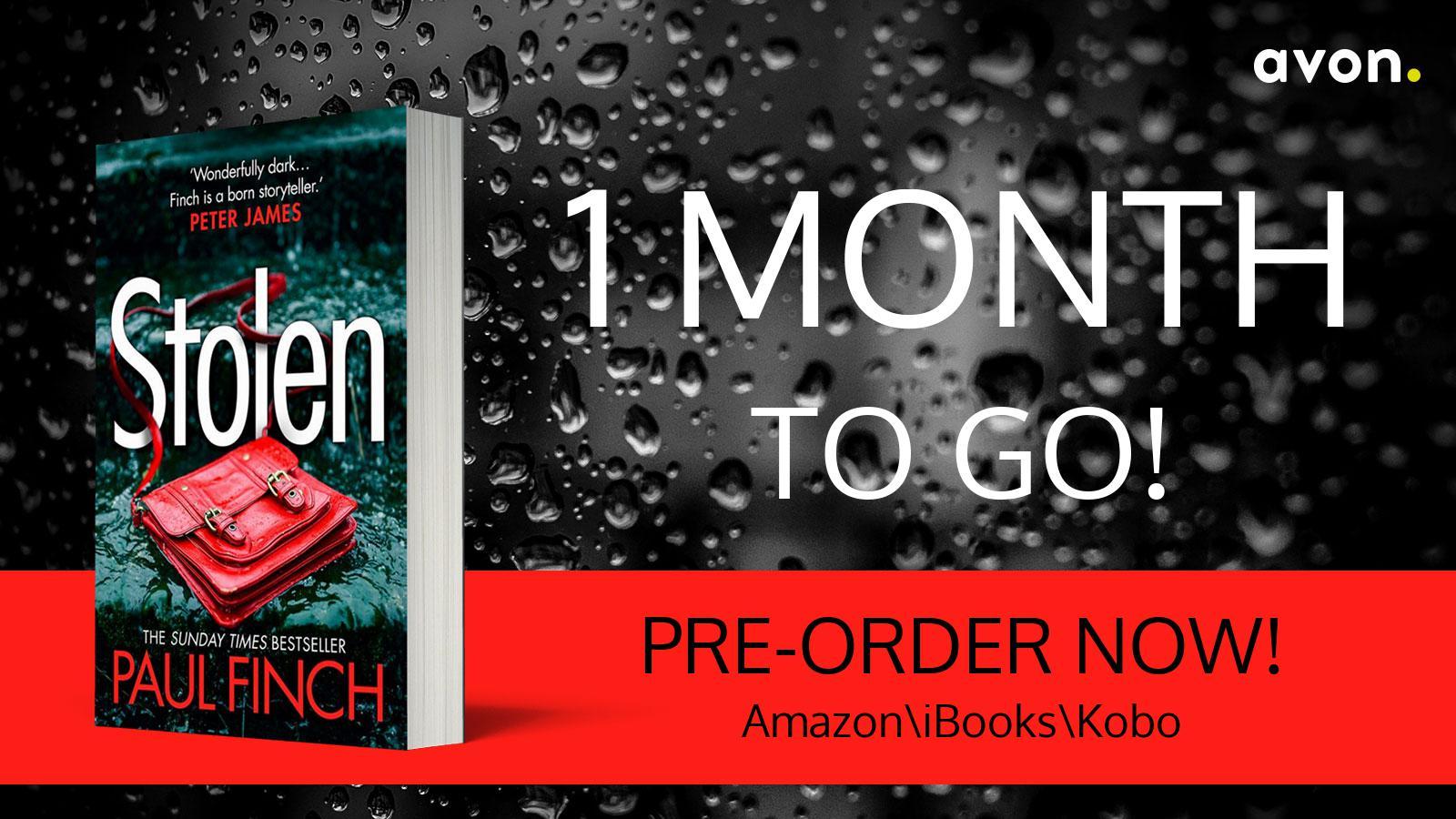
STOLEN, the third book in the Lucy Clayburn series, is taking up much of my bandwidth and much of Avon’s as we fast approach publication date on May 16, and I’m going to be talking a bit more about it this week. 

Okay … I’ll come clean and admit it. Much of today’s blog is going to be a blatant trailer for STOLENIn fact, I’ve even decided to snip out a few choice excerpts and print them on here, so you can judge for yourselves whether it’ll be the book for you.

In addition to that, because I never like to talk purely about myself, I’ll also be reviewing and discussing the late, great William Gay’s marvellous novel, TWILIGHT.

Now, before we go any further, and I can’t stress this firmly enough. It’s not that Twilight, the one about the wistful young lass in love with a vampire. This TWILIGHT is a classic slice of Southern Noir, a grim crime-thriller set in the Tennessee back-country of the 1950s, and it’s got just about everything you’d expect from that genre: grime, poverty, mystery, passion, savage violence, bizarre perversion and even magical realism.

If the TWILIGHT review is the main reason you’re here, you’ll find it, as always, at the lower end of today’s blogpost. Feel free to zoom on down there and get stuck into it straight away. If, on the other hand, you’re keen to know a little more about STOLEN – which I like to think also has a wide range of aspects to it (it’s not just a murder mystery) – then stick around at this end of the blog, and I’ll take you through some of the treats waiting between its covers.

Hardboiled Manchester

I don’t write cosy crime. I don’t do village greens or country house murder mysteries. It’s not that I disrespect those subgenres, it’s just that they’re not for me. My own thrillers are purposely gritty, visceral and urban. I do everything I can, in truth, to tick the ‘hardboiled’ box.

For the uninitiated, hardboiled’ is a subdivision of crime fiction which enmeshes its central character – often a police officer, journalist, or private eye – in the seedy world of inner city organised crime, and is set against a background of vice and corruption. Embittered by their experiences in this terrible time and place, the heroes themselves often become antiheroes who will bend many rules to get a result.

Those who read my cop novels will recognise this as home territory from the off, though I think, with the Lucy Clayburn series, we put our own spin on it. Lucy is a female, after all, a young detective constable who works local CID. She has no real power but is increasingly up against it because her home patch of Crowley, aka November Division, is an unruly Manchester borough where poverty, drugs and crime are out of control. She also has one particular problem that would make her unique among police officers in the UK. 


Raised by a single mother, a former stripper now turned respectable citizen, Cora Clayburn, Lucy was only introduced to her father, Frank McCracken, when she was 30 years old and a 10-year police veteran, and was stunned to find out that, though he’d first met and had had a relationship with her mum when he was a doorman at a Manchester nightclub three decades ago, he has now advanced in his career and become a major player in the Crew, the city’s most dangerous crime syndicate.

As such, Lucy finds herself walking an inevitable tightrope between her own world of on-the-hoof law-enforcement and street-policing and her father’s world of violence and racketeering.

I chose Manchester as the backdrop to this dark melodrama, not just because it was my own patch when I was a serving police officer, but also because it’s the grandest of all those great, bustling, post-industrial northern metropolises. Its centre is the soul of modernity and commerce, though its outer districts (one of which I was born and grew up in) are much less to write home about. The division I myself worked in as a cop, upon which Crowley (which is fictional) is loosely based, could pretty well be summed up as a big, dirty, noisy, chaotic, rain-soaked urban Hell.

Anyway, that’s the backdrop. Now to STOLEN, the third book in the series (though a series, all three of the books – the first two are STRANGERS and SHADOWS – can comfortably be read as stand-alones).

I’m not going to give you the outline, mainly because I don’t want to drop any spoilers, but also because the pitch is all over the internet now as the book is being advertised widely. However, as promised, I am going to take this opportunity to send a few trailers your way (so to speak):

The first thing you’ll notice in the Lucy Clayburn books, as I’ve been boasting all the way through this post, is the tough, frank cop stuff  
‘I’ve not seen her today,’ Newt said. ‘Not yet. If she’s shooting up, she’ll be in the women’s toilets on that row of boarded-up shops. On the other side of Penrose Mill.’
Lucy nodded. ‘I know it.’
‘But I don’t think she’ll be there. Yesterday, she was saying something about going to services.’
‘Services?’
‘I don’t know exactly what it means, but . . . she said it once before when she was going to someone’s funeral.’
‘A funeral?’
‘I think so.’ He tried to remember more. ‘She said she wouldn’t be around till this evening because this afternoon she was attending services out on Fairview.’
‘Fairview?’ Lucy was bemused. ‘A funeral . . . on a landfill site?’
Newt shrugged again. ‘That’s all I can tell you. I didn’t ask, did I? Told you, she’s a nutcase. Christ knows what she gets up to most of the time.’
‘This is all I bloody need.’ Lucy thought about Fairview, that hideous, decayed wilderness, with its foul stenches and its drifting toxic smoke and its gangs of weirdo scavengers scrambling across it like beetles. ‘If this is wind-up, Newt, I’ll make your life a misery from here on. It’ll be stops-and-searches every time I see you. I’ve got good contacts in the Drug Squad, and I’ll make sure you go right to the top of their list.’
‘On my honour,’ he protested. ‘She’s taking a few others to attend services on Fairview.’
‘On your honour?’ Lucy shook her head. ‘Your honour. Are you serious?’ She grabbed him by the collar, lugged him from the wall and threw him along the passage with such force that he staggered and almost fell. ‘Get out of my sight, soft lad!’
He hurried off, walking stiffly without looking back.
‘I ever see you again,’ she shouted, ‘I’ll pop those zits with the dirtiest needle I can find!’

     We also have a bit of a rep for going all-out on the action front …

Lucy sped on, passing through the narrow doorway and entering a long, concrete passage that had never been intended for vehicles. Again, it was cluttered with debris, as though part of the ceiling had collapsed, which made it difficult going. A dark shape bobbing ahead of her revealed her fleeing prey, but before she could catch up with it, she reached a junction of passages obstructed by a wheeled cart that was loaded with wooden pallets.
Lucy braked sharply. She heard feet hammering away ahead as she leaped from her seat to shove it all aside. What this place had once been, she couldn’t fathom. Whatever it was, if the rest of the structure was anything to go by, it was likely to be labyrinthine, which was all she needed when her quarry had a head-start like this.
She clambered back onto her bike and accelerated forward at reckless speed. At the next intersection, she had to slow down to listen. Hearing an echoing clatter of rubble on her right, she swung her machine after it, accelerating again. It was the same at the next junction. Even with her headlamp on full beam, she now saw nothing but endless concrete tunnels telescoping ahead, black elongated nightmares along which her Ducati hopped and skipped as it cleared mound after mound of masonry. Some were so narrow that at times her handlebars all but carved their way along the walls and turned the reverberation of her engine into gunfire.
Lucy swore. She could have overhauled this suspect in any normal circumstances, but it was typical that she’d wound up pursuing in what had to be the only place in Crowley where the speed and power of her Ducati were nullified. At the same time, she found herself having to duck, as missiles came flying back from the fleeing form: bricks, discarded bottles, wooden laths heavy with cement. At least her adrenalin was up, dulling the thudding impacts on her body, the blows of bricks and cans, the crunch of smashing glass on her visor. But Lucy knew that she wasn’t immune to this punishment. If her headlight was taken out, that was it; she’d be marooned in this unlit maze, at the mercy of whoever this maniac was …

     I’ll also admit that I have a penchant for colourful and generally irredeemable villains:

‘Why are you telling me all this?’ Lucy asked as she covertly tested her bonds.
     Torgau pondered. ‘It’s a good question, DC Clayburn. Most of my life, I’ve flown under the police radar. You can call it skill, you can call it luck, you can call it the Devil looking after his own. But after a lifetime dedicated to breaking the law – I mean, I’ve barely ever done an honest job and look at the life I lead – I have the smallest criminal record imaginable. So maybe, just maybe . . . this is an opportunity to show at least one of you what you’ve been missing. Cosy in the knowledge that it won’t mean a damn thing.’
‘Dad hasn’t told you what he was really good at yet,’ Torgau’s daughter chipped in.
Lucy saw that she’d lifted the poker from the flames and was blowing gently on its tip, which had started to glow.
This was Torgau’s cue to talk a little more about himself.
‘Wild Bill was impressed by my ability to steal,’ he said. ‘But what he really liked about me was how I excelled at violence. You may not believe that, because I’m not a big man. And back in Moston in the bad old days, when I was very young, that made me a target for every kind of bully. It began with my father, who hammered me regularly for the most minuscule things. But mainly it was this big kid in the neighbourhood – Arun Swaraj. He gave me a kicking every single day. Until my father saw it happen and refused to let me in the house afterwards. He put an empty milk bottle in my hand and said that I couldn’t come home until I’d smashed it over this guy’s head. I knew he meant it. So that was what I did. Arun went down like the pathetic sack of shit he was. But the really amazing thing was the way his wingmen ran away. My father taught me an important lesson that day, DC Clayburn. Violence works. Especially the nasty kind. The kind from which there is no coming back. That kind of violence doesn’t just earn you respect, it can actually earn you a living.’

     Like the hardboiled crime novels of the 1920s and 1930s, which were hugely concerned with the crime syndicates of the Prohibition-era US, Lucy Clayburn is often up to her neck in gangsters

Formerly a pirate and smuggler in the pay of the Mungiki crime syndicate in Kenya, Zambala, despite a machine gun-toting youth in which he’d violently rejected all things western, had effortlessly adapted to the capitalist lifestyle of the UK. He was now in charge of narcotics, importation and distribution, and his annual contribution to company funds was greater by far than everyone else’s, so, though still an underboss, when he spoke, people listened.
‘Not three weeks ago, one of my sellers was fished out of a Fallowfield sewer.’ He took a sip of mineral water. ‘The guys responsible had put him down the sewer while he was still alive . . . minus his hands and feet, I should add. The cops reckon the chopping tool was a machete.’
Wild Bill pursed his thin grey lips. ‘Not an ideal situation. When our own people are getting their hands and feet chopped off.’
Frank McCracken was the only one who didn’t mutter his discontent. He was too busy wondering where all this was leading. He too had heard rumours that foreign powers were slowly muscling in on their action. Not so much his, maybe. He dealt mainly with those established British gangs who even after all these years still failed to recognise the Crew’s authority. But it was plain there was a foreign presence on the streets.
‘You’re very quiet, Frank,’ Pentecost suddenly said.
McCracken shrugged. ‘We might have to make deals, Bill.’

It wouldn’t be a cop thriller, at least not a realistic one, if it wasn’t filled with hints of the mysterious and the abnormal

The problem with being a police officer – anywhere really, not just in a place like Crowley – was that you knew what went on behind the sometimes paper-thin façade of the local community. So Lucy wasn’t entirely surprised that night to look down the list of prisoners waiting in the traps at Robber’s Row police station, November Division’s HQ, to see that they included professional men with sedate family backgrounds: a senior civil servant, a local journalist, an estate agent, even a bank manager. There were louts and scallies among them too, all the usual suspects; but respectability was a keyword where several were concerned, or superficial respectability at least. Maybe, to an extent, she should have anticipated this, because dog-fighting wouldn’t have existed at all, even as an illegal sport, without the hefty cashflow it generated. It was only ever about gambling, and if you didn’t have the readies for that, you couldn’t participate.
‘Worrying, isn’t it?’ she said, scrolling down the file on the screen belonging to Sergeant Joe Cullen, the Robber’s Row custody officer. ‘Lots of these guys come over as perfect citizens . . . so able to create the impression they’re normal that they can function easily in everyday society. They do jobs efficiently and make them pay. They impress socially. They have friends, families. But deep down, they’re so disturbed that they derive pleasure from watching innocent animals rip each other apart. Either that, or they’re so indifferent to it that they don’t care so long as they make a few quid.’
‘I wouldn’t be surprised if it was the thin end of the wedge, to be honest,’ Cullen replied. He was a foursquare old-schooler, with a weathered hangdog face and a brush of thick grey bristles on his head. ‘If they’re prepared to do this, what else are they up to? Like you say . . . they’re not normal.’

And I have been known, just occasionally, to stray into the realms of Gothic horror

The figure of a man was silhouetted on the gradually paling sky.
Peabody switched his torch on again, but powerful though the Maglite was, the beam didn’t reach far enough. Whoever the guy was, he was about sixty yards away.
‘Hello?’ Peabody shouted, circling around the taped-off area. ‘Who are you, please?’ There was no response. The figure remained indistinct and motionless. ‘You need to clear this area. This is an official crime scene.’
The figure remained where it was.
Peabody was angry rather than alarmed. Primarily at himself. He’d stayed as sharp as he could, and he’d still let this creep sneak up on him. Not only that, he’d told him to get his arse out, and the guy wasn’t moving. Did he carry such little authority?
‘PC Peabody!’ he said, tromping uphill, his heavy feet crunching the trash.
The figure still didn’t move, though now the torch was picking him out. Peabody saw a grey suit, a white shirt, a green tie, dark hair – and a weirdly marked face.
‘What the . . .?’ Peabody breathed. And then he smiled to himself.
This was a wind-up of some sort.
Back when he’d been a probie, he’d been subject to all kinds of mickey-taking, as they all were, of course. There was never a trick too nasty or scary for older coppers to play on younger ones, or that they didn’t find hilariously funny afterwards. He’d hoped all that was past him now, but apparently not. Except that he’d be surprised if anyone found this situation amusing, and the higher up the slope he ascended, the less amusing it seemed. Because the thinner and stiffer the watching figure seemed to be, the darker its eyes, the more weirdly streaked its face, and . . . the redder its mouth.
‘What the hell?’ Peabody said again, this time aloud.
For half a second, he had the horrific notion that a corpse had been propped up. But over the last two or three yards, he realised the truth.
It was a shop mannequin, its suit ragged and filthy, its white shirt not a shirt at all but the mannequin’s own polystyrene flesh, its tie a piece of fuzzy-felt, its hair a ratty wig, its face gruesomely plastered with women’s make-up.
Peabody halted a couple of feet below the static figure. He half-expected a sniggering copper to come out from behind it. But no one did. The only sound was the rustling and flapping of the forensics tent down in the dip. Cautiously, almost gingerly, he scrambled up the remaining distance until he was face to face with it. When he looked down, he saw that its feet were embedded amid broken, twisted branches.
Okay, so it hadn’t happened by accident; someone hadn’t just discarded this thing. No doubt there were dozens of such objects scattered across the landfill, but someone must have set this one up deliberately. And in the last half hour or so, because if there was one thing Peabody was certain about, it had not been here when they’d arrived during daylight …

Hopefully you like the sound of STOLEN. Well, as I say, it’s published on May 16. Two weeks from now …


THRILLERS, CHILLERS, SHOCKERS AND KILLERS …

An ongoing series of reviews of dark fiction (crime, thriller, horror and sci-fi) – both old and new – that I have recently read and enjoyed. I’ll endeavour to keep the SPOILERS to a minimum; there will certainly be no given-away denouements or exposed twists-in-the-tail, but by the definition of the word ‘review’, I’m going to be talking about these books in more than just thumbnail detail, extolling the aspects that I particularly enjoyed … so I guess if you’d rather not know anything at all about these pieces of work in advance of reading them yourself, then these particular posts will not be your thing.
  
TWILIGHT 
by William Gay (2007)

Outline
An open cart is wheeled into a small backwoods town. Not an unusual occurrence, you may think – except that this cart is carrying the bloodied, butchered remains of a family who were apparently murdered alongside each other out in the terrible and mysterious tract of overgrown wasteland called the Harrikin. Weirder still, there is a dead dog alongside the corpses, a dog wearing diamond studs in its pierced ears. The townsfolk are shocked, if at the same time a little blasé. Because this, it would seem, is the sort of thing that happens out in the twilight zone that is the Harrikin.

And this is the opening to Twilight, William Gay’s superb piece of back-country noir, a more than unsettling tale about amoral madness in the depths of the impoverished American South.

We’re in rural Tennessee in 1951, and two young people – Corrie Tyler, and her younger brother, Kenneth – are suspicious that well-to-do local undertaker, Fenton Breece, has cheated their family. On seeing the expensive casket purchased for their late bootlegger father being used elsewhere, they dig up his grave and discover the corpse of their parent not just entombed in a cheap box but sexually violated. Further investigations of other recent burials – in other words, more grave-robbing, performed secretly and by night – uncovers additional evidence that Breece is a fetishist and necrophile. But Breece is a leading citizen who no-one would think the worse of without hard evidence. Kenneth thus breaks into his house, seeking this out, and discovers, among other purloined and highly inappropriate possessions, a whole package of photographs depicting the well-groomed undertaker having sex with a variety of dead women – deceased citizens recently entrusted to him – all now dressed and made-up to look like glamour queens.

Uncertain about the loyalties of local law enforcement, the Tylers attempt to blackmail Breece, thinking that, if nothing else, they can at least escape to a better life. But Breece, who is influential at many levels locally, has already turned to hoodlum-for-hire, Granville Sutter, a skilled and callous killer, to retrieve the evidence. In the ensuing first clash between the vying parties, Corrie dies, and 
Tyler flees into the countryside, Sutter close behind.

Tyler is no expert at this sort of thing, whereas Sutter has done it several times at least. The youngster’s only option, or so it seems, is to head into the Harrikin, that vast and dreamy wilderness, trackless, tangled, littered with eerie buildings and rusted, overgrown machinery, and populated by the strangest, most reclusive people – witches, weirdoes, lost souls, forgotten families – all of whom are more than capable of impeding Tyler in his race against death, as well as in shielding and protecting him. It depends how the mood takes them, it depends on the worsening winter weather, it depends on a great many things beyond Tyler’s control, whether he lives and gains justice, or dies a lonely death and finishes up another plaything in Fenton Breece’s squalid funeral parlour vault …      

Review
There is considerable debate about how the ‘Southern Gothic’ school of literature can actually be defined, though most advocates of the genre would agree that it originated in the American South, having emerged from the chaos and poverty following the defeat of the Confederacy during the Civil War, and that as such it weaves dark, macabre tales about the damaged human condition with bizarre, often grotesque imagery (much of this concerned with waste, decay and violence), and yet, though often Noirish in tone, tends to lean away from the traditional mystery-thriller into the realms of magic realism, where we’re living in a recognisable world but such is the madness and strangeness of it all that an unearthly atmosphere pervades.

However, to indicate how broad a church this is, countless authors are named as practitioners, some of whom, at first glance at least, seem poles apart from each other.

Joe R Lansdale and Harper Lee? Cormac McCarthy and Tennesee Williams?

But there is one thing that firmly unites them. All are supreme wordsmiths, who write richly and lovingly about their native Deep South. Not always approvingly, often damningly, but always colourfully, evocatively and intriguingly.

Very much at home in this diverse but hyper-talented crowd is the late, great William Gay, who sits firmly at the darker end of what is already a pretty dark spectrum – his work usually characterised by ordinary, everyday folk facing desperate moral dilemmas thanks to frightening encounters with evil – with Twilight among the very darkest of his endeavours. 

To start with, it’s exquisitely written. It almost seems like a contradiction in terms when we’re talking about murder and necrophilia and an horrendous journey through a jungle of twisted vegetation and skeletal industrial ruins, but William Gay goes at it in his customary poetic fashion, describing it lusciously and hitting us with one startling visual after another. Never let it be said that beauty can’t be found in waste and decay. Again it seems like a paradox, but we’re almost in the realm of fairy tales, The Wizard of Oz invoked at the same time as The Blair Witch Project, every Germanic woodland fable you can think of (we even have the brother and sister heroes pursued by an ogre!) sitting side-by-side with modern tales of perversion, crime and ruin.

And yet, William Gay does it all with a smile on his face. Though he has much to say about outcasts, loners, the lost and disenfranchised, those who’ve fallen through the cracks even in a depressed economy like rural Tennessee in the early ’50s, and though he is patently disgusted that life is still cheap some fifty years after the Wild West has ended, and sickened by small-town corruption and selfishness, his touch is light. He gives us plenty of laughs along with the screams.

As usual though, none of this would work without characters we quickly get involved with.

Kenny Tyler starts out as the archetypical uneducated country-boy, but inevitably grows in stature during his fight for life out in the world-apart that is the Harrikin, hatching both wisdom and courage, and so giving us a coming-of-age vibe along with everything else.

Fenton Breece, meanwhile, represents a quintessential villain of the Old South, being a snake oil salesman of the most blatant kind, charming, civilised and plausible, all of which nevertheless conceals a truly degenerate soul. The moment he confesses to Granville Sutter that he killed a woman once, and may even – though he doesn’t totally remember it – have killed other women, is quite 
chilling in its shrugged-off matter-of-factness.

Sutter, though a blunt instrument in comparison, is equally complex, because while Breece is rotten to the core, Sutter has no core at all – at least, none that is recognisably human. He initially appears as a typical town bully, another violent brute where women are concerned, but also a confident disposer of men. So, he’s a boor, yes, but he’s also an out-and-out predator, who’s not just good at what he does because he has a streak of innate cunning that goes a mile deep, but because nothing matters to him. He simply doesn’t care about anyone and was probably born with this deficiency; the way some may come into this world lacking an arm or leg, Granville Sutter did so lacking conscience and charity. A madman, then, a psychopath – but as I’ve already said, and as we see through his dreams and reminiscences, a complex one too.

So how do I sum this novel up quickly? Well, in truth, you can’t.

Suffice to say that Twilight is an engrossing, elegiac study of the human darkness at the heart of what once might have been thought chocolate box America. Be warned, it’s not one of those garish hillbilly horror stories, but there is horror here along with humour and intellect, all of it wrapped up in sumptuous southern prose.

So, horror fans … read it. Thriller fans … read it. Literary fiction aficionados … read it. And surrealists and fabulists … you must read it too. This is Southern Gothic at its most haunting.   

Twilight hasn’t, to my knowledge, been adapted for film or TV just yet, and so I’m going to do my usual thing and stick my oar in early, advising any potential movie company who they should be casting when they finally get around to putting this great piece of work on film. Just a bit of fun, of course (like they’d listen to me in real life).

Kenneth Tyler – Ansel Elgort (probably a little older than he is in the book, though not by much)
Fenton Breece – Domhnall Gleeson
Granville Sutter – Michael Chiklis

Tuesday, 23 April 2019

It’s heading this way, the legion of the dead


I’m unashamedly channelling Game of Thrones this week, but not, I trust, in a way that anyone will object to. Because, in truth, the main thing I’ll be talking about is my own novel of 2010, STRONGHOLD ... which bears some remarkable similarities to the events currently unfolding in Westeros.

More about that a little later.

In addition, today, on the same subject of epic horror/fantasy novels that have undergone the glossy TV treatment, I’ll be offering a detailed review and discussion of Joe Hill’s big, scary, 21st century soon-to-be classic, NOS4R2.

If you’re only really here because you want to read the Joe Hill review and/or participate in any resulting discussion, that’s fine as always. Just skip on down to the bottom of today’s post. You’ll find my review in the usual Thrillers, Chillers section. However, if you’ve got a bit more time, why not stick around for the other stuff first … ?

Armies of the dead

As promised, I’m going to talk a little bit about Game of Thrones, but I have to be careful here because I know not everyone watches it at the same time these days, and there are probably some folk who haven’t even started on Season 8 as yet. However, it’s probably not too much of a SPOILER to mention that, as we approach the series’ astounding conclusion, the armies of mankind are now massing around the northern citadel that is Winterfell, while the numerically vastly superior armies of the dead are pouring down from the polar region in unstoppable hordes, and that a gargantuan battle is in the offing.

Probably because George RR Martin never – at least, thus far – reached this point in the novel series, it’s proving to be potent stuff. None of us knows what’s going to happen next and we’re all on the edges of our seats with excitement … me included, even though I, more than many, have cause to recognise some of the dynamics in play here.

Now, before I start, let me make it abundantly clear that I am NOT accusing anyone of copying anything.

There are only so many ideas that have ever been put onto paper, and even though Game of Thrones, or A Song of Ice and Fire, as the books were originally collectively called, only matured in recent times into the gigantic war between the living and the dead that we know today, the saga commenced back in 1996, when the first book in the series, A Game of Thrones, was actually published. So, I can hardly claim that I got there first.

However, let me elaborate a little on the subject of my medieval fantasy/horror novel, STRONGHOLD, first published in 2010, and if nothing else, you’ll see that great minds truly think alike.

In a nutshell, STRONGHOLD focusses on a great fortification, manned by a professional but relatively small army of knights, archers and men-at-arms, and under threat from a colossal force of walking-dead, a horde of rotted but ravening zombies roused from graveyards and carnage-strewn battlefields by Dark Ages magic. Ah yes, you see. There is some similarity here. Only some I’ll admit, but though, overall, it doesn’t even come close to being the same story, it’s close enough for me to feel absolutely no shame in plugging STRONGHOLD this week while everyone is so justifiably excited about Game of Thrones on TV.

Stronghold

It all began in 2009, when I was approached by Jon Oliver, the senior commissioning editor at Abaddon Books, and the unsung genius behind the Tomes of the Dead series.

In short, Tomes of the Dead was a group of stand-alone zombie novels from Abaddon which, while not occupying a shared universe, were specifically written to mark a subversion or reinterpretation of the genre, while sometimes – though not always – employing a recognisable historical backdrop.

My brief was simply to write a zombie novel that would strike a similar note. As a lifelong student of medieval history, and someone who rarely gets the opportunity to fictionalise it outside the short story format, the idea grew on me that I’d like to set something in Britain during the intense and tumultuous reign of the English king, Edward I, who ruled from 1272 until 1307.

Edward Longshanks, as the Scots called him, was a very divisive figure. Though one of the strongest kings that England ever had, and though seen by the English as a just ruler rather than a tyrant, who empowered and enriched his kingdom and came to preside over a near picture-perfect medieval realm, he made relentless aggressive war on England’s neighbours, particularly Scotland and Wales. Ultimately, he was less successful in Scotland, though the violence caused by his ambitions there was ongoing and terrible, while Wales, despite spirited resistance, eventually fell completely under his yoke.  

All this is long ago now, and the hostilities are thankfully forgotten, mainly confined these days to rivalry in sport and terrace banter.

But as both a historian and a writer, I’ve long been intrigued by the split personality of a kingdom that could embrace pageantry and valour, that could build fairy tale castles, sing songs of courtly love and promote the cult of chivalry, a kingdom which in all ways resembled the Arthurian ideal ... and yet one that was also haughty and treacherous with its neighbours, one that would use its immense military power to ghastly effect against its enemies (both real and imagined) and would bring terror and misery to abject lands, while all the time lionising itself for these ‘achievements’.

In so many ways, this is the curse of the West. We saw it in the Romans, the crusaders, the conquistadors, right up in fact to the triumphalist days of the British Empire and the expansion of the fledgling US through territories that basically belonged to other people.

Ugly or not, it’s a fact of history now. It’s also a fascinating dramatic concept.

People who thought they were doing right when plainly they were doing wrong. (Or did they think that? And if they actually didn’t, how on Earth did they handle it in terms of conscience?)

STRONGHOLD gave me the opportunity to try and encapsulate all this in a single horror/fantasy tale.

In it, as I say, I visited Edward I’s England, a dominant military state in the process of violently absorbing a smaller neighbour, Wales …

It’s the year 1295 when the book opens, and the conquest of Cymru is far from complete. King Edward, having constructed a ring of impressive castles to pin down those lands and people that he’s already subdued, now relies on his all-powerful marcher-lords to enforce his will and deal ruthlessly with any recalcitrant.

Thus far, we’ve been following history to the letter, but now we take a right-hand turn into the realms of fiction.

When the Earl of Clun, one of Edward’s most vicious right-hand men, brings his retinue into Wales, ostensibly it’s to recapture Grogen Castle, which for a brief time has been in the hands of Madog ap Llywelyn’s Welsh rebels, but he also lays waste to the land in the process, burning villages and massacring not just those who’ve surrendered to him in good faith, but all those innocents who have strayed into his path.

Perhaps unsurprisingly, when he reaches Grogen Castle, which is high in the Cambrian Mountains, he finds it abandoned and overlooking a now desolated countryside. Clun reoccupies the mighty structure and awaits further orders. He doesn’t anticipate a massive counter-strike. The Welsh have also been defeated at the battle of Maes Moydog, so in all probability the rebellion is over.

But then something happens that he and his men never expected.

Betrayed by Clun, who promised there would be no reprisals against her people, Welsh countess, Madalyn of Lyn, seeks out Gwyddon, a druid, and with his assistance and the mystical Pair Dadeni, the ‘Cauldron of Rebirth’, she rouses an army of rot and decay, not just those slain by the English in recent campaigns, but those adorning the gibbets from years earlier, those buried under cairns and filling the mountain graveyards.

Before Clun knows it, a vast army of the vengeful dead is encroaching on Grogen. Already, his force is cut off. He has only the few hundred men he brought here. They have the advantage of their indomitable ramparts, but the dead have the advantage of already being dead, of not letting wounds impede them, of continuing to attack though bristling with arrows and hacked and clashed by axe and sword.

What follows is a wholesale, non-stop assault on the massive castle, which section by section is gradually overwhelmed. The English, who were at odds with each other in the earlier part of the book, now stand shoulder-to-shoulder and fight furiously, but are aghast with horror as they even see their own fallen inevitably rise up again and join the hideous legion …

Okay, I guess it all sounds pretty simple. A load of sword-wielding blood and thunder, with lots of zombie horror woven in. And all that after I chatted so garrulously about my highfalutin historical and philosophical ambitions. But note that a handful of English knights who have committed terrible atrocities are my central characters here. They – the oppressors, not the oppressed – are the ones under siege and at war with the dead. And this is the point where I try to examine that juxtaposition between bravery and cruelty, honour and arrogance. This is the moment where I take a long hard look at the issues of ‘only following orders’, of ‘my country right or wrong’, of ‘my king before my conscience’, and present my readers with a clutch of heroes who are ravaged by guilt and shame – and all this in the face of impending, seemingly justified destruction.

Okay, sorry about that. Yes, as I said it’s an unashamed plug for a book of mine published nearly 10 years ago, but this is my blog, so I can do what I want (yaaah!).

STRONGHOLD is still out there, still gets quite decent reviews and is still available from most online retailers. So, if you like Game of Thrones, and you can’t wait for that climactic battle between the living and the dead, perhaps you’ll be interested in dipping into this one first?

Just a suggestion.


THRILLERS, CHILLERS, SHOCKERS AND KILLERS …

An ongoing series of reviews of dark fiction (crime, thriller, horror and sci-fi) – both old and new – that I have recently read and enjoyed. I’ll endeavour to keep the SPOILERS to a minimum; there will certainly be no given-away denouements or exposed twists-in-the-tail, but by the definition of the word ‘review’, I’m going to be talking about these books in more than just thumbnail detail, extolling the aspects that I particularly enjoyed … so I guess if you’d rather not know anything at all about these pieces of work in advance of reading them yourself, then these particular posts will not be your thing.

NOS4R2 
by Joe Hill (2013)

Outline
A mesmerising horror novel with an air of urban fairy tale about it, though don’t let that fool you. This is one intensely frightening ride.

In a chilling opening scene, we visit a prison hospital in 2008, where Charles Manx, a suspected child killer who has been lying in a coma for years, apparently revives and terrorises a young nurse with stories about a mysterious and terrible place called Christmasland. However, when other staff check on him, he’s unconscious again, his brain function virtually zero.

In one of many leaps back and forth in time, we now move back to 1986, where a feisty youngster called Vic McQueen uses her Raleigh bike and the mysterious Shorter Way Bridge, a semi-derelict structure in the woods behind her Massachusetts home, to travel to the location of whichever object she happens to be looking for, whatever that object may be, wherever the location may lie. She doesn’t know how this happens, just accepts it as magic, even though the more she uses it, the more physical damage it causes to her, particularly to her eye. Vic thinks she’s the only person who enjoys this bizarre privilege, but when one trip takes her all the way to Iowa, she meets a scatty librarian called Maggie, who routinely uses a special bag of Scrabble tiles to answer questions and find missing items in similar fashion. Whereas Vic suffers with her eye, the Scrabble divination causes Maggie to stutter, though both agree that they feel ill generally whenever they’ve worked one of these miracles.

It is while she’s comparing notes with Maggie, that Vic learns about evil Charlie Manx, an older man, who has similar powers to theirs, which he draws through his classic Rolls-Royce Wraith (the registration number of which you can probably guess) and uses them to abduct children.

When Vic heads for home, the Shorter Way takes such a toll on her that she falls seriously ill, losing her Raleigh in the process. Meanwhile, Charlie Manx – a real person, who does indeed kidnap children in his Rolls-Royce Wraith – enlists burgeoning serial killer, Bing Partridge, to assist in his crimes. Partridge works at a chemical factory and steals several tanks of sevoflurane gas with which to overcome the parents of the child-victims (in the process thinking of the gas as ‘gingerbread smoke’ because of its unique smell, one of many instances in which Christmas joy is turned on its head in this book). Ultimately, Partridge is easily recruited because, though sexually depraved, he is childlike in certain ways, and when Manx tells him that he whisks his abductees away to his wonderful secret refuge, Christmasland, where they can do festive things all day and never grow old, it appeals to him immensely.

Flashing forward ten years, we now find Vic McQueen an unhappy teenager, worn out by her even unhappier parents’ constant fighting. After a bitter row with her mother, she uses the Shorter Way to visit Manx’s house in Colorado – a bizarre place high in the pinewoods, where Christmas music plays all day and Christmas ornaments adorn the surrounding trees whatever month of the year it happens to be. Her plan is to get herself abducted in order to punish her mother, but when she finds another young child locked in Manx’s Wraith, she attempts to free it, only to discover that it has transformed into a horrific, vampire-like travesty of the human being it once was. With the child-thing’s assistance, Manx almost captures Vic, his house burning down in the process, but in a desperately tense and superbly crafted scene, she escapes on the back of a motorbike driven by a tubby but startled motorcyclist called Lou Carmody. Even then, Vic isn’t completely safe. The vengeful Manx follows the pair of them to a mountain diner and general store, where he horrifically kills a soldier on leave before other customers overpower him.
               
We now return to 2008, and the current narrative, where the adult Vic has had success as a children’s author and is several years into a relationship with Lou but is again unhappy. The one light in her life is her son, Bruce Wayne Carmody – Lou having named him so because, though lovable, he is also a comic-book geek – but she continually receives phone calls from the vampire children of Christmasland (and very chilling they are!) berating her for the imprisonment of their father, Charlie Manx. Having already spent time in therapy, which has persuaded her that her earlier experience of this was all stress-related fantasy, Vic subsequently lives in terror that she is losing her mind.

Because of all this, Vic separates from Lou, but not on unpleasant terms, returning to New England. As Manx falls into a coma in prison, and finally dies, her life stabilises somewhat. But then, one day in 2012, she is visited by a ragged, drug-addicted version of Maggie the librarian, who tells her not to relax, because while it’s been reported that Manx died in custody, in reality he resurrected himself and escaped from the morgue, and now is on the loose again, this time hellbent on punishing Vic, not so much by killing her, but by abducting her son, Bruce Wayne, and taking him away to the unearthly winter paradise, which, though it exists on no recognisable maps, we readers have seen and experienced for ourselves, so we know that it’s real: Christmasland …    

Review
I read a lot of books that purport to be new takes on the vampire theme, but I don’t think I’ve encountered any that are quite as original and different as this one. When Stephen King, Joe Hill’s father, first wrote Salem’s Lot in 1975, it was one of the books that put him on the map as a horror supremo. But the bloodsuckers in that one were pretty traditional in their form and methods. It was the high-quality writing, wonderfully detailed characterisation and the sheer, unadulterated scariness of it that made Salem’s Lot such a gem.

Well, NOS4R2 has all that, plus a genuinely new kind of vampire antagonist. But that’s actually faint praise, because in truth there is so much good stuff in NOS4R2 that it’s difficult to know where to start.

To begin with, the notion of so-called ‘inscapes’ – fantasy realms constructed through sheer thought, which, though unreachable except via trans-dimensional conduits like the Shorter Way Bridge or Charlie Manx’s Wraith, nevertheless exist in a real time and place all of their own – is wondrous.

I admit that, at first glance, it may not work for everyone. The idea that this little girl can travel across the whole of North America in less than a minute by riding her Raleigh bike through a derelict covered bridge in backwoods New England may sound like something from a children’s fantasy novel, but then there’s the not insignificant matter of Charlie Manx, who uses his mysterious and imperious Wraith as his own conduit, though in his case the car also acts as a form of revival system from out of which he can draw life-energy vampirised from the innocent to heal life-threatening injury and illness and even restore himself to youth. It may all sound nutty and implausible, but in the world of inscapes – especially the way Joe Hill writes about them – you buy into it straight away.

Of course, the concept of inscape is not original to NOS4A2. Hill has played with it before in his two earlier novels, Horns and Heart-Shaped Box. But it is here where he thoroughly investigates and exploits the notion, and though, as I say, it may at first sound like a juvenile concept, in NOS4R2 it is rendered utterly believable and very, very frightening.

Charlie Manx is a key part of that, of course, and an amazing creation. He is first brought to our attention, because we know no better at this stage, as a serial child abductor and murderer, though in due course we realise that he is a lot more complex than that. Manx is one of the best modern variants on the Dracula theme that I’ve ever encountered. Yes, he does capture children and he does transform them into eerie, ghoul-like things. And yes, he is capable of using extreme violence against their parents and other guardians. But he is also a fully rounded individual. We learn about his difficult past and the bizarre philosophy for life that he evolved as a result of it, which leads him to believe that in taking children away to Christmasland and granting them immortality (of a sort) he is genuinely doing the right thing. He is thus playful as well as wicked and develops a great rapport with Bruce Wayne Carmody after he kidnaps the little boy. Manx is almost likable in these scenes, displaying good humour and generosity, while reserving his real disdain for semi-demented Renfield-like servant, Bing Partridge.

Which brings us onto villain number two. Setting aside the obvious Christmas allusions in his name, Bing Partridge is also a very real person and represents more bravura character-work by Hill. To start with, though devoid of humanity, he is no slavering madman, but extremely ordinary in appearance, and though he seems like a dumbass, this is really a shield with which he continually fools the parents of his child-targets, the mothers of whom he then singles out for truly appalling treatment. He even lures the enlightened Vic McQueen at one point, in a scene that, because we readers know about Bing from the beginning, literally reeks of evil.

The good guys in NOS4R2 are equally real and visible.

Vic McQueen is an unusual kind of heroine, first appearing as a spirited youngster mired in a violent and unhappy home – so far so good – but then evolving, perhaps inevitably, into a brattish teen delinquent, and finally reaching her adult incarnation as a scrawny, grungy outsider, scrawled with unsightly tattoos and suffering recurring mental problems. That said, she’s still a looker. Of course, she is; our heroes and heroines must always be lookers. But she’s been through the mill emotionally, and it shows. Even now she has minimal contact with her demolition expert father, who she blames for most of the domestic problems when she was young, and when she finally reconciles with her temperamental mother, the woman is dying from cancer. It’s no wonder that Vic struggles to hold things together even as she does brave and admirable things.

She does have an on/off boyfriend, of course: the affable heavyweight, Lou, with whom, once again, we’re in the realms of superb character-work by Joe Hill. Though a quality mechanic, Lou is an underachiever because he spends whole days with his head in the clouds. He’s brave, though, if a tad dim, and he loves Vic and their son, Bruce Wayne. He’s no hero in the traditional mode but has so many minor redeeming features that we like him all the way through the book.

Bruce Wayne, meanwhile, has inherited traits from both his parents: he’s courageous and inquisitive, possessing his mother’s looks and intellect and his father’s starry-eyed amiability. The youngster is a distinctly warm presence in the second half of the novel, which is a good thing because this section sees Vic tortured even more terribly by the fearsome denizens of Christmasland. In contrast to this terror, Bruce Wayne brings great meaning to her life and cheers us all up every time he appears, at one point even managing to win Charlie Manx over (or at least persuading him to buy them some fireworks, so they can have a bit of non-Christmas fun).

The other thing about NOS4R2 is how well-written it is. Joe Hill is clearly following in his father’s footsteps in producing big tomes – this one clocks in at about 700 pages – but it’s all so readable, and the descriptive work is sumptuous, particularly when we get to Christmasland. It initially appears as a kind of Tyrolean Neverland, where it is always December 25, icicles dangling permanently from lintels, Christmas trees shimmering, snow falling, everyone housed in Alpine ‘cuckoo clock’ lodges, where they spend all day (every day!) in front of hot fires, drinking cocoa and opening presents. And yet there is darkness here too, Hill displaying great skill to subtly show us just how mind-numbingly awful this would in due course become (it’s no wonder the children are deranged monsters).

Ultimately, NOS4R2 is far more than just a horror novel. It’s a haunting tale but an exhilarating one too. There is romance here and wild, escapist fantasy, plus it’s funny as well as frightening, it moves at rollicking pace and is filled with nods and winks to Stephen King’s world as well as Joe Hill’s; there is at least one reference to Shawshank Prison, and one to Derry, the New England town at the centre of It – all of which adds an air of family warmth to the saga, though I don’t wish to give the impression that Hill is some kind of crude imitation of his father. Not a bit of it. There are undoubted similarities – blue collar types in heartland America getting to grip with a fantastically cruel form of supernatural evil is a recurring theme in both these authors’ works – but Hill is perhaps more disciplined than his dad in terms of linear narrative, and at the same time has a slightly more poetic air about his prose. He possesses a strong voice of his own, though I’ve no doubt that his father is very proud of it.

In truth, I haven’t only recently discovered Joe Hill. He was good enough to sign his first collection of short stories, 20th Century Ghosts, for me at a British Fantasy event many years ago and we chatted briefly. His short form work was impressive way back then, and though he hadn’t written any of his novels at that stage, it was pretty evident that he was going to. Well, now the first batch of them are here, and what a treat they are. I’ve no doubt that NOS4R2 and others like it will have universal appeal, but if there is anyone out there who, like me, particularly enjoys those big summertime blockbusters, the ones that were so massive and yet so engrossing that you’d take them away on holiday with you and they’d last you the entire fortnight, then Joe Hill and NOS4R2 in particular are definitely for you.

Okay, well … I usually like to end these book reviews with a bit of fantasy casting, nominating those actors I’d love to see take the lead roles when or if the book hits the screen. But the good news in this case is that a TV series has not just been commissioned, it has been written and shot – and Joe Hill himself, according to his tweets, is very happy with it. So, hell – forget the fantasy casting this week. Let’s wait and see what the real thing is like.

Sunday, 14 April 2019

When urban myths become chilling reality


We’re talking urban mythology today. True or half-true chillers, which are much more frightening than fiction because the events they describe have actually happened, or at least they are claimed to have actually happened. This is partly because in my new novel, STOLEN, out one month from now, DC Lucy Clayburn finds herself drawn into a nightmarish case entailing a series of atrocities, but only after she starts to investigate a local urban myth.

As that myth involves a mysterious black transit van, today is also an opportune time for us to look at some other creepy but supposedly true stories involving transport (both public and private). I’ll therefore be listing my ‘sinister seven’ spookiest of these, but will only be focussing on those that - as I’ve already said - could well have a kernel of truth in them.

And while we’re on the subject of genuine and terrible incidents on dark, urban streets, I’ll also be reviewing and discussing in my usual intricate detail Pat Barker’s nerve-numbing tale of serial murder in the heart of the inner city – a fictional case derived from all-too-real events – BLOW YOUR HOUSE DOWN.

If you’re only here for the Barker review, that’s fine as always. Just tootle on down to the lower end of today’s post. You’ll find it where my reviews usually are. However, if you’ve got a little more time on your hands, perhaps you’ll be interested first in …

The black van

Readers familiar with my Lucy Clayburn novels will know that she’s a detective constable with a chequered past who now works local CID in Crowley, Greater Manchester Police’s notorious November Division. It’s an ultra high crime district, so she is rarely short of difficult work to do and undergoes continual stress, none of which was helped by the revelation two books ago that her father, from who she has been estranged until very recently and never even knew as a child, is a highly placed gangster in Northwest England’s premier syndicate.

However, all Lucy’s previous cases, and all the angst they might have caused her, now pale to insignificance, because what she is about to uncover in STOLEN can only be described as true inner-city horror, and yet it all starts seemingly so innocently with a rumour – an urban myth, if you like – that a mysterious black transit van has been trawling the housing estates at night and is now being connected with a rash of pet abductions.

Yes, you heard it correctly. Dogs are going missing. So, it’s hardly a high priority for the local overworked and understaffed police force. They don’t even take it seriously. How do local folk know this weird black van is responsible for the missing dogs? Has anyone seen it happen? Does anyone even know if this black van is real? Isn’t it just a schoolyard story given undeserved credibility because of some recent unhappy coincidences?

But then, everything changes … when people also start to vanish.

First of all, it’s the homeless. Again, this is not easy for the police to investigate, because these unfortunates might not have disappeared, they could just have moved on. There are no bodies, no witnesses. There is no evidence of any assault or abduction. It’s another urban myth, isn’t it?

Until householders also begin disappearing. Initially it’s pensioners, but others who are younger and more able-bodied inevitably follow. And now, suddenly, there IS evidence. There is even evidence that a transit van may be involved.

To Lucy’s incredulity, she finds herself assigned to investigate what was previously a silly story, a child’s nightmare, a snippet of folklore. The problem is that she and the rest of the police are late to this game. It may already be the case that something truly horrible is well underway on the November Division.

As I say, STOLEN is out one month from now, May 16 to be exact, from all decent retailers ... 

Kernels of truth

Okay, so while we’re on the subject of modern mythology, here, as promised, are the seven weirdest and scariest ‘true’ vehicular stories that I’ve ever heard. As I say, though, I’ve only picked stories that could and may have a grain of genuine truth inside them. So, this is not just a bunch of urban legends. Don’t be looking here for the vanishing hitchhiker, the axe-murderer in the back seat, or the boyfriend’s head being banged on top of the broken-down car. The stories I’ve chosen here are not apocryphal. They could have happened, and maybe – according to the evidence in some cases – they actually did. 

Here we go …

The People in the Wood

Thousands of folk vanish in the developed world every year and often in circumstances that are suspicious. It’s a frightening stat, and one that allows for all kinds of fanciful theories. One timelessly popular one seems to be that cults and covens exist beyond the veil of society, who are dedicated to doing evil (usually murder) and, somehow or other, remain protected from law enforcement. One myth circulating in the US for decades held that such groups would stage accidents on lonely roads late at night, and when a car stopped, leap out and grab the helpful motorist as their next victim.

As I say, fanciful. Except that recently in Floyd County, Georgia, something similar happened to a sheriff’s deputy. Patrolling a nighttime woodland area, he saw a body on the road get up and run out of sight. When he stopped his cruiser and got out, a group of masked, club-wielding figures emerged from the trees. Only by holding them at gunpoint was he able to retreat and drive away. A later search of the woods by fellow officers failed to locate anyone. His department suspected that the ‘body’ had been intended to trap a civilian but had fled at the sight of a police car.


The Black Volga

An eerie legend of Eastern Europe during the Soviet era concerned a black Volga allegedly being driven around the backstreets of cities in Poland and Hungary, looking to abduct young women and children. The Volga was a handsome vehicle, unaffordable to most ordinary citizens in Eastern Europe at that time, and so was primarily used by Soviet officials. This fed into the rumour that the Communist elite was snatching young people to use them as sex-slaves, or for other nefarious reasons, such as to harvest their healthy organs or even drain their blood in an effort to find a miracle cure for leukemia.

The story might have had a basis in truth as many people disappeared under the Soviet regime never to be seen again, and a number were taken away in government-owned black Volgas. Needless to say, the myth grew with the telling, the vehicle soon adopting white curtains and wheel-trims, which gave it a vampire-like vibe, and even after the Soviet days had ended, seeing itself reinvented as part of a Satanist conspiracy myth, the cultists involved having sprayed it blood-red and replaced its wing-mirrors with horns.


The Old Woman

A famously chilling myth took on an especially scary resonance in Northern England during the late 1970s. It held that a nurse, at the end of a late shift, was driving along a moorland road in pouring rain when she spied an old woman waiting alone at a bus stop. Knowing that no bus was coming this late, the nurse stopped her car and offered a lift. However, not long later, the nurse became uneasy. The old woman had a sour disposition and when she lit a cigarette, the flare of the match exposed hairy ‘apelike’ hands. Stopping the car, the nurse fooled her passenger into stepping out and checking on the headlights, at which point she promptly drove away.

Later, on realising the old woman had left her handbag in the car, the nurse felt guilty and went to a police station, only for the police to open the bag and find that it contained nothing but a meat cleaver. Inevitably, the old woman was looked for but never found. In the late ’70s, the Yorkshire Ripper was terrorising that part of the world, and the West Yorkshire Police allegedly investigated one version of this story which supposedly had taken place on the Leeds to Tadcaster road.   


The Vanishing

The disappearance of Brandon Swanson may sound like an urban myth, but unfortunately, it’s 100% true. It was in 2008, and Swanson, a student at Minnesota West Community College, had just completed his spring semester. He was driving home late at night, when, lost on a backroad, he ran into a ditch. With his car immobilised, he called his family. Unable to give his exact whereabouts, he told them that he thought he was close to the city of Lynd. Swanson’s parents came to collect him, and to help pinpoint him, continued to chat with him on the phone.

Once they were roughly in the right area, they started flashing their headlights, instructing their son to do the same. However, neither party saw another car flashing, which led both to believe that Swanson was not where he’d thought he was. Swanson thus opted to walk towards Lynd, believing he could see the lights of its outskirts. His parents continued to talk to him on the phone, but at around 2.30am, he suddenly shouted: ‘Oh shit!’ The line went dead and that was it: Brandon Swanson was never heard from again. Police located his car the following day, some 25 miles from Lynd, but there was no trace of the young man and no indication what might have happened to him, despite extensive use of search and cadaver dogs. The case remains open, and foul play is suspected.


The Never-Ending Road

An eerie story from Southern California holds that Lester Road, which leads through the mountains near the city of Corona, would occasionally adopt a supernatural dimension, and run on endlessly, leading to nowhere and taking all motorists unfortunate enough to be using it at the time into oblivion. At first, this sounds like a typical urban legend of the internet era, especially as it is most often to be found on ‘Creepypasta’ websites. But if only it was that simple.

There is no Lester Road in the vicinity of Corona today, but there is a Lester Avenue, though this latter has a suburban nature and it seems unlikely that one could be mistaken for the other. However, one possible explanation for the story lies in an unproven tale that, some time in the recent past, a road repair team were assessing a track through the nearby mountains and discovered a hairpin bend and a sheer drop, which, when approached from a certain direction and at a certain time of day (the lighting would be an issue) created the illusion that the road continued straight on. Reports that the team found many car wrecks and dead bodies at the foot of the drop have not been verified. 

  
The Child’s Voice

This story is odd in that it initially appeared to be true, only for questions to be raised later. On August 7, 1973, a child calling himself Larry made contact with truckers in New Mexico using CB radio, crying that his father’s pickup had crashed into a ravine, that his father was now dead and that he could not get out. A major search followed, but it proved impossible to get sense out of the boy. Occasionally his signal faded, but at other times it was picked up in locations as distant as California, Wyoming and even Canada. A helicopter pilot searching the Manzano Mountains, in New Mexico, thought that he was getting close, only to find that the child he was talking to was called David (who he also then failed to locate). When an ex-military searcher made contact with the boy on his high-powered radio set, they spoke for three hours, but Larry remained hesitant to give useful info.

After a week, the boy ceased transmitting, and when police established that no persons called Larry (or David) had been reported missing since Aug 7, the search was called off. Searchers who’d spoken to the child were distressed by this, convinced that the child had been in genuine terror and that it hadn’t been a hoax, but still ‘Larry’ has never been traced. It remains a singular and eerie mystery.


The Dead Body Train

London’s Underground is well-known to be haunted, but the scariest story connected with the ‘the Tube’ is that of the so-called ‘Dead Body Train’. Myths tell that a tunnel closed to public traffic once ran from the Royal London Hospital to a destination unknown, passing only one regular station en route, Whitechapel, but never stopping there ... because its passengers were corpses, hundreds of them stacked in cheap coffins. It sounds outrageous, and of course the authorities deny it, but many old employees on the Underground insist that the story is true.

But what on Earth was it? The mysterious transport has allegedly been out of service since 1900, so it could not have been used to deliver WW2 bombing casualties to hastily-built crematoria or even Spanish Flu victims during the pandemic after WW1.

No official document records the existence of this macabre vehicle, and there is no physical evidence … except a curious bricked-up tunnel at Whitechapel Underground Station, which leads in the direction of the Royal London Hospital, but which no one seems able to explain. The kernel of truth in this tale may lie in the story that bodies were once briefly stored at Whitechapel when the Royal London became overcrowded, and that in Victorian times, the London Necropolis Railway ran funeral trains overground to out-of-town cemeteries. The spooky legend persists though, and the Dead Body Train can still supposedly be heard running through tunnels that no longer exist.
  

THRILLERS, CHILLERS, SHOCKERS AND KILLERS …

An ongoing series of reviews of dark fiction (crime, thriller, horror and sci-fi) – both old and new – that I have recently read and enjoyed. I’ll endeavour to keep the SPOILERS to a minimum; there will certainly be no given-away denouements or exposed twists-in-the-tail, but by the definition of the word ‘review’, I’m going to be talking about these books in more than just thumbnail detail, extolling the aspects that I particularly enjoyed … so I guess if you’d rather not know anything at all about these pieces of work in advance of reading them yourself, then these particular posts will not be your thing.

BLOW YOUR HOUSE DOWN 
by Pat Barker (1983)

Outline
In an industrial city in the Northeast of England in the early 1980s, not long after the crimes of the Yorkshire Ripper, another serial killer is on the loose, a faceless assailant who is slowly working his way through the town’s prostitutes, beating and strangling them, and then hacking them to death with a butcher’s knife.

There is a degree of panic on the streets, but it’s probably not as great as it would be were the victims not sex-workers. Likewise, while the police flood the district with detectives and undercover officers, they make little headway and adopt a distinctly unimaginative approach, waiting and watching from cars on the off-chance the killer will strike again, in other words using the street-walkers as living bait.

In the midst of this horror, a young mother in the neighbourhood, Brenda, is gradually descending into prostitution.

Abandoned by her waster husband with three children to feed and colossal debts to pay, she tries at first to get herself an honest job at what is referred to as the ‘Chicken Factory’, a hideous relic of the industrial past, where the birds, which come in alive, are killed, plucked, gutted and packed for sale (a fairly blunt simile for the working-girls themselves). The work is hard, slimy and sickening, grease covering everything, even getting into the tea, the floors swimming with blood and feathers.  

Brenda tries to stick it out but can’t, especially when she learns that the child-minder looking after her children is abusing them, which means that she must care for them herself during the day (so there goes the job, whether she likes it or not). With nothing else for it – the charity and assistance of neighours will only go so far – she finally takes to the streets.

This, of course, brings whole new degree of grimness to her life: not just the terror of standing in the shadows under the viaduct, knowing that other girls have died nearby, but also having to engage in lewd acts with all kinds of brutish, boorish men, learning to loath both them and herself in the process. It doesn’t even end when a more experienced fellow-prostitute, Kath, offers to show her the ropes. Kath is kind but has many problems of her own, including alcoholism and terrible judgement. Part One of the narrative ends in the most horrific circumstances, Kath falling foul of the prowling killer, being lured into a derelict house and there dying in the most graphic, ghastly and sexually explicit way, but only after the murderer – who remains anonymous in the cloying darkness of the nighttime backstreets – reveals himself to be an impotent nonentity.

Despite this, life for the other prostitutes goes on. Brenda is now part of a close-knit clique, who find comfort in each other’s company, especially when they’re in the pub together, and do the best they can to look out for each other when they’re on the street – even if there is now a new air of fear and despair, the sad face of Kath looking down at them all from billboards and posters.

One of them, Jean, responds slightly differently. Another of the killer’s recent victims, Carol, was her part-time lover, and she takes this loss so personally that she determines to get even with the madman herself. She thus goes out, working the streets alone, hoping that she’ll encounter him, and as she’s secretly armed, fully intending to kill him when he attacks her.

But Blow Your House Down is not a crime novel in the traditional sense, and Pat Barker did not write it to be a melodramatic revenge thriller. It’s very much a slice of brutal authenticity, strongly influenced by the dark tragedy that was the real-life Yorkshire Ripper case, in which the victims turned out to be tired and weary mothers, often struggling for money, rather than the tawdry glamour-pusses we see in the movies, and the villain a pathetic, inadequate nobody rather than some monstrous murdering devil like Hannibal Lecter or Leatherface (and in which, as also happens later in this novel, women were struck down who were not sex-workers, and whose lives and the lives of whose families were devastated as a result). 

As such, for all Jean’s courage, attempting to take the law into her own hands is never going to end well. Blood may well flow, but whose is it likely to be? …

Review
Blow Your House Down was Pat Parker’s second novel, published ten years after the very successful Union Street, which also examined the difficult lives of working-class women in the industrial North of England. Inevitably, the fact that there’s a maniac on the loose changes the tone of this second book, but it’s important to reiterate that Blow Your House Down is not a murder mystery. It’s not a story about a serial killer, and it’s certain not about those charged with catching him. Even Jean, the prostitute determined to get vengeance, is a sad, forlorn figure, who displays little heroism and almost no common sense at all as she undertakes her dangerous quest.

What’s it really about is the women themselves, the victims and the would-be victims, and when you think about it, that’s incredibly refreshing as, so often in books like this we walk with the killer and wallow in his madness, or focus on the cops, feeling every inch of their stress as they struggle to bring in their man, while the victims are treated like faceless slabs of meat.

Blow Your House Down turns all that on its head.

The police, on the few occasions they appear, are shadowy, ambiguous figures, who offer no comfort or reassurance to the street-women, while, though on occasion we do see things from the killer’s perspective – in that scene, for example, which comes straight out of such gritty cinema classics as Psycho, Frenzy or The Boston Strangler – most of the time he’s in the background, little more than a rumour, an urban myth. Instead, for much of the narrative, the fear is caused by other men; not just the layabout boyfriends and drunken, violent husbands (though they do their bit to make the women’s lives even more arduous, one husband, Bill, becoming a police suspect for a time, which destroys his wife’s life in a way that the terrible injuries she survives never could), but the other guys who approach them in the darkness under the viaduct, or behind billboards bearing pictures of the dead, to offer money for sordid encounters – at least, the women hope they’re going to be sordid encounters, and not something a thousand times worse.

What an existence, you may think.

And you’re right. Because even in the more cheerful scenes, when the women gather to joke and drown their sorrows in The Palmerston, a pub in the heart of the red-light district, it’s always undermined by a sense of slow-burning dread, because – though there is a degree of bravado about it – both we and they know that they’re going to have to go out again shortly, and the fear factor is high.

So far so good. In fact, so far so excellent. The book makes for an intense and compelling read. But in character terms, the critics have been more circumspect.

The prostitutes' sorority is strong. They have to look out for each other, because nobody else will. These are people who have nothing, except their kids and each other, and all the while a killer is relentlessly hunting them. But this sisterly closeness is their group response to the crisis. Individually, they’re ghosts. They almost blend into one. You could assume that this is because all uniqueness has been hammered out of them by hardship. However, some readers have criticised Blow Your House Down for not stamping the women with stronger personalities. It’s possible to see them as having been individuals once, even if they aren’t any longer. But whatever the author’s aim, it’s undeniable that none of the characters really shows much depth.
 
However, if Pat Barker stints on deep character development, one thing she never holds back on is grimness. It would be easier, for the sake of taste and decency, for the author to gloss over the dirty details of this seedy world, but that is not what she’s about here. The dialogue is thick with vernacular and four-letter words. The sex scenes are strictly ‘wham slam thank-you, mam!’, minus romance or even eroticism, while, more often or not, the men are so nervous and embarrassed that they can’t even manage to make them about lust. The sites of these trysts are always backstreets and factory yards, amid filth, beer cans and used condoms.

The murder of Kath, as already mentioned, is one of the most distressing that I’ve ever seen on the written page and is purposely prolonged so that the reader isn’t spared one half-second, and because we are in the murderer’s mind while it happens, we are completely unmoved by any of that. It’s a simple, brutal act, which we perform for our own gratification, and the object of our rage might as well be a lifeless mannequin.

If none of this is enough, Pat Barker reflects the localties where these things happen in vivid detail. The Chicken Factory is a blood-spattered hellhole; the pub – The Palmerston – though noisy and crowded, is a classic example of those dingy street-corner boozers, filled with smoke and often volatile in mood; even the streets themselves are unforgiving. I served as a copper in the Manchester badlands in the 1980s, and lived all through the Yorkshire Ripper rampage, and can honestly say that Pat Barker completely captures the atmosphere of that dreary, post-industrial time when mills were empty shells, houses stood in boarded-up in rows, and everything looked as if it was shortly to be demolished.

Not everything about Blow Your House Down is considered to be perfect. The final sequence, which follows the fortunes of Maggie, a local factory-worker rather than a prostitute, who survives a savage attack that could conceivably be the work of the same killer, has been described as ‘odd’ and ‘out of place’. Though it is clearly intended to bridge the gap between the nocturnal world of sex-workers and the ordinary life of everyday folk, implying that the threat of random violence is to be dreaded across the board, especially when the victims are only chosen out of convenience, it maybe jars a little, and I can understand how it doesn’t provide a satisfactory conclusion to the narrative for everyone (especially if they were expecting the killer to be caught in a definitive, clear-cut way).

However, Blow Your House Down remains a remarkable and thought-provoking little book – it only clocks in at 176 pages – and provides an affecting, highly authentic and at times completely shocking read. Okay, it doesn’t really constitute a traditional thriller, but that was never the intention, and even though I’m a thriller fan, I found myself thinking about it for days and days after I’d finished reading. That makes it a winner for me and one that I have no hesitation in recommending to all fans of uber-dark fiction.  

As always, I’m now going to chip in with my recommendations for a cast should Blow Your House Down ever make it onto TV or film. Who knows whether this will ever happen? I’d love it to, though it would make for tough viewing, let me tell you. Anyway, even though I doubt any casting director would ever listen to me, here we go:

Brenda – Joanne Froggatt
Jean – Eve Myles
Kath – Claire Foy
Maggie – Helen McCrory
Bill – Ian Beattie